Post-fire ship hull structure and material assessment
Fire incidents on ships rank among the most frequent accidents, and in recent years, fire incidents have specially increased among container and ro-ro cargo/passenger ships. DNV has supported many cases of post-fire structural and material assessments, and this news aims to share our insights from this work.
Information for: Ship owners and managers, insurers, port authorities, salvage, rescue and towing.
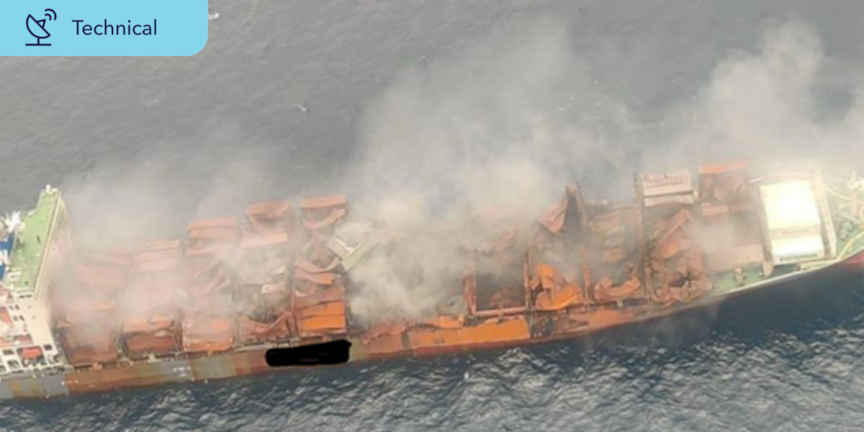
What we have observed
DNV has supported ship managers, salvage companies, flag states, shipyards and port authorities by providing expertise and in-depth knowledge on the post-fire structural and material assessment of ships. The incidents have ranged from isolated small-scale fires in cargo holds to major fires damaging the complete ship.
The fire incidents have identified the need for prompt decision-making in situations where time pressure is high and the crew, cargo and environment are at stake. The situations have involved discussions on whether the ship can continue trading, on the extent of steel renewal and repair methods, on a critical reserve strength assessment while the vessel has been on route, and on fire developing rapidly, fuelled by the cargo (see pictures 1 and 2 below).
Damage risks from prolonged exposure
Prolonged exposure to high temperatures may result in soft annealing, leading to a reduction in mechanical properties, in particular tensile strength where the steel becomes softer.
Another effect is the material hardening, a risk that may occur under uncontrolled quenching during firefighting with seawater or CO2. This could primarily affect the material’s ductility by reducing its fracture toughness and therefore increasing the risk of brittle behaviour.
In addition to adverse effects in material mechanical properties, prolonged exposure to thermal loads could result in steel distortions/deformations. The longer the period of heat exposure and heat intensity, the higher the risk that the material properties affecting strength and toughness have been affected. Typically, fire exposure over four to five hours would increase the risk of material and strength deterioration. When post-fire examination reveals permanent waving deformations, this is an indication of long exposure to heat, and material degradation is very probable. If temperatures have not risen over 250–300oC, there is low risk that material would be affected. The extent and magnitude of these deformations would dictate largely the need for repairs.
Steel hardening due to cooling under firefighting
Steel exposed to high temperatures and cooled down rapidly and uncontrollably, due to firefighting water or CO2 release, increases the risk of hardening and of brittle behaviour, especially if occurred in repeated cycles. This is of particular importance in higher grade steels, which may exhibit lower than original post-fire toughness properties.
A conservative approach in emergency situations would be to degrade the material strength by one grade, for example from AH36 (high strength) to NS (normal strength).
Hardness testing
For post-fire strength and repair plan evaluations, as a minimum, hardness testing of the affected steel according to ASTM A370 is required. Both heat- and non-heat-affected materials should be measured to establish a level of confidence in the measurements. When deemed necessary, destructive testing of samples shall be done under the guidance of DNV (tensile and bend tests as a minimum and location sampling).
Structural repairs
Structural repairs may be dictated by the permanent deformations of the steel plates/stiffeners due to long exposure to thermal load, irrespective of the residual material properties.
Coating condition
A general rule is that if the original coating has no visible signs of damage on the steel surface (e.g. burns, blisters), there is a high probability that the steel has not been adversely affected by the heat input from the fire.
On-going and post-fire support from DNV
In emergency situations, DNV (via DNV ERS™) provides a quick assessment of the residual strength and stability, allowing ship managers and other stakeholders to take crucial decisions on whether to evacuate or initiate firefighting operations to salvage the ship.
As part of the post-fire support, DNV has developed a guideline (to be requested via DNV DATE) that can be used to quickly assess the reserve strength and extent of repairs needed if the steel strength has been affected adversely. This information is important for ship managers to help them prepare for repairs and make crucial decisions on when and where to schedule these repairs.
The use of drones for post-fire damage surveys by DNVcertified service suppliers enables fast access to the affected structure, eliminating the need to secure space for human entry. This significantly reduces time for damage evaluation and speeds up the development of repair plans, eventually leading to efficient planning and reduced off-hire time.
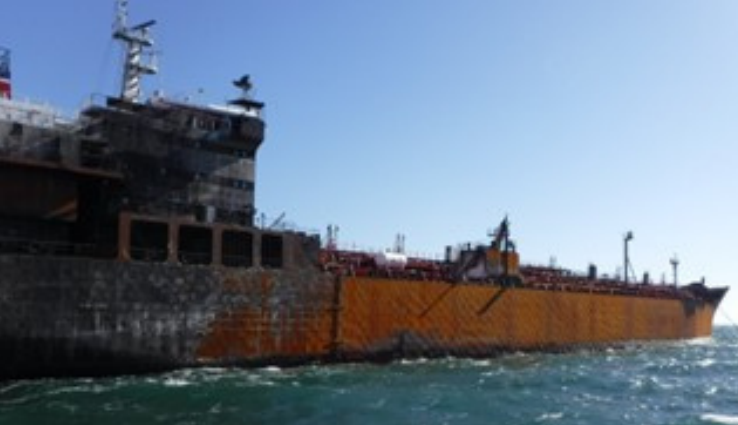 |
Picture 1: Product tanker exposed to extreme fire for three days. Rather than scrapping, drydocking and cost-effective repair were chosen. |
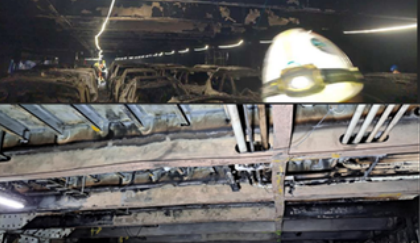 |
Picture 2: Complete cargo hold in a RoPax vessel destroyed by fire. DNV assisted in determining post-fire strength and issued a condition of class allowing continued vessel operation. |
Recommendations
- Quick decision-making is essential, and DNV’s guideline on post-fire strength and material evaluation provides practical recommendations on how to manage such incidents
- Contact DNV ERS™ in the event that a fire is developing, even if the vessel is not enrolled for the service (emergency@dnv.com or 24/7 phone: +47 91 84 97 15)
- Contact DNV DATE for damage evaluations, repair plans and guidance on the post-fire evaluation of strength and materials.
References
- ASTM A370 “Standard Test Methods and Definitions for Mechanical Testing of Steel Products”
- ISO 16859-1:2015 Metallic materials — Leeb hardness test — Part 1: Test method
- DNV’s guideline on post-fire strength and material evaluation (available via DNV DATE)
- DNV news: “Ageing fleet drives surge in number of maritime incidents”
