DNV’s Energy Transition Outlook: Hydrogen to 2060 report examines how hydrogen’s role in the energy system will evolve in the coming decades as decarbonization ambitions collide with cost, policy uncertainty, and energy security concerns.

This edition, four years on from the last hydrogen forecast, reflects a realistic view of hydrogen’s near-term challenges, while confirming its long-term importance for sectors that cannot be electrified. Based on DNV’s independent modelling and industry insight, the report explores where hydrogen is most likely to scale, what is holding it back today, and what must happen for investment to accelerate.

The report examines how hydrogen demand, investment, and regional deployment evolve through to 2060, and the conditions required for projects to move from ambition to scale.


Access the Energy Transition Outlook: Hydrogen to 2060 report and learn more. 
 

Dive deeper into the data

Hover over each graphic to access detailed metrics and supporting insights.

  • Clean hydrogen plays a critical role in decarbonizing hard-to-electrify sectors. Today, the hydrogen industry produces around 100 million tonnes of fossil-based hydrogen per year, accounting for 1.3 billion tonnes of CO₂ emissions.
  • China is driving uptake, with ambitions to scale up clean hydrogen in its 15th Five-Year Plan. 35% of new hydrogen production and use will be in China over the coming decades.

  • Renewable hydrogen and derivatives can strengthen security of supply and energy storage, particularly for countries and companies without domestic fossil reserves.
  • To avoid ongoing dependence on fossil fuels, industries diversify supply chains through both locally produced and imported hydrogen. Current geopolitical conditions are likely to accelerate investment decisions and renewable hydrogen production toward 2030.


  • Clean hydrogen remains reliant on policy, financial support, mandates, and/or a credible carbon price. Hydrogen will become more market-driven by 2040 in those regions with the most advanced hydrogen support currently.
  • Stalled and reversed hydrogen policies are the main reason our mid-century forecast for clean hydrogen is reduced by 45% since our 2022 edition.


Clean hydrogen must close the safety confidence gap to unlock scale

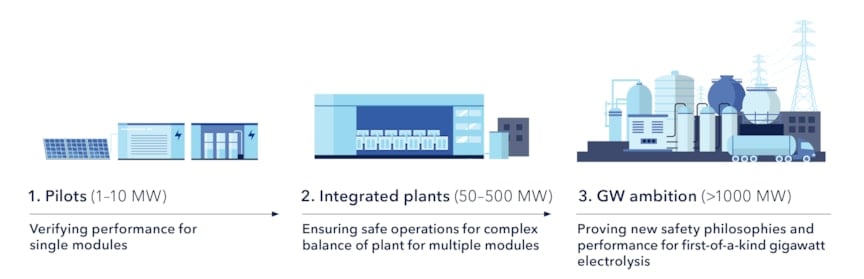
Evolving hydrogen risks: from pilot to industrial scale
This is a static view and does not include interactive features


  • Operational learning from pilot and small-scale projects is informing safer designs and procedures, but scaling is not a copy-and-paste exercise for cost or safety.
  • Large-scale hydrogen requires whole-system understanding, stronger standardization, and clearer safety and sustainability regulations. Regulatory frameworks are evolving, led by early-adopter countries, to build confidence, support verification, and unlock investment capital.

DNV's Energy Transition Outlook: Hydrogen to 2060

See how expectations have been reset and what must change across policy, safety, supply chains, and markets

Explore more