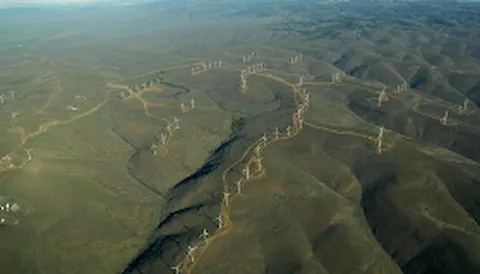
The industry’s most accurate wind flow modelling helps minimize risk and maximize returns for planned wind farms.
Utilize DNV's superior flow modelling capability and experience to quantify the wind resource at your site. Reduce investment risks, position turbines for maximum output, and gain insights into turbine interactions that impact production and lifespan.
Not all CFD models are created equal
Many Computational Fluid Dynamics (CFD) models are available, but not all are equally suited to accurately model the flow of a wind farm. DNV’s CFD service focuses on capturing the most important controlling physics that drive atmospheric flow patterns across wind farm sites.
This has enabled us to build the industry’s largest, best documented, and most widely published track record wind speed accuracy predictions. We are trusted by lenders, developers and utilities, having delivered CFD analyses for over 1000 wind farm projects globally.
Unparalleled experience
Our CFD methodology has been developed and meticulously validated through decades of work by our scientists and engineers. It is powered by STAR-CCM+, a calculation engine trusted by global leaders in the aeronautics, naval, and automobile industries, alongside a powerful in-house supercomputing facility.
In 2025 alone, our global team of over 20 experts conducted CFD assessments for over 150 new wind farm projects located in 29 countries. Over the years, we have analysed wind farm sites situated in all regions of the globe, totalling over 1000 GW. This extensive experience has enabled us to continuously refine our complex flow modelling results and translate them into value for our customers.
Proven accuracy
Over the past decade, we have maintained a systematic validation effort, which indicates that, on average, DNV’s CFD reduces wind speed prediction errors by 40% compared to commonly used linear models[1]. This effort is supported by measurement data from over 270 sites and 6700 mast pairs, including sites affected by complicating factors such as strong wind speed gradients, atmospheric stability, and forestry.
We were impressed by the high quality of the simulation and its flexibility. The visualisation added to our understanding of the flow across the site. In particular, it clearly showed the benefits of incorporating stability and buoyancy effects in the CFD run for this site.
Mainstream
We’d like to congratulate DNV on achieving the best results across the sites relative to other models tested. This outcome is as much about knowledge of atmospheric flow characteristics as accuracy in computer modelling.
E.ON
More physics inside: mesoscale coupling
Our CFD service is built upon a methodology that integrates key controlling physics governing flow patterns across wind farm sites, drawing from our extensive knowledge and experience. Within STAR-CCM+, DNV has developed a customized model specifically tailored for simulating the atmosphere at wind farm scale, with a particular focus on incorporating thermal stratification within and above the atmospheric boundary layer.
In standard CFD assessments, inlet boundary conditions determined based on on-site measurements and empirical correlations. DNV can further enhance the reliability and representativeness of these boundary conditions for the project area by utilizing a mesoscale model. In this scenario, the inflow boundary layer profiles of velocity, potential temperature, and turbulence quantities are derived from combination of Weather Research and Forecasting (WRF) simulations for the site and CFD precursor simulations. These boundary conditions offer valuable insights into the overall atmospheric flow in the region, enhancing the accuracy of microscale models like CFD in capturing the interaction of inlet flow with local terrain complexities, obstacles, and ground coverage changes within the project area simulated by CFD.
From DNV’s visualisations of CFD simulated flow, you can really see how differently the wind behaves in stable and neutral atmospheric conditions at our site. Clearly, DNV’s ability to account for the physics of buoyancy is very important.
Arise
Aerodynamic interactions
Underestimation of wind turbine aerodynamic interaction in pre-construction stages often leads to wind farm underperformance. Employing CFD modelling for aerodynamic interaction is crucial, particularly in large wind farms with row-arranged turbines or pronounced nocturnal atmospheric stability cycles.
DNV's extended CFD capabilities simulate wind farms, accounting for turbine interaction losses by modelling turbines as actuator disks. This validated new wind farm modelling approach[2-5] has demonstrated superior accuracy in simulating wake interactions and blockage compared to standard engineering wake models due to:
Avoiding ad-hoc wake superposition algorithms, instead naturally representing wake superposition through physical principles
More accurately capturing topography's influence on wake development
The outputs of our CFD analyses can be tailored to your specific needs. The typical deliverables include:
Wind resource predictions at each turbine position
Wind resource grids (WRG)
Shear, flow inclination angles, turbulence intensity, flow separation and veer across rotor area
Aerodynamic interaction loss factor for each wind turbine
Maps of the above quantities across a site
Numerical site calibrations (NSC)
Correction factors for of blockage and wakes on power performance monitoring (PPM)
Flow complexity correction factor (FCC) for remote sensing devices (RSD).
References
[1] Bleeg, J. et al., “Modelling stability at microscale, both within and above the atmospheric boundary layer, substantially improves wind speed predictions”, EWEA 2015.
[2] Bleeg, J. et al., “Wind farm blockage and the consequences of neglecting its Impact on energy production”, Energies 2018.
[3] Montavon, C. et al., “Measuring and modelling wind farm blockage offshore”, Wind Europe WRA Technical Workshop 2021.
[4] Montavon, C. et al., “Blockage and cluster-to-cluster interactions from dual scanning lidar measurements”, WESC 2023, Glasgow.
[5] Traiger, E. et al., “Big cluster and far field wakes – an assessment of multi fidelity models against North Sea wind farms SCADA data”, ACP R&T 2023, Austin.
Related information
Have a look at our related publications and research.
As tomorrow’s wind farms cluster into groups of many hundreds of turbines they become so big that they have significant influence on the atmospheric boundary layer.
Learn how to improve your rapid predictions of blockage and wakes by considering site-specific atmospheric conditions with DNV's new innovative model; WindFarmer CFD.ML v2.