Classification and certification of offshore aquaculture assets
Building confidence in offshore aquaculture infrastructure as operations evolve in scale and exposure
Classification and certification of offshore aquaculture assets
Navigating the evolving demands of offshore aquaculture
Offshore aquaculture, also referred to as open ocean aquaculture, is expanding into a wider range of environments, including more exposed locations with higher structural and operational demands. As site conditions, asset scale and regulatory expectations vary significantly by region, classification provides a structured framework to verify that aquaculture systems are designed, built and operated in line with the defined safety and integrity requirements throughout their life cycle.
How does DNV support offshore aquaculture assets and ocean health?
We combine offshore and maritime classification expertise with aquaculture-specific knowledge to support the safe design, construction and operation of offshore aquaculture assets.
Our class notations define technical and survey requirements that enable owners and regulators to demonstrate that assets meet defined expectations for the safety of fish farms and fish containment integrity. Through classification, critical infrastructure risks are identified, managed and verified across the asset’s life cycle. This reduces operational, environmental and regulatory uncertainty.
Maritime execution model

The maritime execution model applies classification as a structured, independent verification approach across the full life cycle of offshore aquaculture assets. Developed through DNV’s extensive offshore and maritime experience, it provides a consistent framework that gives owners, operators and regulators confidence that assets are built and maintained to defined safety and integrity requirements.

Design and construction
Infrastructure risks are addressed before operations begin. Class rules and notations are applied – from the early concept phase through to design approval, fabrication, installation and commissioning. Structural strength, fatigue and mooring systems are verified against defined criteria, with surveys confirming alignment between approved designs and execution.
Discover more: Design approval for offshore assets

In-service follow-up and asset integrity
Your assets remain fit for purpose as operating conditions and operational profiles evolve. Periodic and condition-based surveys are used to maintain class during operation. Integrity management covers structures, moorings, fish containment system and critical components, with class approval required for repairs, modifications and life extension.

Risk, safety and escape prevention
DNV helps reduce infrastructure-related risk across the asset's life cycle through classification. We apply a risk-based focus on containment integrity, station keeping and structural reliability. Performance is verified for regular operation as well as extreme environmental conditions to mitigate failure scenarios that may lead to escapes or operational disruption.
Frequently asked questions
-
As offshore aquaculture moves into larger and more exposed environments, classification helps manage infrastructure-related risks by verifying that structures, mooring systems and containment components meet defined safety and integrity requirements throughout the asset's life cycle.
-
There are three main aquaculture rules and standards:
- Floating fish farming units and installations (DNV-RU-OU-0503)
- Environmental impact of marine aquaculture installations (DNV-ST-0678)
- Fish escape prevention from marine fish farms (DNV-OTG-24)
-
Typical solutions for floating fish farming installations subject to classification include:
- Closed aquaculture facility
- Semi-closed solutions
- Open trussworks
- Submerged
-
Offshore aquaculture classification includes safety performance verification of:
- Floating structures
- Mooring systems
- Fish escape barriers such as the net system, membrane, etc.
- Marine systems
-
Offshore aquaculture can support fish welfare, environmental protection and ocean health by moving farming activities away from sensitive coastal areas into environments with greater water exchange, which can improve farming conditions and reduce localized environmental pressure.
Robust infrastructure and containment are essential to limit escape risk and unintended impact. Classification supports this by verifying the integrity and performance of offshore aquaculture systems.
-
Owners and operators of offshore aquaculture assets operating in exposed or offshore environments should consider classification early to ensure infrastructure integrity, containment and regulatory acceptance.
-
We apply offshore and maritime classification experience together with aquaculture-specific knowledge to support the consistent application of class rules across design, construction and operation.
The content of our rules and standards condense generations of experience collected through the design, fabrication and operation of complex installations operating in demanding marine environments.
Our team has a global focus and reach across regions, we deliver trusted assurance with expert efficiency.
-
This is a well-known risk-mitigating approach for the complete supply chain ranging from designers and yards to manufacturers and service suppliers in general. This concept is based on documented verification from an independent third party.
The maritime execution model (classification) ensures efficient and smooth project execution through:
- Standardization
- Predictability though defining consistent requirements
- Transparency
- Documented capability
-
The maritime execution model (classification) for verification of aquaculture assets is not limited to steel contractions only and covers a wide range of materials:
- Steel
- Concrete
- Aluminium
- Polymers and thermoplastics (HDPE, etc.)
- Composite materials (FRP/CRP)
Customers and cases

OCEAN FARM 1 receives first ever offshore fish farming class certificate from DNV
Owned and operated by SalMar, Ocean Farm 1 is the first salmon farm designed and built for exposed operation, with a novel design that combines solutions from aquaculture and the offshore industry.
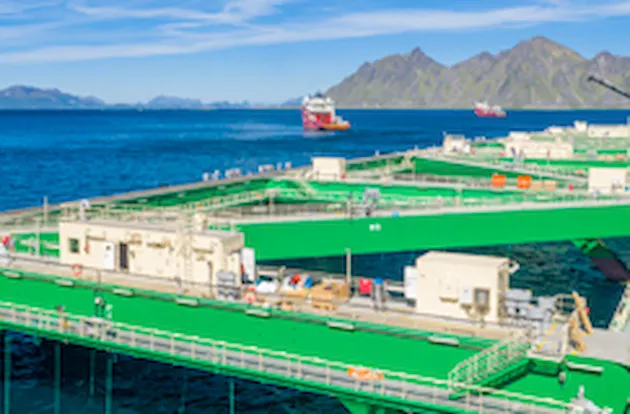
Nordlaks’ Havfarm 1 is capable of accommodating 10,000 tonnes of salmon at any given time
Ordered by the Norwegian company Nordlaks, the 385-metre-long ship-shaped Jostein Albert Havfarm is a revolutionary salmon farm which was built to hold 10,000 tonnes of fish in six 47 x 47-metre nets.
Resources
Rules and Standards Explorer
Access Veracity
Offshore Technical Guidance
Download document
Remote Survey
Access Veracity and order remote surveys
Certification and Verification of Products
Access Veracity for CMC services
Maritime Cyber Security
Understand the importance of cyber security for your business
Emergency Response Service (ERS™)
Our ERS™ experts are on call 24/7 with the right advice and support to ensure that an emergency doesn’t end in a disaster.
Contact us