Port State Control - Q1 2026 Detention review and other updates

Effectiveness of safety management systems and fire safety readiness are still in focus for Port State Control (PSC) authorities. Our Q1 2026 review highlights key detention concerns, upcoming inspection campaigns, new procedures for PSC, and what ship operators should be addressing to reduce risk.
Information for: Shipowners, managers and flag states.
Introduction
PSC activity in the first quarter of 2026 confirms that enforcement remains firmly on the fundamentals:
- Effective safety management system
- Sound maintenance practices
- Crew familiarity with critical systems
Detention statistics and newly announced inspection campaigns indicate that shortcomings in ISM implementation and fire safety remain the most significant compliance challenges for operators. Early awareness and targeted preparation are therefore essential to sustaining strong PSC performance amid an increasingly dynamic regulatory and geopolitical environment.
Q1 2026 review
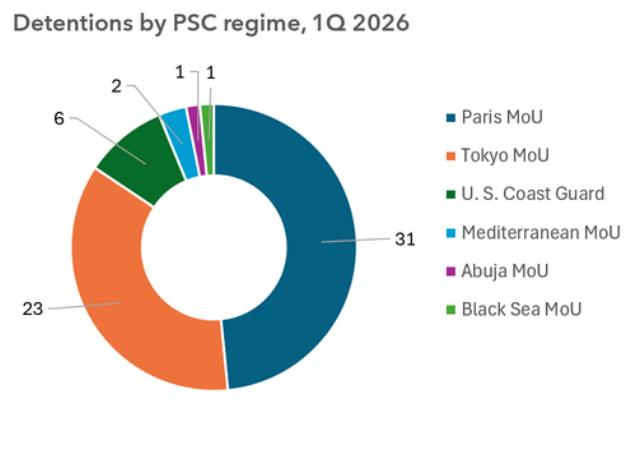
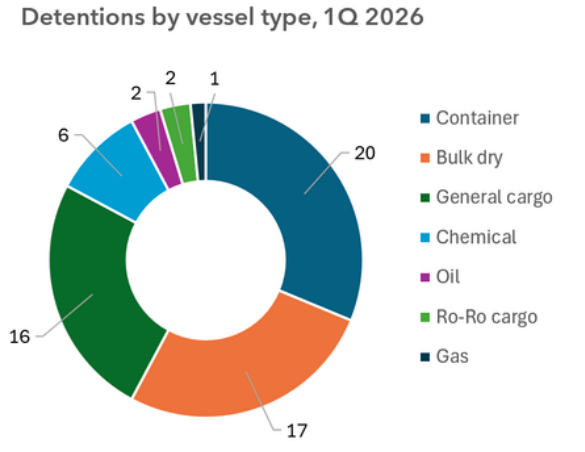
A total of 64 detentions were recorded for DNV vessels in Q1 2026, compared to 52 detentions in the same period in 2025.
Container, bulk carrier and general cargo vessels made up 83% of the detentions, with about 84% of the detentions being recorded in the Paris and Tokyo MoUs.
 |
 |
Detainable deficiencies in Q1 2026 continue to be dominated by shortcomings in ISM implementation. The most frequently cited sub‑categories were “15150 – ISM” and “15109 – Maintenance of ship and equipment” , with the latter used only by the Tokyo MoU and the U.S. Coast Guard.
In addition to these findings, the following detainable deficiency sub‑categories were most frequently observed:
07106 – Fire detection
Example of deficiency: “In engine room workshop found one smoke detector damaged and repaired with rubber tape.”
Why it matters: Compromised fire detection delays early warning in high‑risk areas.
07105 – Fire doors / openings in fire-resisting divisions
Example of deficiency: “Self-closing fire door from engine room to steering gear room not closing correct”
Why it matters: Compromised containment allows fire and smoke to spread beyond the space of origin.
04102 – Emergency fire pump and its pipes
Example of deficiency: “The emergency fire pump unable to pressurize fire main.”
Why it matters: Insufficient fire main pressure severely limits firefighting capability.
04109 – Fire drills
Example of deficiency: “During the fire drill, the firefighters were not wearing their VHF headsets correctly and one of them was not wearing his helmet.”
Why it matters: Incorrect use of PPE and communication equipment puts personnel at risk during real emergencies.
04114 – Emergency source of power – Emergency generator
Example of deficiency: ”During a simulated blackout test, the emergency source of power in automatic mode failed to take load on the emergency switchboard. Several attempts were carried out with unsatisfactory results.”
Why it matters: Failure of emergency power jeopardizes critical safety and navigation systems.
Overall, this demonstrates that consistent focus on an effective ISM system benefits vessel safety and maintenance.
CIC in 2026 on cargo securing
As in previous years, the Paris and Tokyo MoUs are preparing a joint Concentrated Inspection Campaign (CIC), scheduled to run from 1 September to 30 November. This year’s campaign will focus on cargo securing. Further details, including the official press release and the inspection questionnaire, will be published in due course. In addition, a DNV expert webinar is planned.
Guangzhou focus on machinery
The Guangzhou Maritime Safety Administration issued in January 2026 a reminder to reinforce awareness of root cause and safety management of mechanical and electrical equipment failures on board ships. Primary cause, examples of typical incidents, detrimental effects and recommended actions are outlined in the Safety Bulletin 01/2026.
New Zealand – focused inspection campaign on fire safety
Maritime New Zealand has announced a focused inspection campaign on fire safety that will be carried out between 1 April and 31 May 2026.
The following focus points have been announced:
- Fire dampers
- Fixed fire extinguishing systems
- Crew familiarity with fire safety systems
Ship owners, operators, masters and crew should, among others:
- Ensure fire safety systems are operational and effective
- Confirm crew are trained and familiar with fire safety equipment and procedures
- Verify compliance with SOLAS requirements and the relevant domestic rules
Details of the campaign and other focus areas can be found on the Maritime New Zealand webpage – see link below
IMO Resolution A.1206(34) – Procedures for Port State Control 2025
At the 34th Session of the Assembly, Resolution A.1206(34) was adopted and the old Resolution A.1185(33) revoked.
With the addition therein of a new Appendix 20, “Guidelines for Port State Control Officers on Security Aspects” , PSC Officers are now provided with an explicit basis to record security-related deficiencies and to act on ineffective security arrangements.
When clear grounds are established by the PSC Officer, the new Appendix 20 intends that the Duly Authorized Officer (DAO) decides on actions to be taken according to SOLAS 1974 Regulation XI-2/9. Such actions (SOLAS 1974 Regulation XI-2/9.1.3) are defined as:
- Inspection of the ship
- Delaying the ship
- Detention of the ship
- Restriction of operations, including movement within the port
- Expulsion of the ship from port
It must be noted that the attending PSC Officer can also be the responsible DAO.
The new Resolution A.1206(34) also relocates references to potentially detainable deficiencies from certain appendices into the corresponding Area Chapters in Appendix 2.
Recommendations
Strengthen day-to-day implementation:
Safety management systems should be effectively embedded in daily operations, with particular attention to maintenance standards, testing routines, and timely correction of identified deficiencies.
Treat fire safety and emergency preparedness as critical operations:
Fire safety equipment, emergency power systems, and drills should be regarded as operationally critical. All equipment must be fully functional, and procedures should be regularly practiced under realistic conditions.
Leverage DNV’s preparation tools for PSC inspections:
We also recommend using DNV’s PSC Planner when preparing for PSC inspections. The checklists created within the tool highlights key focus areas based on the vessel’s previous deficiencies, port-specific focus areas, the DNV Top 18 items, and applicable CIC questions.
