DNV rules 2026 – Hearing period now open
DNV has submitted its class rules and standards for industry hearing, open for comments from 1 March to 12 April. This year’s hearing covers 77 documents, planned for publication on 1 July 2026. This update highlights the key proposed changes and explains how to submit feedback.
Information for: Ship owners, managers, yards, manufacturers, flag states, suppliers and design offices.
NEED TO KNOW |
|
|
|
 DNV welcomes comments from all interested parties. Feedback on rule proposals is part of a thorough quality assurance process for DNV’s rules and standards.
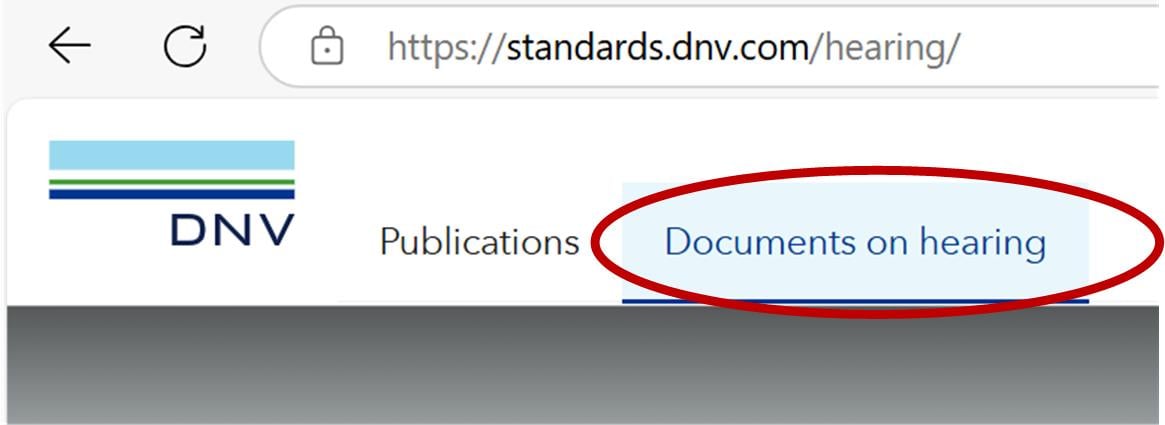
The complete list of documents submitted for hearing can be found in the Documents on hearing tab in the Rules and Standards Explorer.
DNV ship rules (DNV-RU-SHIP):
- Liquified gas tankers: new qualifiers visualizing vessels cargo capabilities and introduced new qualifier FSU for gas carriers used for storage and delivery of LNG to shore (Pt.5 Ch.7).
- Class notation Fish carrier is restructured to cover transport of fish in general and making stability requirements mandatory for transport of live fish only (Pt.5 Ch.10 Sec.18).
- Fishing vessels: adapting to industry standard and current statutory codes (Pt.5 Ch.12).
- New qualifier Ready for class notation Battery to signify a vessel being prepared for later battery installations (Pt.6 Ch.2 Sec.1).
- New qualifier T for class notation Strengthened signifying that T-bars provided on the cargo deck for securing wooden sheeting, are strengthened to support temporary equipment and securing cargo (Pt.6 Ch.1 Sec.2.)
- New class notation FL for extended fatigue life (Pt.6 Ch.1 Sec.17).
- New qualifier PPV for class notation VCS, vapour control systems, for cargo tanks designed to withstand higher pressure and thus to reduce VOC emissions (Pt.6 Ch.4 Sec.11).
- For class notation Shore power: new qualifier IEC for meeting complete IEC requirements, new qualifier Permanent for vessels utilizing shore power continuously and introducing new class notation Shore power ready to signify a vessel being prepared for later shore power installations (Pt.6 Ch.7 Sec.5).
- New qualifier ULEV for class notation ER, emission reductions system for NOx or SOx to signify an ultra low emission vessel (Pt.6 Ch.7 Sec.7).
- Alternative survey programme: new qualifier Fuel for class notation ASP enabling an extended and flexible scheduling of internal gas fuel tank(s) survey (Pt.6 Ch.9 Sec.8).
Offshore rules (DNV-RU-OU):
- New class notation FL for design fatigue life with qualifiers specifying the fatigue life in years and the expiry year for the design life (DNV-RU-OU-0101, 0102, 0103 and 0104).
- Updated the advanced fatigue life notation FMS, new qualifiers specifying the selected design fatigue factor (DFF) level, fatigue life in years and expiry year (DNV-RU-OU-0101, 0102, 0103 and 0104).
- New class notation NUI for normally unattended installations (DNV-RU-OU-0102, 0103).
- Added class notation CMON for construction monitoring for fatigue critical details (DNV-RU-OU-0101, 0102, 0103 and 0104).
- Class retention requirements added for class notation Sustainability (DNV-RU-OU-0300).
- New requirements for floating fish farm structures that are made of composites or polymers (DNV-RU-OU-0503).
- Complete rewriting of in-service class requirements for floating offshore wind farms, enabling alternative ways of survey and follow-up (DNV-RU-OU-0512).
Offshore standards (DNV-OS):
- Restructured DNV‑OS‑A101 to clearly distinguish common requirements that apply to all units from the additional requirements that apply to specific unit types, such as production, drilling, and well intervention units (DNV-OS-A101).
- Added requirements for NUI notation, where the risk to personnel is normally reduced and this can be reflected in the system design (DNV-OS-A101).
- Updated the requirements for FMS notation, including an option to select between two design fatigue factors (DNV-OS-C101).
- Removed requirements for towing equipment, class requirement now only cover the towing fittings (DNV-OS-C101, DNV-OS-C102).
- Updated requirements for support of heavy equipment and topside foundations, including winches (DNV-OS-C102).
Recommendations
All stakeholders are encouraged to review the proposals relevant to them. Feedback is highly valued and will help shape the final documents.
References
Contact
Please contact your local DNV office or rules@dnv.com
