Clarifications on blackout recovery requirements for DP notation closed bus-ties qualifiers
The application of the closed bus-ties qualifiers to DP shuttle tankers and the general technical development of DP systems has caused a need for a more detailed specification related to propellers driven by 2-stroke crosshead engines and certain switchboard configurations. This news clarifies blackout recovery requirements to the complete DP system when applying redundant DP notations with closed bus-ties qualifiers.
Information for: Design offices, shipyards, suppliers, manufacturers, and owners/managers.
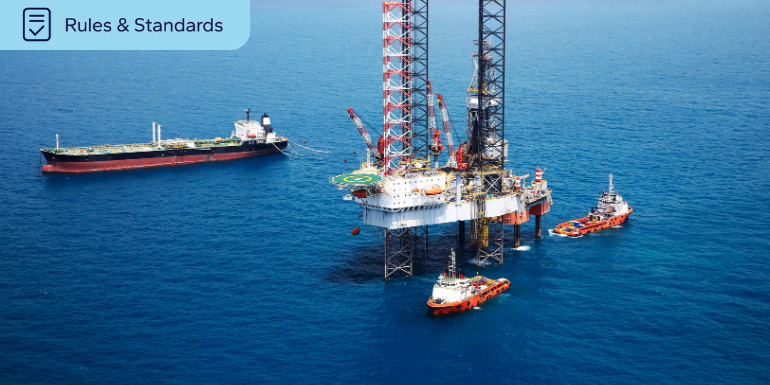
The industry is now applying redundant Dynamic Positioning (DP) notations with closed bus-ties qualifiers (CB, CBS and/or CBT) on DP shuttle tanker designs where the main propeller is part of the DP system and driven by a 2-stroke crosshead main engine. These qualifiers introduce a requirement for blackout recovery of the DP system.
The existing DNV requirements do not include specific requirements on how this functionality shall be arranged for DP thrusters driven by such engines. Some clarifications are also needed for certain switchboard configurations. To clarify this for ongoing and upcoming projects, DNV is introducing a retroactive requirement proposal to be updated as follows in the next revision of DNV RP-0591 for redundant dynamic positioning systems with closed bus-ties:
Current text:
DNV RP-0591 [3.4.4.2.8]: For CB, CBS and CBT, an automatic blackout recovery function shall be arranged. This system shall perform blackout recovery on individual switchboard sections. The recovery time shall be such that the DP control systems receive thruster ready signals within 45 seconds. Enabling of thrusters in the DP control system can be done manually.
New proposed text:
DNV RP-0591 [3.4.4.2.8]: For CB, CBS and CBT, an automatic blackout recovery function shall be arranged:
- This system shall perform blackout recovery on individual switchboard sections.
- The recovery time shall be such that the DP control systems receive thruster ready signals from recovered thrusters within 45 seconds.
- Thrusters* driven by 2-stroke crosshead engines shall be recovered such that the DP control systems receive thruster ready signals as soon as possible. The start sequence (of the 2-stroke engine) may include manual interaction when this can be managed from a manned workstation, preferably at the DP control centre.
- Blackout recovery time for thrusters, including propellers driven by 2-stroke engines, shall be tested, recorded and provided in the relevant operational procedure(s)/manual(s).
- The enabling of thrusters in the DP control system can be done manually.
- Limited to one bow and/or one stern thruster, this requirement may be exempted for: Thrusters connected to main switchboard sections that do not contain own power sources and can only be fed by neighbouring switchboards through bus-ties breakers Thrusters connected to main switchboard sections where electrical energy storage (EES) constitutes the only directly connected power source(s)
Notes:
*“Thrusters” refers to all DP propulsion actuators, including tunnel and azimuth thrusters, waterjets, main propellers and rudders.
The application of DP closed bus-ties qualifiers – namely CB, CBS and/or CBT – will generally necessitate adjustments to power generation, storage and distribution systems, as well as modifications to thruster systems, compared to designs that do not utilize these qualifiers.
The revision of DNV RP-0591 for redundant dynamic positioning systems with closed bus-ties is currently underway and incorporates various proposed changes beyond those specified in this news. The targeted completion date for the revision is October 2026.
Recommendations
When implementing redundant DP notations with closed busties qualifiers, it is essential to observe these requirements. The entity responsible for DP system integration must ensure that all parties involved in the delivery of sub-systems clearly understands these requirements so that they can be effectively incorporated into the integrated DP system design.
The recorded results should be taken into consideration by the vessel operator and implemented into operational procedures as relevant. The recovery function is expected to be demonstrated at the 5-yearly complete DP survey.
References
- [1] DNV RU-Ships Pt.6 Ch.3 Sec.1 Dynamic Positioning Systems – DYNPOS and DPS
- [2] DNV RU-Ships Pt.6 Ch.3 Sec.2 Dynamic Positioning Systems with Enhanced Reliability – DYNPOS(E, ER)
- [3] DNV RP-0591 – Redundant dynamic positioning systems with closed bus-ties
The DP notations mentioned above under [1] and [2] may be assigned the closed bus-ties (CB) qualifiers: CB, CBS and CBT. Example notation DYNPOS(AUTR-CBT). These qualifiers require compliance with DNV RP-0591.
