Tomorrow's wind farms, today's models: Closing the AEP prediction gap

Engineering wake and blockage models have served the offshore wind industry well, but as projects scale into multi-GW clusters, a widening accuracy gap is emerging. DNV's benchmarking reveals the risk, and its CFD.ML v2 model − accessed via WindFarmer − offers a new approach.
Author: Tom Levick
As offshore wind projects scale, with the first 15 MW turbines now operational and regional clusters set to exceed 1,000 turbines in the coming years, current engineering wake and blockage models face growing accuracy challenges. Developers are designing and financing tomorrow's wind farms today, yet the engineering models they use were tuned on a previous generation of projects – a discrepancy that may only surface during independent engineering review at financial close.
Engineering wake models such as Jensen (Park), Eddy Viscosity*, and TurbOPark have delivered reliable results when tuned against data from currently operating wind farms. However, these models achieve accuracy through empirical parameter adjustment (i.e. tuning) rather than by resolving the underlying atmospheric physics.
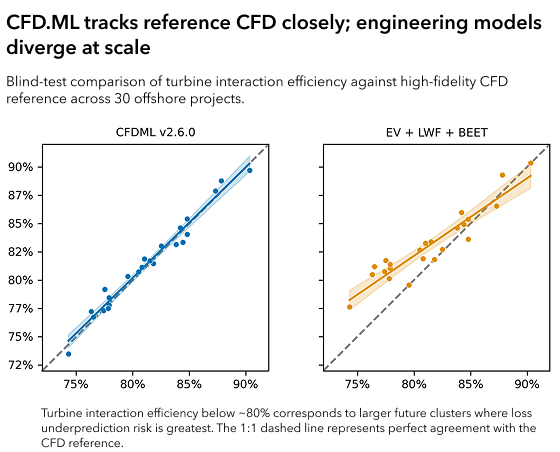
A DNV benchmarking study across 30 offshore projects found that while engineering models showed no systematic bias for today's wind farm scales, an increasing gap emerged for larger future clusters, with engineering models tending to underpredict turbine interaction losses. This gap represents a risk of AEP overestimation of up to 5% on annual yield at the largest-scale projects.
Well-validated, higher-fidelity models, like DNV’s CFD, are much more likely to generalize well to the wind farms of tomorrow because they resolve more of the physics driving wake and blockage effects. CFD.ML v2, a machine learning surrogate model, was trained on CFD results across a wide range of atmospheric conditions and wind farms, and shares this advantage. The full detailed methodology and validation results are available here.
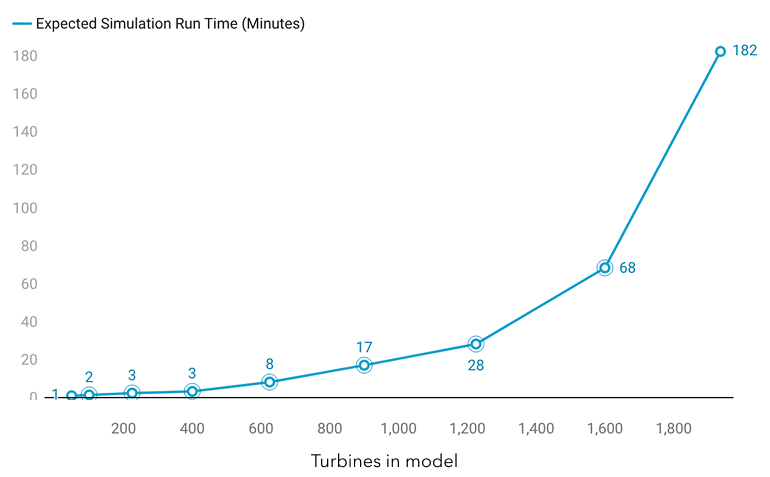
DNV's CFD.ML v2 is now commercially available for offshore wind projects through the WindFarmer API. This model delivers comparable accuracy with run-times similar to engineering models, computing AEP and losses for individual wind farms in around 90 seconds, and clusters of 1,200 turbines in approximately 30 minutes**. Following extensive validation and customer trials, CFD.ML v2 is now fully supported for production use in energy assessments.
Identifying the AEP uncertainty gap in existing engineering models
How CFD.ML v2 closes the accuracy gap
Reduced bias and spread
CFD.ML v2 demonstrates significantly tighter error distributions and close-to-zero mean bias relative to benchmark high-fidelity CFD simulations. This reliability is critical when assessing large wind farm clusters, minimizing the risk of significant error in early modelling – particularly for multi-project clusters where long-range wake propagation between neighbouring wind farms becomes a material factor that engineering models risk underestimating.
Practical for use at every project stage
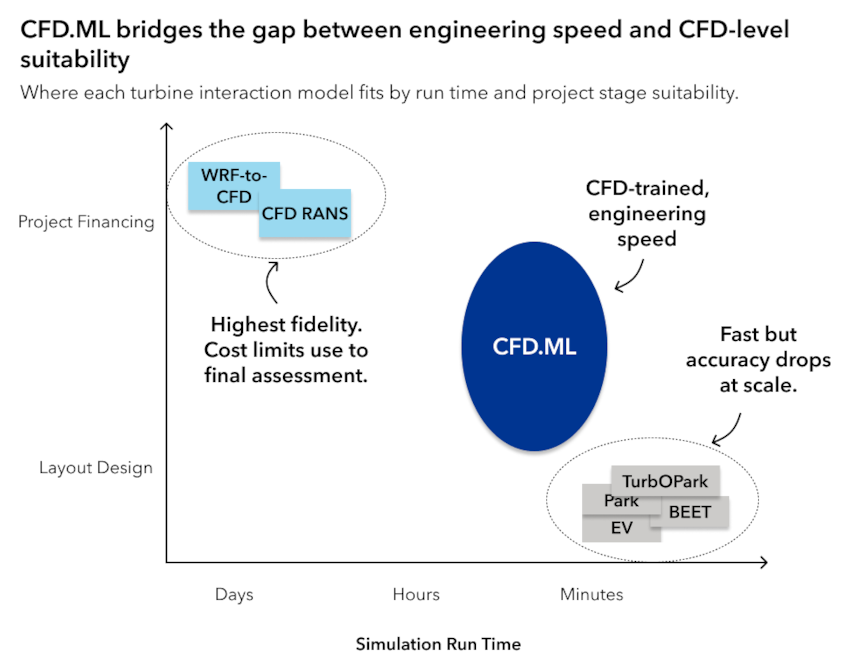
Unlike high-fidelity CFD simulations, which are computationally demanding, CFD.ML runs efficiently – predicting AEP in approximately 1.5 minutes for 100 turbines, 9 minutes for a 600-turbine cluster, and 30 minutes for 1,200 turbines. Run-times can increase where loss factor breakdowns require multiple calculation passes**.
It also opens use cases that were not previously feasible with high-fidelity CFD: layout optimization, scenario comparison across turbine types or configurations, and extension or repowering assessment for operational wind farms. This efficiency, and lower cost, make it practical for use throughout project stages, as illustrated below.
A single, coupled model for wake and blockage effects
CFD.ML predicts total turbine interaction effects rather than modelling wakes and blockage separately. This reflects the strong physical coupling between these phenomena: pressure gradients related to blockage affect wakes, and the low momentum in wakes influences blockage. Engineering approaches do not currently capture this interaction.
Site-specific atmospheric conditions, not generic assumptions
Wake and blockage effects depend strongly on atmospheric conditions – turbulence, shear, and the temperature profile through and above the boundary layer.
DNV's mesoscale-to-CFD approach captures these by coupling mesoscale weather modelling (WRF) with microscale CFD simulation. WRF provides atmospheric conditions across the project area. These inform the inflow for the microscale solver, which resolves turbine interaction effects from wind-farm scale down to individual rotors. Validation against operational data – including blockage measurements, internal wake patterns, and external wake effects – confirms that this approach reproduces observed behaviour across a range of conditions and wind farms. CFD.ML learns from these simulations, approximating the physics resolved in full CFD at substantially lower computational cost.
Multi-fidelity modelling, without late-stage project surprises
DNV recommends matching model fidelity to project stage and risk tolerance. For high-value projects, running DNV CFD at least once in the project lifecycle substantially reduces turbine interaction uncertainty – providing an energy estimate grounded in high-fidelity CFD physics that can inform financing decisions.
Because CFD.ML predictions are trained to emulate DNV CFD results, using CFD.ML in early project stages reduces the risk of significant changes to energy estimates when full CFD is commissioned later. For projects requiring extra confidence at earlier project stages, DNV can deploy site-specific CFD.ML models trained on a CFD simulation of the customer's wind farm, combining the accuracy of site-specific mesoscale-to-CFD with faster computation for subsequent design iterations from CFD.ML.
Enabling iterative, CFD-grade analysis throughout the project lifecycle
Because CFD.ML is trained to emulate DNV's mesoscale-to-CFD results, applying it at earlier project stages reduces the risk of material changes to energy estimates when full CFD is commissioned later.
Project teams can progressively reduce uncertainty across the development lifecycle – not just at the point of final assessment. This allows project teams to explore a broader design solution space earlier, rather than relying on a single high-fidelity run at a late project stage.
Integration into existing workflows via the WindFarmer API
CFD.ML is available through the WindFarmer API, allowing integration into existing design and analysis workflows. Cloud-based computation removes the need for specialized local hardware, especially for large projects. The API architecture supports parallel evaluation of multiple layout configurations, which can improve efficiency in comparing several design options, or enable faster optimization workflows.
While several wake modelling tools offer API access, the WindFarmer API provides automated access to CFD.ML's turbine interaction predictions, enabling workflows that would be impractical with traditional desktop software or high-fidelity CFD.
What’s new in CFD.ML v2
| Upgrade | How it helps |
| Multi-stability training | The Graph Neural Network now ingests atmospheric stability states, learning sensitivity to eight free input parameters that describe atmospheric conditions, capturing the drivers of long-range cluster-to-cluster wakes that neutral-only models underpredict. |
| Total turbine interaction prediction | CFD.ML predicts overall turbine interaction effects, rather than requiring separate models for wake and blockage. Since wake and blockage effects are physically coupled, modelling them together avoids the approximations inherent in combining independent wake and blockage models. CFD.ML outputs provide blockage corrections through post-processing for comparison with historical assessments. |
| Scale-ready dataset | Today’s training set includes future-size wind farm clusters, with farms up to 1,300 turbines. CFD.ML continues to learn as more high-fidelity training data is created. |
CFD.ML v2: now available for offshore wind projects
CFD.ML v2 is now commercially available through the WindFarmer API for offshore wind projects, with expansion to onshore applications underway. The model delivers near-CFD accuracy in minutes − approximately 1.5 minutes for a 100-turbine layout and 30 minutes for 1,200 turbines − whilst requiring no special hardware for the end user. CFD.ML v2 is fully supported for production use in energy assessments following extensive validation and customer trials.