Are power prices shaping the investment decisions of energy intensive industries?

Europe’s industrial landscape is undergoing one of the most significant shifts in decades. Decarbonization, electrification, rising international competition, and changing regulations are creating a new reality in which energy costs can no longer be assumed to be stable or predictable.
For energy intensive-industries, this uncertainty now sits at the heart of strategic decision-making. As electricity becomes the primary energy source powering Europe’s industrial transformation, long-term power price forecasting has become a board-level priority.
Investment decisions under pressure
Industrial assets, whether they consume or produce energy, depend heavily on long-term- electricity price dynamics. A deviation of just 10–20% in power prices over a 15-year asset lifetime can materially affect the internal rate of return (IRR), determining whether a project proceeds as planned, is delayed, or becomes unviable.
For decades, energy procurement teams could rely on multi-year gas and electricity contracts, or power purchase agreements (PPAs), to secure predictable costs. That stability has eroded. Today, procurement has become a strategic function that directly influences competitiveness, margins, and license to operate.
However, volatility alone isn’t the primary challenge. The greater risk lies in miscalculating future market scenarios.
Factors influencing electricity prices: A market defined by volatility
Electricity prices across Europe are becoming more volatile, driven by several structural forces that are reshaping how industrial companies plan, operate, and assess long-term- investments:
- The rapid expansion of weather-dependent renewable generation, alongside increased forecast uncertainty
- Shifting demand patterns from electrification and reduced fossil fuel consumption
- Slow uptake of electricity demand and demand-side flexibility
- Geopolitical tensions and volatility in commodity markets, including gas, coal, oil, and CO₂
- Industry-specific risk factors for energy-intensive sectors, such as inflation, CBAM, trade tariffs, global competition, and the cost of capital (WACC)
In addition to these systemic pressures, capacity constraints, transmission congestion, and the rollout of flexibility measures are contributing to higher grid and transport fees, with significant variation between European member states. Together, these dynamics are reshaping total cost of ownership models across Europe.
For decades, manufacturing and processing industries operated with relatively stable energy commodity costs, often secured through multi-year gas and electricity contracts, including PPAs. That stability can no longer be assumed. Higher grid and transport costs are increasingly passed through to industrial consumers, while securing a PPA has become more strategically important and considerably more complex.
Electricity price forecasts are now central to every business case
Whether an organization is investing in energy‑producing technologies, such as electrolysers, heat pumps, e‑boilers, battery energy storage systems (BESS), or thermal storage, reliable electricity price forecasting has become a critical component of the business case.
In an environment characterized by volatility, the quality of investment analysis now depends as much on the credibility of the price forecast as on underlying technology costs. Long‑term decisions increasingly hinge on how well a forecast captures peak‑hour dynamics, congestion patterns, and structural market shifts, as well as whether the modelling approach has been rigorously validated.
For industrial companies, this shift raises a fundamental question: How can decision-makers assess whether a forecast is sufficiently credible to inform long-term investment decisions?
New opportunities, and why they depend on forecast quality
At the same time, new opportunities are emerging for companies seeking greater resilience, flexibility, and access to affordable energy. These include:
- On-site energy storage, both electrical and thermal
- Fuel switching, from fossil fuels to electricity or to blends of natural gas, biogas, and hydrogen
- Reevaluating N-1 resilience requirements at the company level
- Providing flexibility services to grid operators, which can strengthen both the energy system and project economics
However, the viability of each of these opportunities depends on a clear understanding of how different forecasting approaches perform. Weighted metrics, scenario‑specific validation, and multi‑year back-testing provide a far more accurate view of how forecasts behave under varying market conditions, and, by extension, how investment decisions are likely to perform in real‑world conditions.
Staying competitive in a changing Europe
As power price forecasting becomes essential for long-term- planning, organizations are increasingly turning to advanced modelling techniques. Modern machine-learning based power price models, combined with sound fundamental market insights, can offer industrial users a more realistic reflection of actual market behaviour. These approaches are better able to capture non-linear dynamics, weather-driven volatility, and congestion related- price divergence, factors that traditional models may not fully reflect.
However, the use of a machine learning model alone is not sufficient. In markets characterized by structural uncertainty, machine learning models can overfit historical patterns or underperform during price shocks if they are not rigorously validated. What matters most is not the sophistication of the algorithm, but how well the model performs as conditions change, during periods of scarcity, extreme weather, unexpected demand shifts, or geopolitical disruptions.
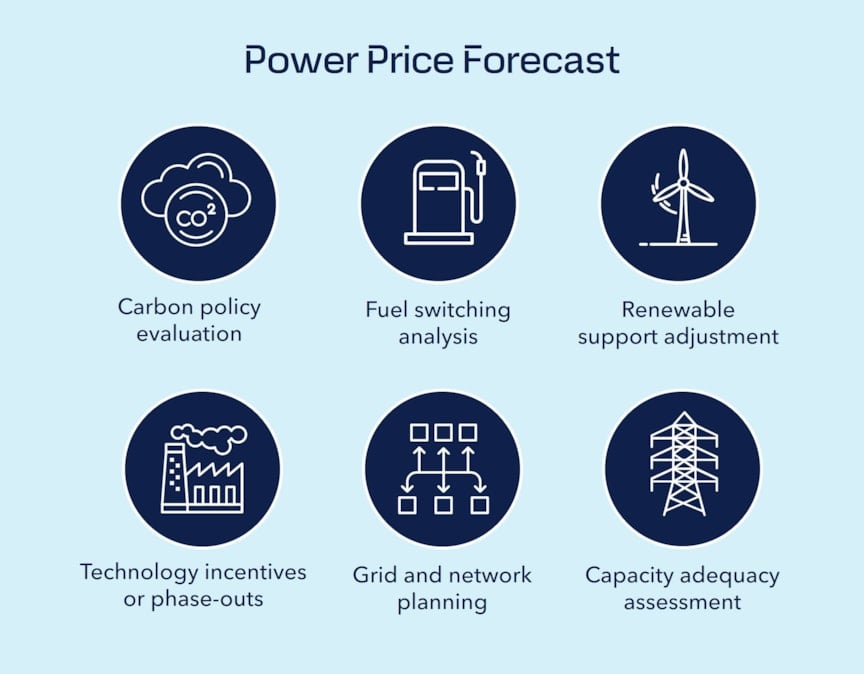
Forecasts you can trust will define industrial competitiveness
Europe’s industrial companies are facing relocation pressures, rising input costs, tightening climate policies, and accelerating electrification. In this environment, the credibility of power price forecasts has become decisive.
Forecasts that cannot be validated cannot be relied upon
Industrial decision-makers now require:
- Transparency in modelling assumptions
- Rigorous multimeric accuracy assessment
- Scenario specific performance
- Models that behave realistically under stress
Reliable, well validated price outlooks are no longer optional. They are essential for derisking major capital investments, safeguarding long-term IRR, and planning with confidence amid ongoing volatility.
The companies best positioned to succeed in this landscape will be those that base their decisions on forecasts grounded in evidence, transparency, and robust validation; forecasts that provide the confidence to commit capital, accelerate decarbonization, and capture emerging opportunities across Europe’s transforming energy system.


