Green molecules and Europe's system resilience

This article is part 1 of the three-part green molecules (1) strategy series, using European case studies to show how biomethane, biogenic CO₂, and multipurpose crops act as strategic enablers of Europe’s interconnected energy and agriculture system.
Green molecules as a system level insurance policy
Europe’s energy transition and agricultural reform are often treated as separate, or even competing, policy domains. Yet, challenges in both sectors point to the same underlying issue: the fragility of modern critical infrastructure. Power grids strain under rapid electrification, industries struggle to source biogenic feedstocks, and intensive farming systems face low prices, weather extremes, nitrogen emissions, soil degradation, and biodiversity collapse.
In this context, biomethane and biogenic CO₂ should no longer be viewed as marginal or temporary options. They must be reframed as hedging instruments that help manage systemic risks across Europe’s interconnected energy and agriculture systems.
This reframing matters. Biomethane and biogenic CO₂ are too often positioned as short-term “bridge” solutions, reinforcing their peripheral status and limiting policy support. Yet, these molecules can deliver far more than emissions reductions: they can help restore biodiversity, strengthen rural economies, and improve climate resilience across critical infrastructure.
Biomethane and grid resilience
The challenges of an “all-electric” transition are becoming increasingly visible. Countries such as the Netherlands face severe grid congestion2, leading to the curtailment of renewables, volatile pricing, and multi-year delays for new grid connections. Expanding the power system to meet rare winter peaks or “Dunkelflaute” periods is costly3, underutilized, and provides limited direct climate benefit.
Biomethane offers a pragmatic hedge: it uses existing gas infrastructure, can be stored underground for months, and provides dispatchable, net-zero energy during winter conditions. This flexibility acts as a systemic insurance. By anchoring a significant part of the energy transition in green molecules - not electrons alone - Europe can better manage market volatility and reduce the risks of brownouts, blackouts, or long-term deadlocks such as those affecting Dutch housingand industrial deployment.
Building a biogenic CO₂ ecosystem
Biogenic CO₂ strengthens resilience and unlocks new market opportunities. It offers digesters an additional revenue stream, supplies essential feedstock for e-fuels, and enables negative emissions through geological storage. It also helps critical industries secure supply stability in an uncertain future (eng., 2024). As a scalable, lower-cost alternative to direct air capture, and a net-zero-compatible substitute for fossil CO₂ biogenic CO₂. allows Europe to safeguard key value chains - from food production and industrial chemistry to aviation fuels and greenhouse horticulture - while navigating technological and geopolitical uncertainty.
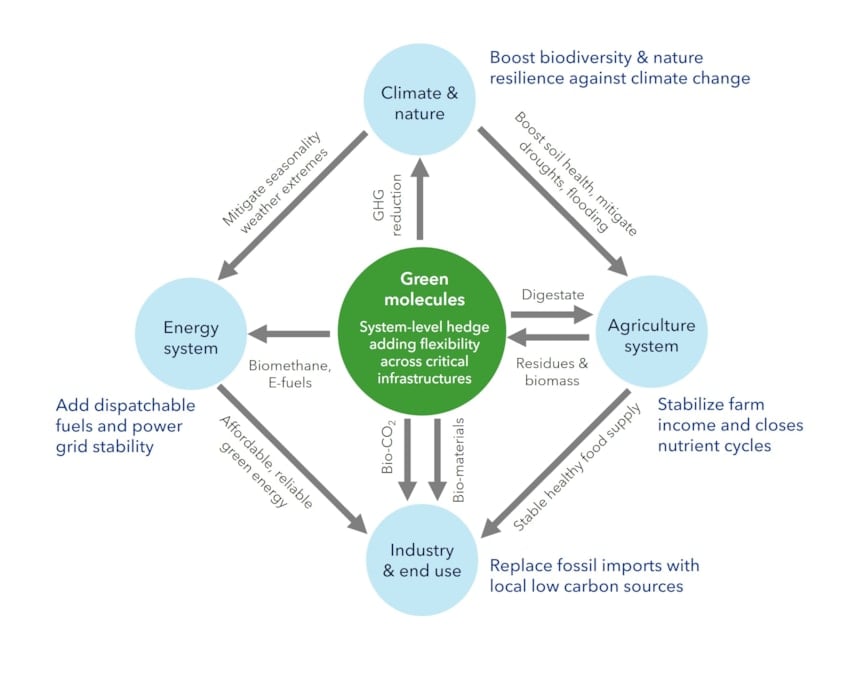
Illustration on the envisioned green molecules hedging strategy: a network of flexible digesters turn all available agriculture biomass, manure, residues, multi-purpose break crops etc. into green molecules (biomethane and biogenic CO₂)
A more resilient agriculture sector
Positioning green molecules as hedging instruments also reshapes the future of European agriculture. The sector faces mounting pressure as a major contributor to water and air pollution, biodiversity loss4, and methane and N2O emissions5, while remaining reliant on EU income support6. At the same time, it must meet stricter targets on chemical use and nitrogen emissions, whilst battling low prices7 and the ever growing impact of climate change. A shift is needed from large-scale exports of low value commodities toward healthy, high-quality foods, restored soils and ecosystems, and supplying Europe’s growing domestic demand for green molecules. This requires a dense network of bioenergy parks, linked to existing gas grids and emerging CO₂ backbones. These parks would process manure and agriculture and forestry residues, supplemented with multipurpose crops that provide either food, feed, fibers or fuels depending on market needs. Such parks could also relieve grid pressure through CHP, electrolysers, and batteries, whilst diversified cropping reduces reliance on monoculture, chemical inputs, and degraded soils - improving soil fertility and micro-nutrient content. As farmers diversify across multiple independent markets and soils are being restored, the sector becomes more resilient to droughts, floods, and price shocks – benefiting both agriculture and Europe’s wider infrastructure.
Lessons from the Netherlands
The Dutch experience illustrates how overlooked technical risks can escalate into structural crises. Rapid post-war growth in agricultural production and accelerated renewable energy investments ultimately collided with grid bottlenecks and nitrogen deposition in vulnerable ecosystems These twin-challenges froze housing and industrial development, and stalled parts of the energy transition. Green molecules offer the system resilience needed to prevent similar crises. Reducing reliance on intermittent electricity and animal-based mono-cultures will give Europe the resilience it needs to deliver its ambitions.
A permanent role for green molecules
Reframing biomethane and biogenic CO₂ as strategic hedging instruments - rather than transitional fuels - creates a more robust policy rationale. The key question is no longer whether they outperform wind, solar, batteries, hydrogen, or biomass on marginal abatement costs, but whether Europe can reach net zero without the “molecular insurance” that protects both urban and rural systems from weather volatility, grid congestion, and climate related disruptions in food and energy supply. With dispatchable capacity, negative emissions potential, nutrient recycling, soil regeneration, and integration between energy and agriculture policies, green molecules earn a permanent role in Europe’s climate and security strategy.
Long-term support for biomethane and biogenic CO₂ is therefore not a concession to fossil or animal farming industries, but an investment in system resilience. They are the infrastructure equivalent of a diversified financial portfolio: less glamorous than AI tech stocks, but essential for navigating market recessions. They are essential to Europe’s journey toward net zero.
Coming next: part 2 on how biogas can provide an income floor for agriculture.
References
- Green molecules are energy carriers or chemicals produced using renewable energy sources and sustainable feedstocks, direct substitutes for fossil counterparts, resulting in minimal net greenhouse gas emissions. In this work we focus mainly on bio-methane, biogenic CO₂ and hydrogen from electrolysis.
- Solving the gridlock, Boston Consulting, 2024
- Frontier Economics ensuring resilience in the European energy transition
- Food system impacts on biodiversity loss, United Nations Environment Programme
- Greenhouse gas emissions from agriculture in Europe
- Rethinking agriculture
- Grower: Are you willing to produce while losing money?
3/6/2026 1:00:00 PM