Biomethane: a strategic backup for Europe’s power system
By Jan Willem Turkstra, Wouter van der Goot

This article is part 2 of a three-part series on green molecules strategy, using European case studies to demonstrate how biomethane, biogenic CO₂, and multipurpose crops act as strategic enablers of Europe’s energy and agricultural system.
Why domestic biomethane matters for energy security and grid resilience
Europe is electrifying at pace. Wind and solar are scaling, heat pumps and electric vehicles are becoming mainstream, and dependence on imported natural gas has begun to decline.[1][2] Yet the transition is also exposing a structural challenge: power systems do not only need low-carbon energy – they need dependable capacity during the moments that matter most.
Across Europe, the pace of new connections, grid reinforcement, and flexible capacity is struggling to match the pace of electrification. Congestion is becoming a practical constraint on renewable build-out and on new loads such as electric heating and mobility.[3] At the same time, electricity markets are showing greater volatility, including more frequent negative prices during periods of surplus generation.[4]
The stress test comes in winter: demand rises sharply (space heating, mobility, and industry), whilst renewable output can be low for prolonged periods. When cold, dark, and windless conditions persist for days – or even weeks – storage alone cannot always bridge the gap, and the system needs firm, dispatchable backup. If resilience is not built in, the consequences can be severe: the February 2021 ‘polar vortex’ event in Texas is a reminder of how extreme weather, technical failures, and surging demand can combine into major disruption and loss.[5]
Even as average temperatures change, planning assumptions should account for more frequent extremes.[6] There is also continuing scientific discussion about large-scale ocean circulation changes (including the Atlantic Meridional Overturning Circulation), and what that could mean for European winter severity.[7][8] The practical point for energy system design is the same: resilience needs to cover rare, high-impact winter conditions, not only the average year.
A pragmatic role for biomethane
Europe needs a pragmatic resilience layer alongside electrification. Locally produced biomethane should be treated as a strategic energy security asset – not only as a decarbonization fuel. Its value lies in being dispatchable, storable, and locally produced, enabling it to support the power system during winter peaks, grid stress, and extended periods of low wind and solar generation.
Crucially, existing gas infrastructure – pipelines, storage, and distribution networks – can be repurposed as a strategic advantage, enabling a more resilient and cost-effective electrification pathway than ‘electricity-only’ solutions that require substantial overbuild.
From principle to practice
Putting biomethane to work as a resilience resource requires deliberate choices. A key principle is to use electrification where it is most efficient, and biomethane where it reduces system risk and total cost.
- Recognize biomethane’s system value. Treat it as dispatchable low-carbon capacity that underpins security of supply during ‘Dunkelflaute’ periods (periods of low wind and solar generation) and winter demand peaks – not as a marginal, volume-only substitute for fossil gas.
- Maintain and repurpose critical gas assets. Preserve and adapt pipelines, storage, and distribution networks where they provide resilience and optionality for the power system and heat sector, avoiding premature decommissioning.
- Deploy hybrid end-use solutions where they reduce risk. Combine efficient electrification (heat pumps) with biomethane backup for periods when the power system is most constrained, supported by smart control and time-restricted operation.
- Design markets and policy around avoided system costs. Ensure support mechanisms account for avoided grid reinforcement and avoided investment in backup generation, not only commodity energy volumes.
Illustrative case: hybrid heating as a grid-friendly pathway for the residential sector
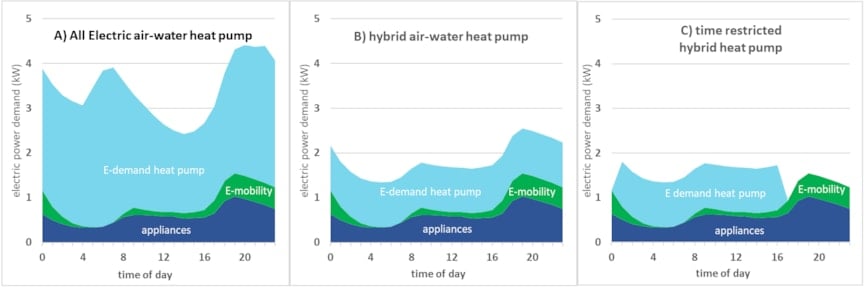
Hybrid heat pumps for individual homes illustrate the use case. For much of the year, a heat pump can provide efficient heating using renewable electricity. But during prolonged cold, dark, and windless winter periods – when demand peaks and the grid is most strained – relying solely on electricity can significantly increase peak demand and drive costly reinforcement.
During these peak periods, switching space heating to biomethane can provide flexible, dispatchable capacity, helping to avoid blackouts and reduce the need for uneconomic investment in grid overbuild and backup power plants.[9]
Why this matters for the energy system
If biomethane is positioned as strategic backup – alongside electrification, flexibility, and other dispatchable low-carbon sources – the system-level benefits are significant.
- Stronger energy security. Regional biomethane reduces exposure to imported fossil gas and provides locally controlled, storable energy for critical periods.
- Higher system resilience. Using biomethane during winter peaks and periods of system stress provides dispatchable backup when the electricity system is most constrained.
- Lower total system cost through infrastructure reuse. Repurposing existing gas transport, storage, and distribution assets can reduce the need for costly grid overbuild, whilst supporting a more robust electrification pathway.
What this means for decision-makers
Energy policy and planning can reflect biomethane’s resilience value by (1) prioritizing high-value use cases where it avoids disproportionate electricity system investment, (2) enabling hybrid solutions in constrained networks, and (3) safeguarding and repurposing critical gas infrastructure where it supports security of supply.
- Value flexibility explicitly. Compare options based on whole-system impacts, including avoided grid reinforcement and avoided backup generation.
- Support targeted hybrid pathways. Use hybrid heat and decentralized combined heat and power (CHP) where they reduce peak electricity demand and congestion risks.
- Plan for infrastructure reuse. Treat existing gas networks and storage as assets to be repurposed for resilience and security, rather than liabilities to be retired by default.
Strengthening resilience in Europe’s power system
Europe’s electrification journey is essential, but it must be resilient. Locally produced biomethane can play a strategic role as dispatchable backup during periods of peak demand and constrained renewable output, whilst reducing exposure to imported fuels.
By repurposing existing gas infrastructure as part of the solution, Europe can strengthen energy security and enable a more robust pathway to net zero.
Scaling biomethane sustainably – whilst protecting food production and reducing wider agricultural emissions – will be critical, and is a topic we will explore in the next article in this series.
Coming next: part 3 on how green molecules can provide an income floor for agriculture
References:
- https://alternative-fuels-observatory.ec.europa.eu/general-information/news/european-battery-electric-vehicle-market-surges-34-first-half-2025-led
- https://energy.ec.europa.eu/topics/energy-efficiency/heat-pumps_en
- See DNV Energy Transition Outlook 2025, section on electrification
- https://www.pv-magazine.com/2025/08/26/germany-records-453-hours-of-year-to-date-negative-electricity-prices/
- https://en.wikipedia.org/wiki/2021_Texas_power_crisis
- https://www.yourweather.co.uk/news/forecasts/this-weather-situation-could-plunge-europe-into-an-ice-trap-with-lots-of-snow-and-frost.html
- Open Letter by Climate Scientists: https://en.vedur.is/media/ads_in_header/AMOC-letter_Final.pdf
- https://www.uu.nl/en/publication/what-will-happen-to-europe-if-the-gulf-stream-weakens-significantly
- In order for the all electric heat pump to deliver true net zero heating, the back up power will likely need to be hydrogen. Nuclear and CCS options are not feasible as they must run near baseload. Batteries are ineffective over multi day periods just as interconnection as the low wind conditions will affect large parts of Europe.
- Total heat pump heating commodity costs of ~2,670 euro /year, with a ~0.25 euro/kWh power price, 0.14 euro/kWh (bio)methane price (commodity+ taxes), a time-of-use based E-network tariff and a fixed 300 euro gas network fee. The original natural gas costs (commodity+ network) were ~3,300 euro/year. See page 5: https://www.acm.nl/system/files/documents/ontwikkeling-netkosten-tot-en-met-2050-en-de-kostenverdeling-via-nettarieven.pdf