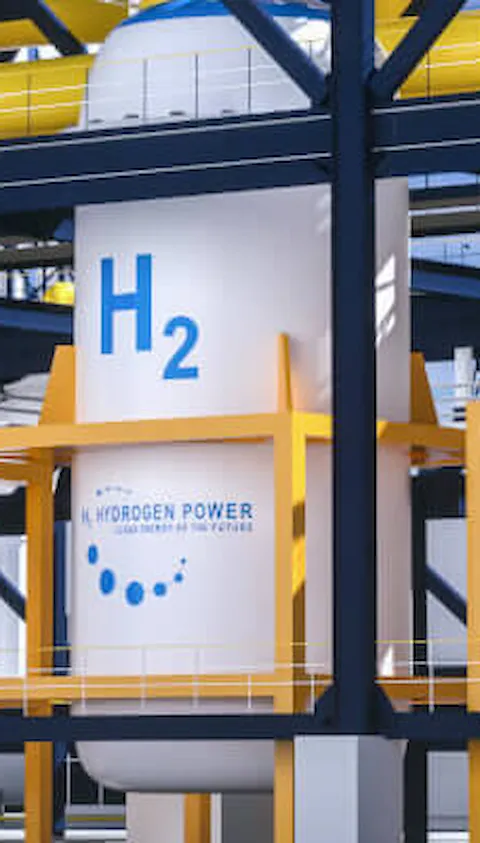
Hydrogen
Hydrogen and its derivatives remain limited in total volume but indispensable for decarbonizing heavy industry, shipping and aviation. Low-carbon supply and ammonia trade grow rapidly after 2040.
- Hydrogen’s role rises but stays limited globally. Hydrogen and its derivatives expand strongly through the 2050s yet still offset only a modest share of final energy by 2060; the biggest leaps occur after 2050 as electrolysis scales and trade matures.
- 85% of hydrogen is low carbon by 2060. Supply comes from methane reforming with CCS and multiple electrolysis routes (grid-connected and dedicated renewables) as costs fall and standards tighten.
- Hydrogen provides ≈3% of global final energy by 2050 and continues rising beyond mid-century.
Source: DNV ETO 2025 p. 56 - 85% of supply in 2060 is low carbon: 28% methane + CCS, 50% electrolysis (renewables and grid), 2% nuclear.
Source: DNV ETO 2025 p. 57 - Pipelines at medium distance, ammonia for oceans. Hydrogen mainly moves by pipeline within/among neighboring countries; intercontinental trade is overwhelmingly ammonia, reaching ~65 Mt/yr seaborne by 2060 (≈74% of hydrogen & derivatives trade). Up to 80% of hydrogen pipelines can be repurposed gas lines, costing 10–35% of newbuild.
- Costs: electrolysis converges; blue holds niches. Electrolytic hydrogen narrows the gap as renewables and capex drop; methane reforming with CCS remains cost-competitive where gas is cheap and for ammonia chains, supplying ~27% of H2 in 2060.
- Hard-to-electrify sectors depend on H2/derivatives. Hydrogen, ammonia and e-fuels power ~10–35% of aviation/maritime energy by 2060, complementing biofuels and efficiency.
- Industry becomes the largest H2 user. Manufacturing leads hydrogen demand through mid-century and beyond; around 30% of primary steel is expected via hydrogen routes by 2060.
- System integration matters. Electrolysis growth leans on abundant, low-cost electricity; more VRE hours at very low prices are pivotal to levelized costs.
- Ammonia dominates inter-regional trade, reaching ≈65 Mt/yr seaborne by 2060, ≈74% of hydrogen and derivatives trade.
Source: DNV ETO 2025 p. 58 - Around 200 GW onshore and 20 GW offshore wind are dedicated to hydrogen production by 2060.
Source: DNV ETO 2025 p. 56
Your media contacts for hydrogen

