OT cybersecurity assurance across a multi-platform offshore development
DNV Cyber assessed the operational technology (OT) cybersecurity of vendor equipment packages for a multi-platform, multi-year oil and gas field development, providing the asset owner with independent assurance from design review through to validation up until offshore commissioning.
The project involved several engineering contractors and dozens of equipment package vendors spread around the world.
Independent design reviews, risk assessments and validation activities checked vendor equipment against the asset owner’s OT cybersecurity requirements.
The scope included vendor design assessments, risk assessments, support for policies and procedures development, acceptance test witnessing at factories, fabrication yards and offshore sites. Vulnerability assessments and penetration testing were performed between delivery phases of the build.
Addressing cybersecurity issues before offshore installation supported the asset owner’s secure-by-design requirements while helping reduce remediation costs and offshore resource demands.
On large offshore developments, cybersecurity assurance across the full vendor and contractor landscape can place significant demands on an asset owner’s time and internal resources. A single platform may include equipment and systems from many suppliers. Each must be assessed on its own and as part of an integrated package, at factories and fabrication yards worldwide and again at the offshore location. Vendors and contractors also vary in cybersecurity maturity, which affects how well they document their systems, write and run test procedures, prove compliance and configure systems securely.
In this project, the asset owner set the cybersecurity requirements. The engineering, procurement, construction, integration and commissioning (EPCIC) contractors were responsible for detailed engineering, procurement, construction at the fabrication yards, offshore installation and final commissioning. The contractors and their vendors had to meet the owner’s requirements before handing over the assets for operation. The project’s scale and geographic spread made consistent assurance difficult, because equipment and systems had to be checked at factories and fabrication yards worldwide and again at their final offshore locations.
The asset owner needed assurance that the assets were secure by design and met applicable national regulations, international standards and internal cybersecurity requirements. The EPCIC contractors engaged DNV Cyber to provide OT cybersecurity advisory and verification services, drawing on its experience in large capital expenditure (CAPEX) projects in the energy and shipbuilding sectors.
The value of cyber assurance is not simply finding issues. It is finding them early enough that they can be resolved without disrupting the wider project.
OT Cybersecurity Manager, Major Energy Operator
A consistent approach to assurance across vendors and sites
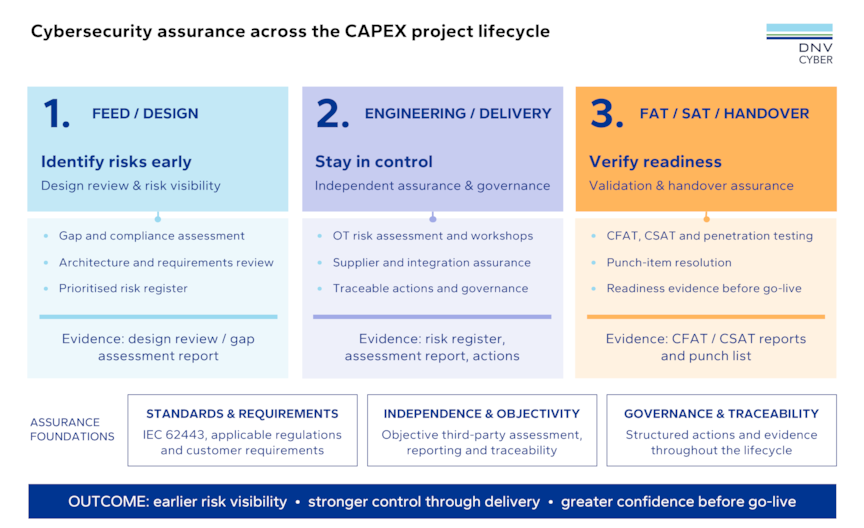
DNV Cyber’s scope covered OT cybersecurity design reviews, gap and risk assessments, Cyber (Integrated) Factory Acceptance Testing (C-(I)FAT), Cyber Yard Acceptance Testing (CYAT) and (offshore) Cyber Site Acceptance Testing (CSAT). Where vendor documentation lacked sufficient detail, DNV Cyber supported the review and development of Cyber Functional Design Specifications (FDS), policies and procedures and other mandatory design documentation.
DNV Cyber developed validation testing procedures to address applicable national regulations, international standards such as IEC62443 and the asset owner’s internal cybersecurity requirements.
During factory and yard acceptance testing, consultants witnessed testing against these procedures to verify that they were correctly followed and that the results were accurately documented, and performed vulnerability assessment and intrusive penetration testing. Findings were recorded in a punch register for vendors to address before the next stage. The aim was to resolve findings before final offshore installation, leaving offshore activities focused on verification and non-intrusive penetration testing.
For a project of this scale, cyber assurance needs to be embedded throughout the project lifecycle. A consistent approach helps us maintain oversight across contractors and vendors while ensuring the required standards are addressed at each stage.
OT Cybersecurity Manager, Major Energy Operator
From design to commissioning: assurance at the right time
Across complex CAPEX projects, the timing of OT cybersecurity assurance can be as important as its scope. Clear requirements at the outset, followed by assurance throughout delivery, help address weaknesses before they become more difficult and substantially costly to resolve.
Broad corporate cybersecurity policies often need to be translated into project-specific OT requirements. Clarifying these during design helps avoid differences in interpretation and inconsistent implementation. Long project lifecycles also require ongoing assessment of vulnerabilities, emerging threats and technology obsolescence through design, testing and commissioning.
Offshore operating constraints make the timing of testing particularly important. By site acceptance testing, a platform may already be in production, ruling out intrusive testing and restricting downtime to maintenance windows. Multiple vendors may need access during the same window, while limited accommodation constrains the number of specialists on site. Completing intrusive testing and as much assessment work as possible at the onshore fabrication yard enables a more thorough assessment and reduces pressure on offshore capacity.
For asset owners, the lesson is to treat OT cybersecurity assurance as part of project delivery, not simply a final acceptance check. Clear requirements, consistent verification across vendors and timely onshore testing provide a stronger basis for confidence in the delivered assets, while reducing exposure to late-stage remediation and demands on limited offshore resources.