Europe's hydrogen pathway: Slower growth, sharper focus
By Corin Taylor and Jo-Anne Tomkins

DNV’s new hydrogen report forecasts European demand to more than treble by 2060. But significant technical, policy, regulatory and commercial challenges remain.
From optimism to realism
Our latest hydrogen outlook reflects a significant downward revision in the demand and uptake of hydrogen from our previous forecast in 2022. This is driven by three main factors:
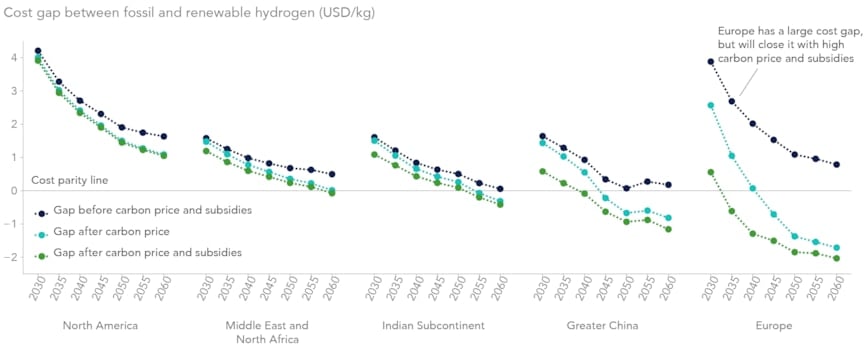
- Green hydrogen is costing more than previously thought, with higher interest rates and electricity prices, and insufficient scale to bring capital costs down significantly. The cost premium compared to fossil hydrogen is particularly acute in Europe, and even with a rising carbon price, additional support will be needed until 2040 to bridge the gap.
- Policies have not followed ambition. EU blending mandates, for example, are not being enforced for industry, or adopted by all member countries.
- Electrification has powered ahead, with falling costs and improving performance of batteries and heat pumps enabling electrification of increasing portions of heavy road transport and industrial heat – pushing out hydrogen. This is reflected in the focus on electrification in the EU’s response to the current energy crisis.
Renewable hydrogen will only reach cost parity with unabated fossil hydrogen through strong policies
Industry focus sharpens
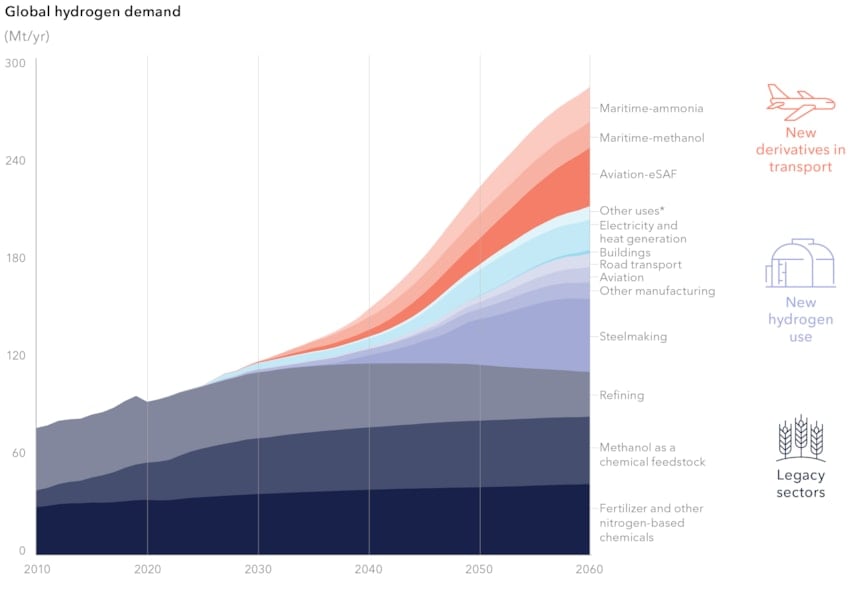
The outlook still contains positive developments and opportunities. Globally, the clean hydrogen sector has been forced to focus on a narrower set of core uses, particularly industrial uses, including partial decarbonization of existing refining, fertilizer and chemical production, and feedstock for synthetic fuels for sustainable aviation and maritime offtake. We also see growing interest in using renewable hydrogen for direct reduced iron, to help decarbonize the steel industry.
Total hydrogen demand grows 170%, and diversifies
Signs of progress
More projects are now taking investment decisions, often at a smaller scale than originally planned. As of December 2025, around 0.5 GW of capacity is now operational in Europe and a further 4.5 GW post-FID, with refining accounting for around half the total offtake.
Although the implementation of policies has been limited compared to the ambitions, they are making a difference. Blending mandates for transport fuels are supporting refinery business cases and key projects are receiving European Hydrogen Bank and national government production subsidies. Increasingly, this is being organised on a transnational basis: for example, funding for Danish production projects is supporting the planned hydrogen pipeline to Germany.
In the UK, the government is progressing low-carbon hydrogen via Hydrogen Allocation Rounds and Low Carbon Hydrogen Agreements, within an ambition for up to 10 GW by 2030. An updated UK hydrogen strategy is expected imminently. The government is also developing transport and storage business models and has conducted consultations on hydrogen blending.
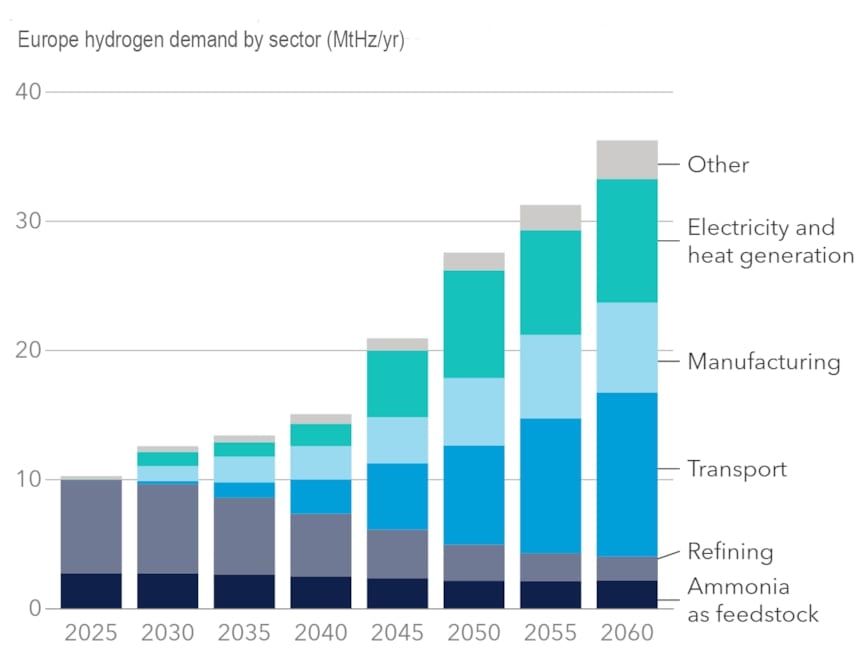
By 2060, DNV forecasts that all of Europe’s 35 million tonnes of hydrogen consumption will be decarbonized, mostly through domestic renewable hydrogen, but with important roles for imports from regions with low-cost abundant renewable resources. Low-carbon blue hydrogen production with carbon capture, will also play a role in Europe. Indeed, three sizeable low-carbon hydrogen projects are already under construction in the Netherlands.
European hydrogen demand will more than triple by 2060
What needs to change?
So what is still needed? Policy certainty is key, including no backtracking on blending mandates in sectors such as aviation, and an easing of the Renewable Fuels of Non-Biological Origin (RFNBO) requirements to reduce production costs.
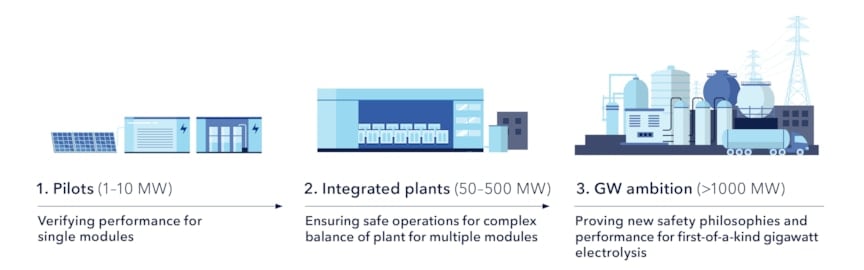
But whatever the policy, it is technically challenging to build large-scale hydrogen plants. It is not simply a case of placing lots of small electrolysers side-by-side. The balance of plant, the safety approach, and the on-site storage all need to be developed for the specific project in the specific location. Additionally, uncertainty in demand profiles and confirmed offtakes are leading to difficulty in securing FID.
DNV’s experienced technical experts are busier than ever carrying out risk assessments and due diligence, advising on electrolyser technologies and verifying facilities and equipment against regulatory requirements. For example, we carried out a technology assessment, operational benchmarking and safety advisory for RWE’s 300 MW GET H2 Nukleus development in Germany, which provided a robust decision basis for RWE to advance the project.
We are also regularly asked to assess whether pipelines can be repurposed and to test industrial burners and other end-use equipment. DNV’s work is underpinned by data gathered from research and testing conducted across our laboratory and testing sites including:
- Groningen, Netherlands – testing of industrial burners for blends and 100% hydrogen, including product quality and NOx emissions, hydrogen purity and metering. This includes the H2MET joint industry project (JIP) to advance hydrogen flow metering, crucial for accurate measurement of hydrogen volumes. The JIP has brought together global gas network operators including Gasunie, BP, Shell, and Aramco, with flow meter manufacturers such as Emerson, Endress+Hauser, and Siemens.
- Spadeadam, UK – large-scale pipeline rupture testing, venting and flaring, ignition consequence and gas accumulation within the HyStreet facility. Two new JIPs are being launched and are currently accepting participants, Verification of the effect of hydrogen on the integrity of pipeline repairs and Inline inspection techniques for hydrogen and hydrogen blends.
As the last few years have proved, building a clean hydrogen sector takes a coordinated effort by both policy implementers, and the industry. It takes time to decarbonize hard-to-electrify sectors and increase Europe’s energy security. However, slowly and steadily, it can be achieved.
To grow, hydrogen must close the safety confidence gap and document emissions reductions