
EU MRV for ships of 400 GT and above
The EU Monitoring, Reporting and Verification (EU MRV) Maritime Regulation (Regulation (EU) 2015/757) aims to assess the environmental impact of maritime transport by collecting and reporting emissions data. It serves as the foundation for carbon tax determination through the EU Emissions Trading System (EU ETS). The EU MRV applies to vessels engaged in commercial transport of cargo or passengers on routes which begin and/or end at ports within the European Economic Area (EEA).
The revised EU MRV regulation encompass general cargo ships , as well as offshore ships of 400 GT and above.
Learn more in our article EU MRV extended to ships from 400 GT - start preparing now.
EU MRV requirements
Monitoring plan (MP)
A MP must be prepared by the company in accordance with EU MRV requirements and assessed by an independent accredited verifier, like DNV. The content of the MP is defined by the EU MRV regulation and includes a description of the method chosen to monitor and report emissions.
For administrative convenience, a MP template is available through the Fleet Status Portal under Services. The preparation and content of the monitoring plan remain the responsibility of the company. Use of the template does not form part of the verification assessment and does not influence the outcome of verification.
Since 2024, vessels are required to have updated EU MRV MPs. The updates include an outline of the overall control system (OoCS) and changes related to CH4 and N2O emissions to fulfil EU ETS requirements. Companies must submit an MP for each relevant ship to the respective administering authority (AA) for approval.
Emissions Report (ER)
The ER contains information about the amount of fuel consumed and the distance travelled, as well as the cargo carried on voyages to, between and from EU ports. If a change of company occurs, a partial ER must be submitted. A partial ER can be defined as the aggregated data from the beginning of the year to the date of company change.
Companies may use various methods and systems to collect and submit operational and emissions data. DNV provides a reporting format that can support data submission processes through Operational Vessel Data (OVD). For more information, please visit our OVD page. The reporting format has been designed to accommodate information required under the EU MRV, IMO DCS and FuelEU Maritime frameworks. The collection and submission of data remain the responsibility of the company and are separate from the independent verification activity. Verification activities are conducted independently of any reporting tools or data submission solutions used by the company. Periodical site visits are carried out by DNV as required by regulation to gain sufficient understanding of the company’s and ships’ monitoring and reporting systems described in the MP.
DNV offers site visits in combination with ISM company audits, with a recommended frequency of every third year. Site visits are also offered as a service to companies not having ISM certification with DNV.
Document of Compliance (DoC)
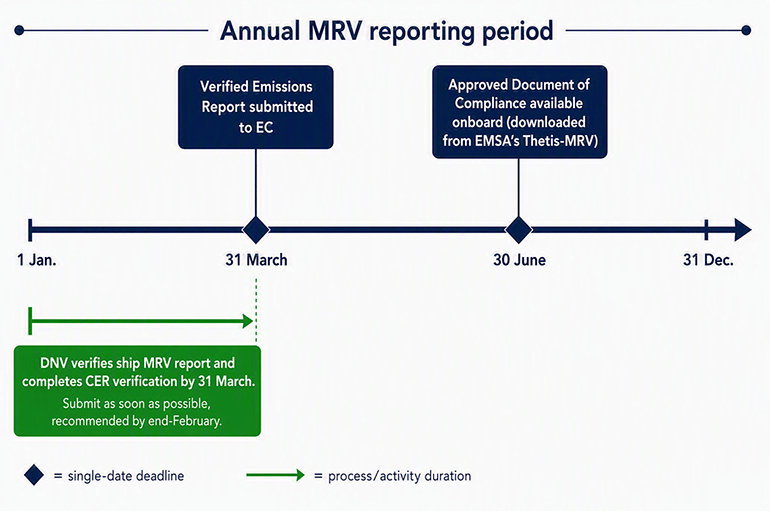
Upon submission of the aggregated ER, DNV’s technical experts verify it against operational data, bunkering data and external data. The verified ER (annual or partial) in a given year must be submitted by the shipping company to the European Commission, AA and authorities of the flag state, at the latest by 31 March of the following year. It is important to note companies must also submit a verified company-level emissions report (CER) at the latest by 31 March of each year. The CER summarizes the total emissions from all ships under the company’s responsibility during the previous year, this includes annual and partial ERs. Therefore, annual and partial ERs must be verified before the CER can be created and submitted for verification.
The AA can ask for the verified report earlier, however not before 28 February.
By 30 June, the DoC of the ER must be carried on board. The DoC of the ER is available on EU’s database THETIS-MRV.
A simplified annual cycle for the EU MRV is illustrated below:
Why DNV as your verifier for the EU MRV?
- DNV SE is an accredited body for the EU MRV verification services in accordance with EU Regulation 2015/757 and amending Regulation (EU)2023/957, As your verifier, DNV offers: Experience with EU MRV verification activities across a broad range of vessel types and operations
- An established verification process aligned with applicable regulatory requirements
- A global network of qualified verification personnel
- Experience with the reporting frameworks applicable to EU MRV, IMO DCS and FuelEU Maritime
- Optional digital reporting and data exchange solutions, including Operational Vessel Data (OVD), reporting formats designed to accommodate EU MRV, IMO DCS and FuelEU Maritime framework requirements, and API-based data transmission with major reporting system providers
The use of DNV digital reporting solutions is separate from the independent verification process. Verification activities are conducted independently of any reporting tools or data submission solutions used by the company.
FAQs
Our comprehensive FAQs provide you with answers to most questions on the EU MRV. DNV customers can also use our DATE service for questions on the EU MRV.
Related links
EU MRV extended to ships from 400 GT - start preparing now
Read our statutory news from 8 April 2024
Digital MRV reporting and verification
View prices and order online
EU ETS – Emissions Trading System
Visit our topic page
IMO DCS – Data Collection System
Visit our topic page
SEEMP Part III
Visit our topic page
Disclaimer
DNV Group company DNV SE is the accredited body for EU MRV verification services as per EU Reg. 2015/757. Consequently, the EU MRV verifications and the issuance of EU MRV compliance documents will be provided by DNV SE as accredited body. The respective verification decisions are at the discretion of the DNV SE.
Fleet Portal related services such as Emissions Insights, data checks, online forms and report aggregation as well as the IMO DCS verifications are provided by DNV group company DNV AS.