MRV Regulation
| Answer: |
|---|
Answer:The EU MRV (Monitoring, Reporting, and Verification) Maritime Regulation (Regulation (EU) 2015/757) applies to ships of 5,000 gross tonnage (GT) and above, regardless of their flag, that carry passengers or cargo for commercial purposes to or from ports in the European Economic Area (EEA). However, with the new amendment Regulation (EU) 2023/957, as of 1 January 2025, the MRV Maritime Regulation will also apply to:
A limited number of categories of ships are excluded, notably:
|
| Answer: |
|---|
Answer:As of 1 January 2024, the EU MRV regulation covers the following types of greenhouse gas emission:
|
| Answer: |
|---|
Answer:For a voyage to be covered by the EU MRV, at least one of the two ports of call of the voyage must be located in an EU territory, i.e. voyages into, within and out of the EU shall be reported. |
| Answer: |
|---|
Answer:No, only ports where cargo is loaded or unloaded or where passengers embark or disembark are considered ports of call. Consequently, stops for the sole purpose of refuelling, obtaining supplies, relieving the crew, going into dry dock or making repairs to the ship and/or its equipment, as well as stops in port because the ship is in need of assistance or in distress, stops for ship-to-ship transfers carried out outside ports or stops for the sole purpose of taking shelter from adverse weather or rendered necessary by search and rescue activities are excluded. |
| Answer: |
|---|
Answer:The EU MRV regulation applies the berth-to-berth concept for voyages. Hence, a voyage starts at berth of one port of call and ends at berth of the next port of call. Sailing with a pilot and/or anchoring while waiting for port entrance are part of the voyage. The time spent at sea shall be calculated based on port departure and arrival information and shall exclude anchoring. |
| Answer: |
|---|
Answer:The expression “ports under the jurisdiction of a Member State” refers to ports located in “EU territory”, i.e. to which EU law fully applies: ports in the nine EU Outermost Regions (Açores, Canarias, French Guyana, Guadeloupe, Madeira, Martinique, Mayotte, Reunion and Saint Martin) as well as ports in Norway (except those on Svarbald) and Iceland qualify as EU ports. EEA member states’ overseas countries and territories which do not qualify as EU ports of call: Akrotiri, Anguilla, Aruba, Ascension, Bailiwick of Guernsey, Bermuda, British Antarctic Territory, British Indian Ocean Territory, British Virgin Islands, Bonaire, Caico Island, Cayman Islands, Curaçao, Ducie Island, Dhekelia, Falkland Islands, Faroe Islands, French Polynesia, Futuna, Greenland, Henderson, Isle of Man, Jersey, Miquelon, Montserrat, New Caledonia, Oeno Island, Pitcairn, Saba, Saint Barthélemy, Saint Helena, Saint Pierre, Sint Eustatius, Sint Maarten, South Georgia, South Sandwich Islands, Svalbard, Turks Island, Tristan da Cunha, Wallis. Source: https://www.emsa.europa.eu/reducing-emissions/mrv-changes/faq-mrv-changes.html |
| Answer: |
|---|
Answer:All relevant data need to be monitored on a voyage basis and then aggregated annually. |
| Answer: |
|---|
Answer:The EU MRV is neither class nor flag related, so this will have no effect on the EU MRV reporting. |
| Answer: |
|---|
Answer:No, DNV can also perform the verification for ships not classed with DNV. |
| Answer: |
|---|
Answer:The company shall submit a Monitoring Plan to the verifier (DNV) without undue delay and no later than two months after that ship’s first call at a port under the jurisdiction of an EU member state. |
| Answer: |
|---|
Answer:The Owner or ISM company is responsible for EU MRV compliance. |
| Answer: |
|---|
Answer:From 5 June 2023, revisions to the MRV regulation requires that upon change of company, a partial MRV Emissions Report (ER) is to be submitted for verification. The verified partial MRV ER should be submitted to the administering authority, flag state authorities of member states, the European Commission and the new company as close as practical to the day of change of company and no later than three (3) months thereafter. The verified data covering the previous company’s responsibility period should form part of the MRV ER that will be submitted by the company responsible at the end of the reporting year. However, the previous company’s emissions for a vessel which has been taken over by a company will not be part of the aggregated emissions data at the company level for the new company. Therefore, the company taking over the ship will not be liable to surrender allowances for the period when the vessel was not under the previous management or ownership. Nevertheless, the current owner/manager still needs to request the verified aggregated MRV data for the previous company’s period to fulfil MRV obligations at the end of the year. This data, combined with the log abstract data, will form a full-year MRV ER. |
| Answer: |
|---|
Answer:No, DNV as verifier only verifies submitted data and issues a DoC based on that report. DNV is in no position to confirm that a vessel has not been compliant within the scope of EU MRV during previous years, without verification. |
| Answer: |
|---|
Answer:Movements related to the installation of wind turbines offshore or to the carriage of supplies to wind turbines will continue to be not subject to the EU MRV regulation until the reporting period 2024. From reporting period 2025, offshore ships of 400+ GT will have to monitor their emissions according to MRV.From 2027, units of 5,000+ GT will have to also surrender allowances for their emissions according to the ETS; for units of 400 GT to 5,000 GT, this is yet to be decided by the EU. The definition of “offshore ship” is also pending, but we would expect that wind turbine installation vessels would fall under that definition. |
| Answer: |
|---|
Answer:Greenhouse gas (GHG) emissions from offshore ships shall cover GHG emissions released during voyages from the last port of call to a port of call under the jurisdiction of a member state and from a port of call under the jurisdiction of a member state to the next port of call, as well as within ports of call under the jurisdiction of a member state by the following ships, other than ice breakers, designed or certified to perform service activities offshore or at offshore installations: accommodation ship, anchor handling tug supply vessel, cable layer, cable repair ship, crew/supply vessel, commissioning service operation vessel, diving support vessel, dredger, drilling ship, floating production storage and offloading (FPSO), floating storage and offloading (FSO), gas, hopper dredger, gas processing vessel, mining vessel, offshore construction vessel, offshore supply ship, offshore support vessel, oil, pipe burying vessel, pipe carrier, pipe layer, pipe layer crane vessel, platform supply ship, production testing vessel, research survey vessel, service operation vessel, standby safety vessel, trenching support vessel, well stimulation vessel, wind turbine installation vessel, work/repair vessel. |
| Answer: |
|---|
Answer:“Port of call” for offshore vessels means the port where ship stops to relieve the crew. |
| Answer: |
|---|
Answer:Yes, if the offshore facility has an asssigned UN/LOCODE and/or is permanently connected to a port. Any offshore facility having an assigned UN/LOCODE and any offshore facility located outside port areas but permanently connected to a port are considered ports within the EU MRV maritime regulation. Stops at those facilities will therefore be considered a port of call, provided that the loading/unloading of cargo or passengers or relieving of the crew take place there. More information: https://climate.ec.europa.eu/document/download/31875b4f-39b9-4cde-a4e2-fbb8f65ee703_en?filename=policy_transport_shipping_gd1_maritime_en.pdf |
| Answer: |
|---|
Answer:According to 2015/757 EN, Art. 11.3, the Emissions Report (ER) shall state the technical efficiency, i.e. EEDI or EIV. If missing, this information must be entered in the DNV Fleet Status portal prior to submitting the ER, using the input field “Technical efficiency” available on the ER review page. Please enter the ship’s EEDI as given on the Energy Efficiency Certificate, or, in case the ship does not have an attained EEDI, the EIV (Estimated Index Value) should be given instead. The EIV shall be calculated according to MEPC.231(65). Data should also be available and consistent in THETIS-MRV.
|
| Answer: |
|---|
Answer:The EIV for cruise passenger ships with non-conventional propulsion is calculated according to MEPC.233(65), and for all other vessels according to MEPC.231(65). The EEDI is calculated according to MEPC.308(73). The requirements regarding the declaration of EIV or EEDI in the ER for a particular vessel are as follows: If an Energy Efficiency Certificate (EEC) has been issued on the vessel, the EEDI is stated on that EEC and shall be stated in the ER. In all other cases, the EIV needs to be stated, except for regarding:
If in doubt, please contact date@dnv.com. |
| Answer: |
|---|
Answer:Both the 2017 and 2024 editions of ISO 8217 may be used for fuel testing, with the fuel grade determined according to the version applied. Table 6 of the MRV Guidance Document 1 allows the identification of the fuel type based on the corresponding ISO 8217 standard version used. DNV accepts applying both versions for emissions reports until further notice. The procedure for verifying the fuel’s viscosity from the BDN, based on both ISO 8217:2024 and ISO 8217:2017 combined, applies as below:
|
MRV Monitoring Plan
| Answer: |
|---|
Answer:In case of any change to the monitoring plan, the company shall submit an updated plan to DNV for verification. Monitoring plans can be amended in the MRV Monitoring Plan online form found on Veracity > Fleet Status > MRV & DCS > Monitoring Plans. |
| Answer: |
|---|
Answer:Preamble 22 of the the MRV regulation states that the new company should receive a copy of the latest monitoring plan and document of compliance, if applicable, from the old company. Hence, this is intended by the regulation, but the preamble is not enforceable in itself and this provision is apparently not repeated in the regulation itself. Thus, the old company is in our opinion not required to hand over the approved monitoring plan to the new company according to the MRV regulation. It goes without saying that the respective sale and purchase contract might contain an obligation to deliver the ship with all necessary certificates (this is standard in all sale and purchase contracts) and therefore also the MRV monitoring plan. A potential buyer would want to check the monitoring plan in its due diligence before buying a ship and would also include this in the contract. |
| Answer: |
|---|
Answer:The new company shall submit the new plan without undue delay, but no later than two months after the change of company. |
| Answer: |
|---|
Answer:Generally, emergency generator engines do not need to be regarded as an emission source as per the MRV regulation. Only main engines, auxiliary engines, gas turbines, boilers and inert gas generators are regarded as emission sources. If the emergency generator engine is, however, used for operational purposes, it must be regarded as an auxiliary engine and, as such, has to be listed as an emission source in the monitoring plan. Its consumption shall be monitored, and its emissions be reported in the Emissions Report.The German AA (DEHSt) is currently the only authority that explicitly requires emergency generators to be included in the plans as auxiliary engines. Since they hold the final decision-making authority regarding plan approval, it is necessary to comply with these requirements. In Veracity, under the EU MRV Monitoring Plans section, you will find a guidance document that outlines how to implement the recommendations of the German AA within your plans. |
| Answer: |
|---|
Answer:DNV recommends that the monitoring plan be updated using the online form application in Veracity, in order to obtain a new compliance document and to avoid issues with third parties (e.g. PSC). |
| Answer: |
|---|
Answer:The power to be stated in the monitoring plan is the figure stated on the IAPP certificate. |
MRV Digital Reporting to DNV
| Answer: |
|---|
Answer:From 1 January 2024, the reporting period for the EU MRV Regulation is defined as from 1 January until 31 December of any given year. For voyages starting and ending in two different years, the respective data should be accounted under the year concerned |
| Answer: |
|---|
Answer:DNV requires that all voyages into, within and out of the EU shall be reported for MRV. For our clients who have MRV and DCS with DNV, reporting of all voyages is required. |
| Answer: |
|---|
Answer:No, the EU MRV regulation defines a voyage using departure-from-berth and arrival-at-berth. Therefore, the reporting of those exact events is required for every single voyage. Start of sea passage and end of sea passage may be reported additionally (if including consumption) but not instead. |
| Answer: |
|---|
Answer:Both the log abstract and the bunker reports can be submitted as XLS or CSV files and according to the interface description. DNV no longer provides any updates or maintenance to the CSV file converter, as standard Excel spreadsheets can now be used as a format for data reporting. The current version of the interface description is available online under OVD Interface description at https://developer.veracity.com/docs/section/datastandards/operationalvesseldata. |
| Answer: |
|---|
Answer:The frequency of the updates is up to the user’s preference. Since DNV provides you with a quality check of the data as they come in, we recommend taking advantage of this by submitting the data on a frequent basis in order to fix any issues timely. |
| Answer: |
|---|
Answer:No, for the verification of the emissions, we require all events including consumption and nothing more. |
| Answer: |
|---|
Answer:The current version of the interface description is available online under OVD Interface description at https://developer.veracity.com/docs/section/datastandards/operationalvesseldata Or through the Fleet Service portal: Vessel Services > MRV & DCS > Manage data > Operational Vessel Data standard (OVD) > OVD Interface description. |
| Answer: |
|---|
Answer:Each file can include single or multiple reports – this is up to the user’s preferences. |
| Answer: |
|---|
Answer:Yes, a second submission of the same events (identified with the exact same date, time and IMO number) will overwrite those previously submitted. |
| Answer: |
|---|
Answer:Deletion of submitted records can be done at DNV Fleet Status > MRV & DCS > Manage data > Go to Manage data in OVD Admin – by selecting the vessel and the relevant period for deletion. Alternatively, deletion of submitted records can be done by submitting another file with the same name (correct records shall be kept, and the ones to be deleted shall be omitted). |
| Answer: |
|---|
Answer:A system-to-system connection, using modern API technology and allowing fully automated data transfer, can be established anytime upon request – simply send a query to date@dnv.com. Moreover, many third-party vendors of ship-to-shore reporting systems are already integrated with Veracity – see here for a list of Veracity integrated partners. |
| Answer: |
|---|
Answer:According to Section 8.3.1.6 of guidance document 1 (The EU ETS and MRV Maritime General guidance for shipping companies), the reporting of the fuel type should be according to the ISO 8217 standard (both the 2017 and 2024 editions of ISO 8217 may be used for fuel testing). The procedure for verifying a fuel’s viscosity from the BDN is based on both ISO 8217:2024 and ISO 8217:2017 combined:
If you have two fuels falling into the same grade by viscosity, those should be reported as the same fuel type for MRV, DCS and FuelEU Maritime.
|
| Answer: |
|---|
Answer:The departure event, including the exact cargo, shall be reported when the cargo amount is reliably known. |
| Answer: |
|---|
Answer:The port in Korea is the departure port. Since cargo changed there, voyage starts there. The stops in China and Singapore don’t change the cargo so the emissions there count to the voyage. The port in the EU is the relevant arrival port determining the relevant voyage, since cargo will change there. The voyage ends in that EU port. The whole voyage from Korea to the EU is MRV relevant. |
| Answer: |
|---|
Answer:This is not a voyage, as it terminates in the same port with the same cargo amount. Thus, this is regarded as a port stay. Furthermore, it is important to note that the departure out to anchorage shall not be reported as the departure from berth, as this would indicate the start of a voyage, which it is not. |
| Answer: |
|---|
Answer:Anchoring events do not have to be reported, but the time at anchor elapsed since the last reported event has to be reported. There is no difference between inner and outer anchorage if coming from outside the port area as in this case. |
| Answer: |
|---|
Answer:As per the MRV regulation, drifting and anchoring are two different things. Anchoring is to be reported as anchoring, and drifting is part of the voyage. |
| Answer: |
|---|
Answer:In this scenario, the 30-minute trip is part of the voyage to port 2, which starts under point “b”. Going back to berth is just a stoppage in a harbour, i.e. “waiting at berth” without cargo operations, which does not constitue a relevant port call and is therefore not the end of a voyage.
|
| Answer: |
|---|
Answer:Any at-sea reports are voluntary, but in case of longer voyages which might be difficult to reproduce without noon reports, the reporting of daily reports such as noon reports can reduce the need for potential follow-up requests. |
| Answer: |
|---|
Answer:Generally, emergency generator engines do not need to be regarded an emission source as per the MRV. Only main engines, auxiliary engines, gas turbines, boilers and inert gas generators are regarded emission sources. If the EG engine is, however, used for operational purposes, it must be regarded an auxiliary engine and, as such, that engine has to be listed as an emission source in the monitoring plan (MP), its consumption be monitored and the emissions be reported in the ER. |
| Answer: |
|---|
Answer:Yes, but this is automatically done anyway when reporting the required events, arrival at berth and departure from berth. |
| Answer: |
|---|
Answer:No, it is voluntary, even for ice-classed vessels. We recommend not reporting those figures separately. Those figures shall, however, not be left out but shall be reported together with the non-ice navigation figures. |
| Answer: |
|---|
Answer:No, wind force declaration is voluntary. |
| Answer: |
|---|
Answer:Cargo change at a rig, FPSO, offshore field, etc. without UN/LOCODE is to be reported as an STS (event name “STS”). Also, for a voyage on which STS takes place, the From field is the departure port, the To field the arrival port. The rig, FPSO or offshore field where the STS takes place is not a From/To location and shall not be entered in the From/To field. |
| Answer: |
|---|
Answer:Cargo fuel shall be included in the cargo field, i.e. as cargo transported, together with any other cargo. |
| Answer: |
|---|
Answer:In case you report the ROB’s fuel type style, please make sure to report 0t, i.e. please do not just leave the field blank. In case you report the ROB’s fuel BDN style, please report the ROB in any event for every fuel reported to be consumed in this event. There is no need to report the ROB at the beginning of the year. |
| Answer: |
|---|
Answer:As per the EU regulation 2015/757, only main engines, auxiliary engines, gas turbines, boilers and inert gas generators are regarded emission sources. Based on the above, it is our understanding that as long as the excavator is not powered by the above-mentioned CO2 emission sources, the excavator FOC does not need to be reported for the EU MRV. |
| Answer: |
|---|
Answer:Like reporting positive BDNs when bunkering bunker tanks, negative BDNs shall be reported when de-bunkering tanks, e.g. for use as cleaner. |
| Answer: |
|---|
Answer:Annex I of the MRV regulation does not include a default value for ethane. It is recommended to use as a default value the emissions factor in Resolution MEPC.364(79) EEDI Guidelines (Table 7 in the The EU ETS and MRV Maritime General guidance for shipping companies, document 1). |
| Answer: |
|---|
Answer:The sulphur content does not affect the fuel type for emissions reporting. Annex I of the MRV regulation segregates fossil fuel types by viscosity grades instead of sulphur content. According to Section 8.3.1.6 of guidance document 1 (The EU ETS and MRV Maritime General guidance for shipping companies), the reporting of the fuel type should be according to the ISO 8217 standard (both the 2017 and 2024 editions of ISO 8217 may be used for fuel testing). Please refer to Table 6 of the MRV guidance document 1, which allows the identification of the fuel type based on the corresponding ISO 8217 standard version used. |
| Answer: |
|---|
Answer:Emissions factors to be used for biofuels are specified by the Commission Delegated Regulation (EU) 2023/2776, Annex I. In case of fuel blends, each blend component shall be considered separately. Please note that only under the EU ETS scheme, where the company uses a fuel complying with the sustainability criteria and GHG emissions-saving criteria for the use of biomass, the CO2 emissions factor of the biomass fraction of the fuel shall be zero. For OVD reporting requirements covering alternative fuels, please visit the OVD resources page. |
| Answer: |
|---|
Answer:Please be informed that DNV’s option for vessels with 300+ scheduled voyages per year to report in a way other than per-voyage has been phased-out. On average, the overall effort savings were not justifying the continuation of that approach. We hope that this decision finds your agreement, and we trust that our MRV verification service, which is optimized for the event reporting approach, will fully meet your needs for any of your vessels. |
MRV THETIS
| Answer: |
|---|
Answer:THETIS-MRV is the EU MRV system to report CO2 emissions from ships according to the EU Regulation 2015/757. THETIS-MRV is accessible |
| Answer: |
|---|
Answer:EMSA provides information about their THETIS-MRV system, including video tutorials, on their website. |
| Answer: |
|---|
Answer:In order to report EU MRV or FuelEU scope, it is necessary to register the Company in THETIS-MRV. On the EMSA website a “Register Now” button is available to create an account. For further information, we recommend visiting the EMSA website, with special attention to the video tutorial C01 covering the registration process. |
| Answer: |
|---|
Answer:A partnership request needs to be sent to DNV, and DNV has to confirm it, to enable the Company to submit the Monitoring Plans and Reports for DNV's verification. |
| Answer: |
|---|
Answer:DNV supports customers throughout the THETIS-MRV submission and verification process by providing the best available information and detailed guidance. For THETIS-related inquiries, customers may register a case through our DATE service or contact their Customer Success Expert for assistance. |
| Answer: |
|---|
Answer:
*The Company should ensure that the information contained in its THETIS-MRV account is kept up to date at all times. Whenever any changes are made to a vessel in THETIS MRV, the Company should review all tabs within the "Ship" page (e.g., "Ship", "Company", "Verifier", “Docs”) to ensure that all information is accurate and up to date. |
| Answer: |
|---|
Answer:The published Emissions Report data is accessible without logging in. Please refer to the table linked in the lower right corner of the following page: https://mrv.emsa.europa.eu/#public/emission-report. |
| Answer: |
|---|
Answer:The Company should ensure that all information available in THETIS-MRV is up to date and that the documentation available under the "Ship" tab reflects the vessel's current status. The following documents should be uploaded to THETIS-MRV:
Additional documentation may be required depending on the vessel's circumstances, ownership structure, or the requirements of the relevant Administering Authority. Therefore, the Company should ensure that all information and supporting documents remain accurate and up to date. |
| Answer: |
|---|
Answer:Yes, effective 1 January 2024, it is mandatory to upload the monitoring plan (MP) to the THETIS-MRV platform. The procedure is as follows:
The “Documentation” tab in THETIS will include the Assessment Report issued by the verifier. Any other relevant documentation should be made available to the AA (e.g. external procedures, risk assessment, document mandating the MRV/ETS responsibility, if applicable). |
| Answer: |
|---|
Answer:The required steps depend on the current status of the Monitoring Plan:
If required, new documents can be uploaded at any time regardless of the verification status. |
| Answer: |
|---|
Answer:If a Monitoring Plan is rejected by the Administering Authority, in most cases, the Company should prepare a new revision of the Monitoring Plan and submit it to the verifier through the DNV Fleet Portal. To support customers in preventing such situations, DNV has prepared dedicated guidance containing examples of requirements applied by specific Administering Authorities. Should any questions or uncertainties arise, we recommend contacting the relevant Administering Authority directly or contacting DNV through the DATE service or your Customer Success Expert. When submitting the revised Monitoring Plan, the Company should provide the rejection letter or any comments issued by the Administering Authority explaining the reasons for the rejection and possible deadlines. This information enables the verifier to take the Administering Authority's observations and recommendations into account during the verification process and assess whether the identified issues have been adequately addressed. |
| Answer: |
|---|
Answer:As stated in the EMSA Guidance Document (2.5.1), the official recommendation is for each Company to submit a report covering its own period of responsibility. If the vessel did not perform any voyages within the applicable scope during the previous Company's responsibility period and no partial report was submitted by that Company for verification, but the vessel did perform such voyages during the subsequent Company's responsibility period, an exception to the above approach may be considered. In such cases, the Company responsible for the latter period should contact its relevant Administering Authority and obtain confirmation permitting the submission of a report covering both its own responsibility period and the preceding zero-emission period. |
| Answer: |
|---|
Answer:By 31st of March of each year, companies shall submit Emissions Report (ER), which has been verified as satisfactory by a verifier, to the EU Commission. To ensure timely verification, we therefore recommend that companies submit the ERs for verification in THETIS-MRV once the report has been verified in Veracity, without delay. |
| Answer: |
|---|
Answer:In order to change reports submitted to the Commission, the company must formally withdraw them by clicking the button “Revise report” on the top right of the THETIS window. The report can be then amended. After amending, the report needs to be re verified on direct request sent to the verifier via DATE or Customer Success Expert. The verifier assesses the report and verifies it, makes a new Verification Report and issues a new DoC. Upon receipt of the Emissions Report from the verifier, the company may then proceed with re-submitting it to the Commission. |
| Answer: |
|---|
Answer:Customers will be informed about the completion of the Emissions Report verification and the availability of the XML files for download by way of the respective status at Veracity > Fleet Status > MRV & DCS > Verification > MRV ER status. |
| Answer: |
|---|
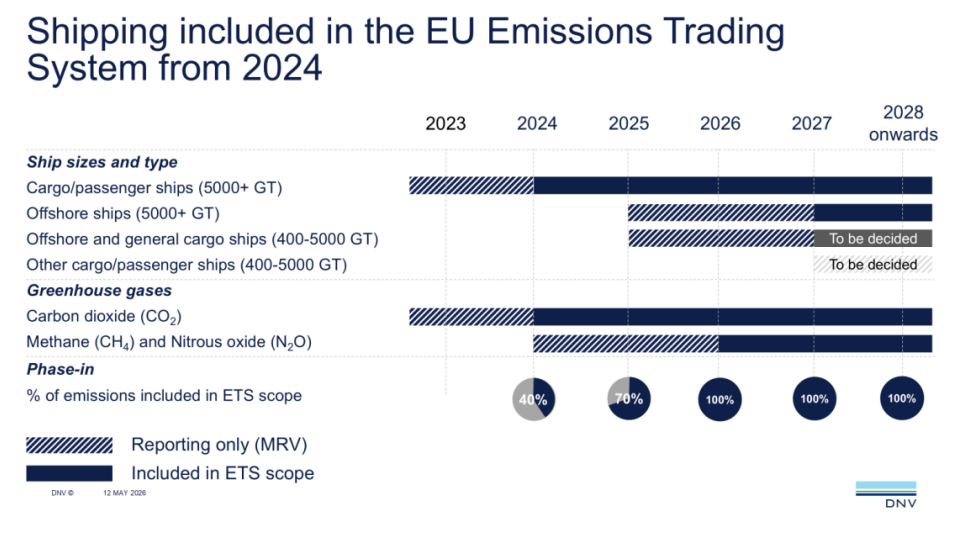
Answer:All greenhouse gases are required to be monitored and reported under the EU MRV and EU ETS frameworks from the 2026 reporting period onwards. The timeline below outlines the reporting periods from which each greenhouse gas became subject to monitoring and reporting requirements.
|
| Answer: |
|---|
Answer:No. According to FAQ 11 on the EMSA homepage: a ship that has not carried out any EEA-related voyages during a whole reporting period (calendar year) will not be required to submit a verified emissions report under the terms of Article 11 of the MRV regulation. The ship will not be required by member states’ authorities to have a Document of Compliance (DoC) on board as a proof of compliance for that specific reporting period, when calling at EEA ports between 30 June of the following year and 29 June of the year after. |
| Answer: |
|---|
Answer:Upon confirmation with Regulatory Bodies, in case of a vessel’s scrapping during the year, an Emissions Report is necessary in case the ship’s activities fell into the scope of the regulation. The company in charge of the ship before the scrapping yard should submit the report as soon as possible, before the applicable deadlines for ERs. |
| Answer: |
|---|
Answer:A vessel may be removed from a Company's fleet in THETIS-MRV once the MRV Emissions Report has been submitted to Commission. The reported data will remain available in THETIS-MRV after the vessel is removed. However, access to the associated documentation may become restricted. For this reason, it is recommended to download any documents that may be required in the future before removing the vessel from the fleet. Please also note that removing a vessel from the fleet in THETIS-MRV does not prevent the Company from adding the vessel for Company Emissions Report (CER) purposes, where applicable. |
| Answer: |
|---|
Answer:According to the proper workflow, the reporting periods should be uploaded in chronological order. Where a reporting year is divided into two reporting periods, the Company responsible for the latter period will not be able to complete its reporting obligations until the first reporting period has been successfully verified and completed. For this reason, Companies are strongly discouraged from manually creating additional reporting periods in THETIS-MRV, as reporting data should be uploaded using the verified XML files. If the vessel needs to be released to the previous Company so that it can complete its reporting and verification obligations, the current Company should first ensure that all data relating to its own reporting period has been removed from the vessel's record. In more complex scenarios, such as when a reporting year is divided into more than two reporting periods, or where there is uncertainty regarding the appropriate workflow, Companies are advised to contact DNV directly for guidance to ensure a successful reporting and verification process. |
| Answer: |
|---|
Answer:According to Article 9(6b) of Commission Delegated Regulation (EU) 2019/1122, when none of the ships under the responsibility of a shipping company have carried out activities within the ETS scope in a reporting year, an open MOHA should be set to the “Excluded” status. It is a responsibility of the national administrator in the Union Registry to grant a MOHA the “Excluded” status, upon instruction of the relevant administering authority. The administering authority may, if necessary, request the shipping company to provide a verified zero-company-level Emissions Report or other relevant evidence to ascertain whether relevant activities were carried out within the ETS scope. To facilitate the process, it is good practice for a shipping company to reach out to the relevant administering authority as soon as it becomes aware that it did not have any activities within the ETS scope in a reporting year before the annual deadline to report verified emissions (i.e. 31 March). Upon setting the MOHA status to “Excluded”, the shipping company will not be required to enter any emissions value in the MOHA for that reporting year. If the shipping company does not intend to perform voyages from/to EEA ports in the future, it can consider closing the MOHA. |
| Answer: |
|---|
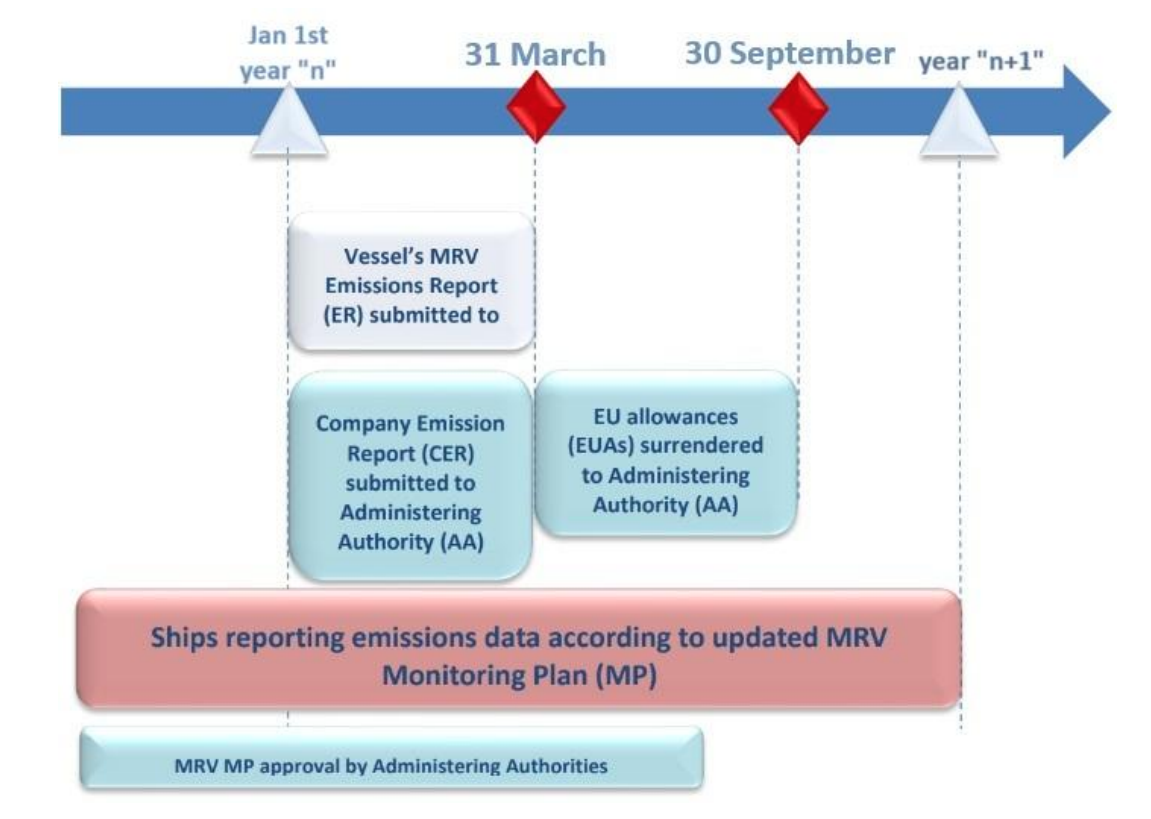
Answer:From 2025, companies shall submit by 31 March of each year to the administering authority the aggregated emissions data at company level that cover the emissions in the reporting period of the previous year. The timeline below outlines the MRV/ETS requirements.
DNV recommends to:
The Company Emissions Report, after submission to verifier in THETIS-MRV, must also be submitted for verification through the DNV Fleet Status Portal (by uploading the XML file exported from THETIS-MRV). Once verified, the CER changes its status in THETIS-MRV to “Verified as satisfactory”. The Report may then be submitted to the Administering Authority through THETIS-MRV. |
| Answer: |
|---|
Answer:To revise a verified Company Emissions Report (CER), you should contact us directly via DATE or through your Customer Success Expert to align the process. Please DO NOT delete the CER and create a new CER when report is being revised as it will interfere with the workflow. |
| Answer: |
|---|
Answer:According to Article 4 of the implementing regulation 2016/1927, the verifiers shall use the electronic version of the template available in THETIS-MRV when issuing the DoC. The electronic template does not require adding any signature other that the name of the verifier. The document available in THETIS should be considered valid by PSC. |
| Answer: |
|---|
Answer:This is covered by the functionality in THETIS; hence, there is no need for separate information to the flag administration. Administering Authorities have access to THETIS and can also choose to receive alerts if considered necessary. |
| Answer: |
|---|
Answer:No, the DoC is issued stating the vessel’s name and flag at the end of the reporting period and does not need to be revised if those change. |