Carbon Insetting - Book and claim verification
Supporting the strategic approach to decarbonizing maritime transport
Get independent verification of your book and claim systems to ensure credible, traceable and transparent environmental claims. For shipping companies, cargo owners, fuel suppliers or logistics providers seeking trusted decarbonization solutions.
Journey continues on Veracity, DNV's trusted digital platform.
Carbon Insetting - Book and claim verification
The time is today
Freight transportation is a notable contributor to global greenhouse gas (GHG) emissions, with shipping playing a significant role on a well-to-wake basis. This makes maritime transport a critical and hard to abate sector in the global transition towards decarbonization.
To reduce these emissions, shipping companies and cargo owners are increasingly turning to mechanisms that go beyong the physical supply chain.
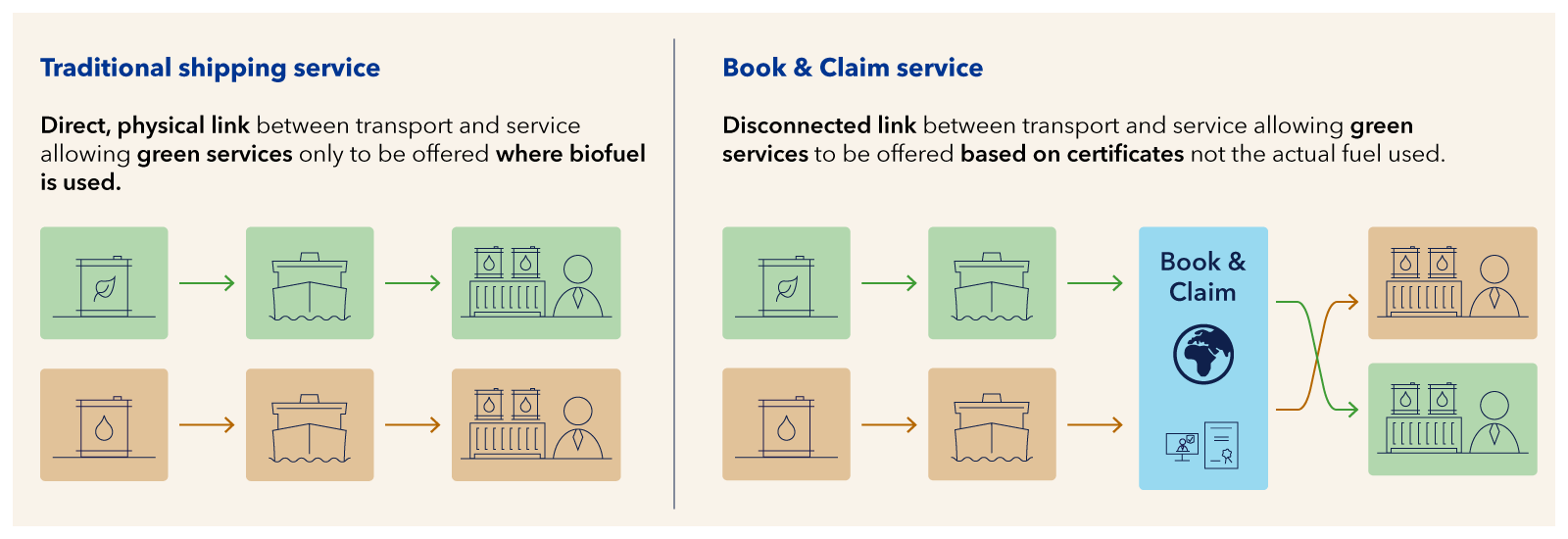
Through a book and claim approach, the environmental benefits of sustainable fuels can be separated from the physical transport service and allocated via certificates. This allows organizations to support decarbonization even when direct access to low-carbon fuels is limited.
Rely on independent verification from DNV Maritime Advisory
As book and claim markets mature, stakeholders need assurance that environmental attributes are accurately tracked, managed and allocated. Independent verification plays a key role in building confidence in both the system and the resulting environmental claims.
DNV provides tailored verification services covering the full process – from emission baseline definition and system validation to fuel verification, certificate allocation and issuance of independent statements. Our independent assurance helps strengthen system integrity and supports the adoption of low-carbon transport solutions.
Benefits of using DNV's book and claim verification

Independent credibility and trust
You get impartial third-party verification, giving your customers, regulators and other stakeholders confidence that your book and claim system, as well as the related environmental claims, is robust, transparent and credible.
Robust chain of custody and traceability
You have traceability and a reduced risk of double counting thanks to our verification of the governance, transaction processes, and chain-of-custody mechanisms behind environmental attributes.

Alignment with recognized standards and frameworks
You can rest assured that you have consistent implantation and market acceptance, as we assess book and claim systems against relevant international standards and industry frameworks.
Stronger sustainability reporting and claims
Your verified book and claim system generates reliable data and evidence that can strengthen ESG reporting, customer communications and decarbonization strategies while improving stakeholder confidence.
DNV's approach to book and claim verification
FAQs
-
Book and claim is a chain-of-custody model that allows the environmental attributes of low-carbon fuels or transport services to be transferred separately from the physical fuel flow. This enables organizations to support and claim verified emissions reductions even when the sustainable fuel is not physically used within their own transport operation.
-
Book and claim is generally based on verified environmental attributes generated within the transport or fuel value chain, whereas traditional carbon offsets are generated outside the value chain. Book and claim is designed to support direct demand for lower-carbon fuels and transport services while maintaining traceability of the associated environmental benefits.
-
Depending on the scope, DNV may verify:
- Book and claim methodologies
- Chain-of-custody models
- Environmental attribute registries and ledgers
- Fuel sustainability documentation
- Emission reduction calculations
- Allocation methodologies
- Transaction records
- Retirement mechanisms
- Governance and control systems
The objective is to ensure transparency, traceability and integrity throughout the system.
-
Independent verification increases confidence that environmental claims are credible, transparent, traceable and protected against double counting.
-
Yes. DNV can perform ex-ante assessments, methodology reviews, chain-of-custody evaluations and gap analyses to identify potential risks and improvement opportunities before the system becomes operational.
-
The assessment can be aligned with relevant international standards and industry frameworks, including:
- ISO 22095 (Chain of Custody)
- ISO 14083 (Transport GHG emissions)
- Smart Freight Centre Market-Based Measures Framework
- RED II / RED III requirements
- ISCC and RSB sustainability systems
The applicable framework depends on the specific use case and market.
-
Depending on the application, verification may involve:
- Biofuels
- Renewable diesel (HVO)
- Sustainable Aviation Fuel (SAF)
- Biomethane
- Renewable and low-carbon hydrogen
- Hydrogen derivatives
- Renewable energy attributes and certificates
DNV combines expertise from both transport decarbonization and energy systems to assess these solutions.
-
Book and claim systems sit at the intersection of transport and energy markets. DNV can leverage expertise from our Energy Systems specialists in areas such as:
- Renewable fuels and biofuels
- Hydrogen and RFNBOs
- Sustainability certification systems
- Renewable energy certificates
- Energy attribute tracking systems
- Energy supply chain assurance
This multidisciplinary approach helps clients develop robust and future-ready solutions.
-
No. While DNV Maritime is a leading verifier in maritime decarbonization, DNV Maritime Advisory is an approved verifier according to the Smart Freight Centre scheme and holds expertise across multiple transport sectors including maritime, road freight, logistics, fuel production, aviation, and emerging hydrogen value chains.
Contact us