UK ETS site visits: key steps towards compliance

UK ETS verification includes a site visit as part of the annual verification process. Maritime operators should prepare early on by ensuring their Emissions Monitoring Plan (EMP) is approved and by assembling the documentation needed to support verification of the Annual Emissions Report (AER). More about the UK ETS site visit requirements in this news.
Information for: Ship owners and managers.
Site visits under the UK ETS
Site visits are an important part of the annual verification of the AER. Without a site visit, the verifier is unable to verify the AER. The location and scope of the visit are determined by the verifier’s risk analysis and will focus on the management and monitoring of relevant emissions data. A site visit does not necessarily require attendance on every ship or at every location. DNV’s default approch is to visit the ISM Company.
An in-person site visit should normally be expected. A virtual site visit may be conducted only where the verifier concludes that it can provide reasonable assurance and the maritime operator obtains approval from the regulator. The operator’s application for a virtual site visit must include the information provided by the verifier, for instance on the outcome of the risk analysis, and be submitted by 28 February in the subsequent year. For example, where emissions are reported for the 2027 year, the application for a virtual site visit must be submitted no later than 28 February 2028.
Timeline and deadlines
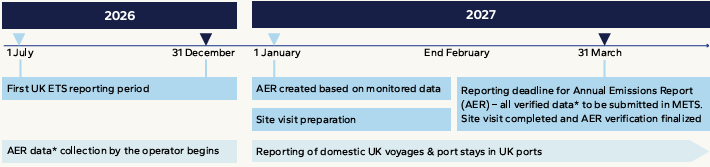
The site visit is a prerequisite for finalizing verification of the AER. As the AER must be verified by 31 March 2027 for the first UK ETS reporting period (1 July to 31 December 2026), DNV recommends completing the site visit no later than the end of February 2027. A summary of the UK ETS timeline and deadlines:
For future reporting periods, DNV recommends aligning UK ETS site visits with other scheduled verification activities, such as EU MRV, FuelEU Maritime and relevant ISM company audits, where possible to reduce duplication and streamline preparations.
Prepare required documentation
Operators should prepare the documentation needed for the verification, including:
- The approved Emissions Monitoring Plan (EMP)
- The verifier’s risk analysis
- Data-flow activities and control procedures
- The applicable regulator’s approval for a virtual site visit
- A complete list of vessels covered by the maritime operator’s AER
- Verification report from the previous year (if verified by another verifier)*
The EMP is maintained at company level and describes the monitoring methodology, vessels under the operator’s responsibility and relevant emissions sources. Ship-level emissions are aggregated into one company-level AER, which must be verified before submission to the regulator.
Ship-level and company-level verification
Our current verification approach requires all ship-level emissions reports of the operator’s fleet to be verified by DNV. Supporting evidence documents, including applicable cargo samples, Bunker Delivery Notes (BDN) and Proofs of Sustainability (POS), should be provided through DNV’s OVD Admin in My Services on Veracity.
The company-level AER will be created in our My Services portal based on the maritime operator’s fleet. Verification can only be completed once the required site visit has been carried out, the EMP has been approved, and the vessel list and underlying ship-level information have been provided.
We are further developing our combined company-level and ship-level verification approach for the UK ETS. Further practical information on the process and required customer actions will be communicated as the approach is finalized.
Recommendations
- Plan your UK ETS site visit early on and, whenever possible, combine it with an EU MRV and/or FuelEU Maritime site visit. For more information, see the DNV Technical & Regulatory News referenced below.
- Ensure your Emissions Monitoring Plan (EMP) is approved.
- Prepare the required documentation, including your risk assessment, data-flow activities and relevant procedures.
- Engage DNV early on to support site visit planning and annual verification activities.
References
- UK ETS for maritime – UK authorities
- DNV Technical & Regulatory News:
- Newsletters from UK authorities (Issue 8 and Issue 9)
- Statutory instrument: The Greenhouse Gas Emissions Trading Scheme (Amendment) – Extension to Maritime Activities
*Applicable from the second reporting period onwards, as no previousyear verification report exists for the first UK ETS reporting year
