The UK ETS expands to maritime from 1 July 2026

The UK Emissions Trading Scheme (ETS) is rapidly evolving, shaping how industries price and manage greenhouse gas emissions as the UK moves toward net-zero. As the scheme expands and its carbon market strengthens, understanding its key mechanisms and implications is becoming increasingly important for the maritime sector.
Information for: Ship owners and managers.
UK ETS implementation timeline
The UK ETS expands to maritime activities from 1 July 2026, and the implementation timeline for the UK ETS in shipping introduces several steps that operators need to follow to be compliant. One of the first requirements is the submission of an Emissions Monitoring Plan (EMP) by the ship operator to the regulator (an equivalent to the EU ETS administering authority). An EMP is submitted per company (operator) and includes relevant data such as a list of ships, their particulars, emission sources, etc. The EMP does not undergo assessment by a verifier but instead is subject to approval by the regulator.
Operators must use an independent verifier accredited by UKAS, such as DNV, to verify their Annual Emissions Report (AER), a company-level report. Operators must submit their AER by 31 March each year and must surrender the number of emissions allowances by 30 April. The deadline to surrender allowances for the first scheme year (1 July to 31 December 2026) will be 30 April 2028. A standard reporting year runs from 1 January to 31 December, while in 2026, only half of the year is subject to reporting (from 1 July, 2026). A summary of the timeline is illustrated in the following figure: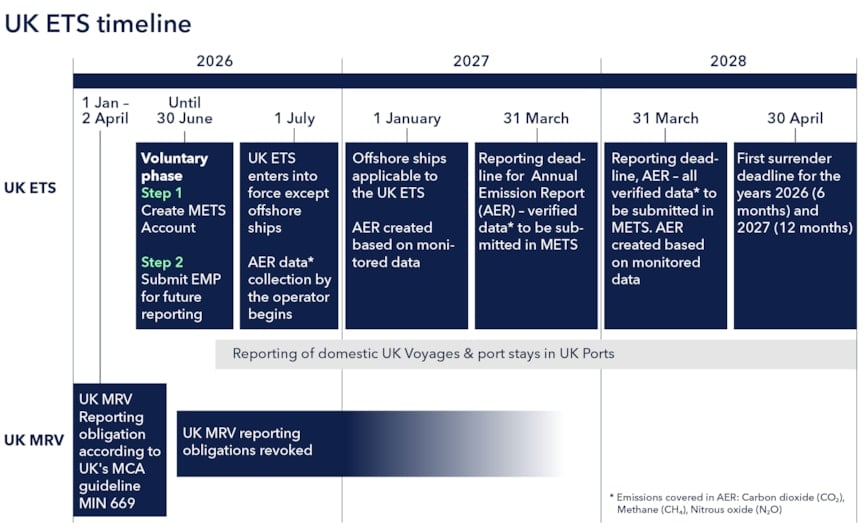
Further, Appendix 1 provides an annual wheel illustration of the UK ETS process.
UK ETS scope and compliance cycle
As of 1 July 2026, the UK ETS applies to cargo and passenger vessels of 5,000 GT and above, with the inclusion of offshore ships delayed until 1 January 2027. The scheme covers emissions from domestic voyages between UK ports. A domestic voyage includes voyages from one UK port to another, as well as voyages that start and end at the same UK port. In addition, emissions generated during ports of call are within scope, including time spent at berth, whether moored or anchored, at UK ports and offshore installations.
Ship operators are required to monitor and report emissions occurring in UK ports and on domestic UK voyages. As a result, emissions from ports of call on international routes are also captured under the UK ETS. The greenhouse gases covered are aligned with those under the EU ETS and include emissions from combustion and slippage of carbon dioxide (CO₂), methane (CH₄) and nitrous oxide (N₂O), calculated on a tank‑to‑wake basis. Methane and nitrous oxide are reported using IPCC AR5 global warming potential values (CH₄ = 28, N₂O = 265).
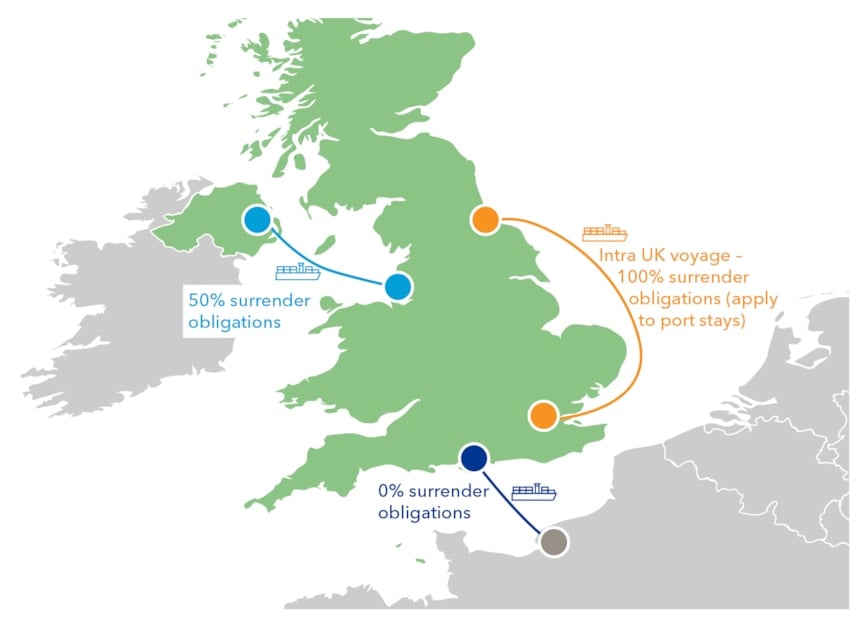
Exemptions apply to ships engaged in government non‑commercial maritime activities, fish‑catching and fish‑processing vessels, and ships operating Scottish ferry services. In contrast to the UK MRV framework (revoked as of 2 April 2026), voyages between the UK and ports outside the EEA, including those in UK Overseas Territories and Crown Dependencies, are not included in the UK ETS, as they are not considered domestic voyages. In addition, a 50% deduction applies to the UK ETS surrender obligation for voyages between Northern Ireland and Great Britain. Other exemptions are stated in the regulations.
The following figure illustrates the principles for a voyage between Northern Ireland and Great Britain, where the surrender obligation, is 50%, while port stays in both Northern Ireland and Great Britain are subject to a 100% surrender obligation. For a voyage between France and Great Britain, there is no (0%) surrender obligation for the voyage itself; however, the port stay in Great Britain remains subject to a 100% surrender obligation.
Responsibility for UK ETS compliance lies with the ship operator, which by default is the registered owner of the ship. Alternatively, responsibility may be delegated to the ISM company, provided there is a legally binding agreement with the registered owner assigning UK ETS compliance obligations. Where this applies, details of the agreement must be made available in METS (Manage your Emissions Trading Scheme). The regulator oversees the operator’s full compliance cycle, including approval of the Emissions Monitoring Plan (EMP), review of annual emissions reporting, and supervision of surrender obligations. Each operator is assigned a regulator based on the operator’s registered address. Each UK nation has its own regulator, while the Environment Agency acts as the default regulator for operators located outside the UK. See also below for more information on the regulator.
As mentioned above, by 30 April each year, operators must surrender a number of UK ETS allowances corresponding to their verified emissions. For the first scheme year, surrender is required by 30 April 2028. Failure to surrender allowances by the deadline results in civil penalties, aligned with those applied across all sectors of the UK ETS.
What are the requirements for UK ETS compliance?
Shipping companies in scope must comply with a set of monitoring, reporting and allowance surrender obligations. Unlike the EU ETS, the UK ETS does not require a Document of Compliance (DoC) on board. Instead, all compliance processes are managed digitally via the METS system, analogue to THETIS-MRV and the UK ETS Trading Registry.
Each operator must prepare and submit for approval an EMP at the company level, in METS (like in the EU MRV scheme, but only one plan needs to be created per company) covering all ships under its responsibility. The EMP describes the monitoring methodology, list of vessels, emission sources and calculation methods. The EMP is not assessed by a verifier before submission to the assigned UK regulator (see below). Only one EMP per company is permitted in METS.
Assignment of regulator
The regulator is determined based on the operator’s registered address:
- England – Environment Agency
- Scotland – Scottish Environment Protection Agency (SEPA)
- Wales – Natural Resources Wales (NRW)
- Northern Ireland – Northern Ireland Environment Agency (NIEA)
- Operators located outside the UK – Environment Agency (default)
For additional information on each regulator, refer to the newsletter linked in "References".
Practical first steps towards UK ETS readiness
Since the UK ETS compliance obligations for maritime shipping apply from 1 July 2026, operators shall already consider preparatory actions during the voluntary onboarding phase (until 30 June 2026) to support efficient implementation.
As all UK ETS processes are handled digitally via METS account. Requests for METS account setup can be submitted using the following form. Operators applying for a METS account will also have a holding account opened for them by the UK Registry Administrator and will receive instruction on how to appoint Authorised Representatives for the Registry account.
During the voluntary phase, the METS platform is already available for familiarization and EMP preparation. In parallel, a dedicated UK ETS functionality is available in DNV’s Fleet Portal (for DNV customers) to support the creation of a company‑level EMP. Under MRV Monitoring Plans, the action “Submit UK EMP to METS” consolidates verified MRV Monitoring Plan data from selected vessels and transfers it to METS, where it is used to draft the operator‑level EMP. To receive DNV data in METS, operators must chose DNV as their data supplier under Accounts > Users and Contacts in the METS platform.
This functionality supports the preparation of a single company‑level EMP, combining all vessels under the operator’s responsibility. Transferred data can be reviewed, acknowledged and supplemented directly in METS as part of the EMP workflow. System‑to‑system data transfer is the standard approach, with XML download intended only for specific cases where data is merged with externally generated files before submission.
Recommendations
- Ensure your organization has access to METS, as all UK ETS submissions and approvals will be handled digitally via this platform. Registration form listed in references below.
- Review the DNV Fleet Portal “Submit UK EMP to METS” feature to understand upcoming data transfer workflows for EMP preparation.
- Begin assembling key inputs for the company-level EMP, including the list of vessels under the responsibility of a company.
- Agree on the responsibility for UK ETS and secure an agreement with the ISM company.
- Identify internal roles for reporting, verification coordination and allowance management ahead of the first compliance cycle.
- Consider when to engage a UKAS accredited verifier (like DNV) to support future annual emissions report verification.
References
- The most recent newsletters from the UK Authorities (Issue 3, Issue 4), previous newsletters can be found in the METS guidance page for registered users
- Link to Managing your Emissions Trading Scheme – METS (requires prior registration here: form)
- Helpful videos from the Department of Energy Security & Net Zero (DESNZ)
- DNV communication on UK ETS - December 2025
- Statutory Instrument: The Greenhouse Gas Emissions Trading Scheme (Amendment) – Extension to Maritime Activities
