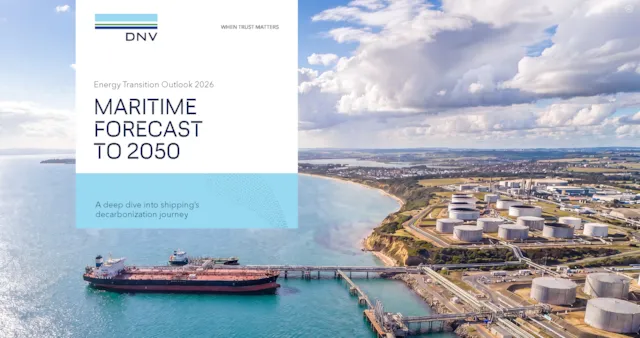
In an uncertain transition, shipowners must adopt fleet strategies which can perform across multiple outcomes.
Download the Maritime Forecast to 2050 to uncover key trends shaping the future of shipping:
Different regulatory futures
The report explores four regulatory scenarios, ranging from NZF adoption to prolonged gridlock, and their implications for shipping.
Stronger regulation leads to more efficiency
Up to 25% lower fleet energy demand by 2050 under stronger global regulatory signals.
Fuel demand depends on regulatory pathways
Low‑GHG fuel demand could reach 22 Mtoe by 2030 and 185 Mtoe by 2050 under stronger regulatory scenarios.
Watch back: Maritime Forecast to 2050 launch event
The programme features a keynote speech from DNV Maritime CEO Cristina Saenz de Santa Maria, a presentation of the report's key findings by lead author Øyvind Sekkesæter, a fireside chat between DNV Group President & CEO Knut Ørbeck-Nilssen and IMO Secretary-General Arsenio Dominguez, and a lively round-table discussion with leading voices from across the maritime industry.
Maritime Forecast to 2050, edition 2026
The 10th edition of Maritime Forecast to 2050 explores how shipping can navigate an increasingly complex and uncertain energy transition. As ships ordered today will operate well beyond 2050, decisions taken now must balance near-term compliance with the long-term flexibility needed to respond to evolving regulations, fuel markets, and technologies.
While global alignment at the International Maritime Organization (IMO) remains uncertain, regional regulation is already shaping real-world decisions on fuel use, operations, and investment. The report examines how different regulatory pathways could influence fuel demand, energy-efficiency uptake, and fleet strategies.
To help stakeholders navigate this uncertainty, it introduces a scenario-based framework that helps shipowners evaluate fleet strategies across multiple futures and identify pathways that balance cost, risk, and flexibility.
Watch the key highlights of the 2026 edition
Tune in and explore how shipping can navigate an increasingly complex and uncertain energy transition. While decarbonization is progressing, uncertainty around regulation and fuel markets is reshaping investment decisions, operational strategies, and fuel choices across the maritime value chain.
Ships ordered today will operate well beyond 2050, but many of the factors shaping their future performance remain uncertain. Regulatory requirements are advancing faster than the fuel, infrastructure, and technological systems needed to support them, making long-term investment decisions increasingly complex. The industry therefore needs greater clarity and alignment among all stakeholders to provide the confidence required for long-term investment. In the meantime, shipowners need strategies that deliver benefits today while remaining resilient across a range of regulatory and market outcomes.
Cristina Saenz de Santa Maria
CEO Maritime
DNV
Different regulatory scenarios will lead to different outcomes
Regulation is a key driver of maritime decarbonization, but uncertainty defines the current moment. The outcome of the IMO NZF negotiations will determine the pace of the energy transition, shaping future demand for low-GHG fuels and the scale of energy-efficiency uptake in the years ahead. The report presents four regulatory scenarios ranging from NZF adoption to prolonged gridlock, reflecting the uncertainty of future policy outcomes and illustrating how different pathways could shape fuel uptake and energy efficiency deployment.
Energy efficiency remains the most immediate decarbonization lever
Energy efficiency delivers fuel and emissions reductions under all scenarios while helping shipowners manage rising fuel costs. Stronger global regulatory signals could accelerate the uptake of energy-efficiency measures, enabling the global fleet to consume up to 25% less energy by 2050 compared to a scenario where regulation is driven by regions. This can be achieved through fleet renewal, operational improvements, and retrofits. A case study of a hydrodynamic measures retrofit on a 5,000 TEU container vessel showed potential annual fuel savings of 16%, with a payback time of around one to four years depending on future fuel prices.
Low-GHG fuel markets depend on demand and scale
The transition to low-GHG fuels depends on stronger regulation-driven demand signals and continued investment in fuel production. Depending on regulatory outcomes, shipping’s demand for low-GHG fuels could range from 4 to 22 Mtoe by 2030 and 33 to 185 Mtoe by 2050. As demand grows across shipping and other sectors, competition for fuels and feedstocks is expected to increase, placing pressure on fuel availability and cost. Based on current project pipelines, a maximum of 270 Mtoe of low‑GHG fuel supply could materialize by 2030, though the true value is likely to be significantly lower due to project delays, cancellations, and other uncertainties.
The fuel choices of tomorrow are still taking shape
By 2030, the fuels shipping can consume will largely be determined by the capabilities of today's fleet and current orderbook. Looking further ahead, the picture becomes much more open. Significant future fleet capacity remains undecided in both 2040 and 2050, meaning the eventual fuel mix will be shaped by investment decisions that have yet to be made. The pace of alternative-fuel uptake will depend on fuel availability, competitiveness, infrastructure development, and the regulatory and commercial incentives that emerge over the coming decades.
Robust strategies must perform across multiple futures
Uncertainty around regulation and fuel markets is creating material risks across operations, costs, and competitiveness, making it essential for shipowners to adopt fleet strategies that perform across multiple regulatory, market, and technology outcomes. The Maritime Forecast to 2050 introduces an updated scenario-based risk management framework to support this, helping shipowners identify fleet strategies that perform across contrasting futures, while highlighting the strong sensitivity of outcomes to regulatory developments and scenario weighting.
Take control of your decarbonization journey
Decarbonizing shipping is becoming increasingly complex, requiring smart decisions and strategic investments in an uncertain transition.
To get practical and start taking control of your decarbonization journey, we suggest focusing on these key areas:
TheMaritime Forecast to 2050 by DNV is a comprehensive maritime report that provides insights and guidance for the maritime industry on its path to decarbonization. It is part of DNV's Energy Transition Outlook series.
The Maritime Forecast to 2050 is published annually and has been released regularly since its first edition in 2017. Each edition provides updated insights and recommendations based on the latest developments in the maritime industry, including regulatory changes, developments in alternative fuel supply, and technological and infrastructural advancements, helping stakeholders stay ahead of global maritime trends.