Energy Transition Outlook 2026

South East Asia

A forecast of the energy transition in the region to 2060, based on the data from DNV's Energy Transition Outlook 2026

Key takeaways
  • Energy security is a central challenge for South East Asia. Countries are looking to diversify energy supply, which is currently dependent on imported oil. 
  • Renewables are growing, with solar set to become the region's largest renewable power source. Renewables are largely meeting new electricity demand rather than displacing coal, which accounts for nearly half of generation today. 
  • Electricity demand is forecast to grow strongly, driven by manufacturing, cooling, data centres, rising incomes, and transport and industry electrification. 
  • The ASEAN Power Grid (APG) remains crucial for the region's transition. Interconnected grids and cross-border electricity trade can reduce costs, improve resilience, and support economic development. 
  • Climate resilience is becoming increasingly important as extreme heat, flooding, storms, and water-related risks affect infrastructure, productivity, energy demand, and economic competitiveness.

This region stretches from Myanmar to Papua New Guinea and includes the Pacific Island States.

South East Asia energy transition at a glace

Metric

2025

2060

Population

708 million

801 million

GDP*

USD 12.2 trillion

USD 29 trillion

GDP/person

USD 17 100

USD 36 200

Energy use

35 EJ

49 EJ

Energy use/person

50 GJ

62 GJ

CO2 emissions**

2.2 Gt

1.4 Gt

CO2 emissions/person

3.1 tonnes

1.7 tonnes

*All GDP figures in the report are based on 2017 purchasing power parity and in 2023 international USD.

**Energy- and process-related CO2 emissions, after carbon capture and storage, before direct air capture.

80 %

Fossil fuels

32 %

GDP growth

3 BN

USD losses

Where South East Asia stands today

  • Fossil fuels supply about 80% of primary energy. Dependence on imports is high, and the impacts of the Iran war have reverberated into the region: for member states in the Association of Southeast Asian Nations (ASEAN) alone, 17% of LNG supply and 55% of crude oil imports originate from the Middle East. In April 2026, ASEAN reported that importing oil and gas at current prices increases import costs by USD 3.36bn
  • Energy Demand continues to grow on the back of GDP growth. Between 2020 and 2026, GDP grew by 25%, manufacturing energy demand increased close to 30% and transport needs by 40%. Electricity demande rose by 40% over the same period in the region.
  • Climate change is intensifying multi-hazard risks, such as Cyclone Senyar killing 1,200 people and affecting 10 million people in Indonesia, Malaysia, and Thailand (WMO, 2026a). The damages in Indonesia alone from this event are estimated at over USD 3bn (Stanway, 2025).

Key agendas shaping South East Asia’s energy transition

  1. Import dependence and chokepoint exposure spur diversification
  • While coal and gas remain dominant in power, renewables are expanding due to their energy security and economic advantages and driven by higher net-zero ambitions.
    However, scaling renewable power requires overcoming technical, financial, and institutional barriers, alongside frameworks for grid integration and infrastructure tailored to local context.
  • Governments continue to prioritize reliable and affordable electricity. This includes coal due to its regional availability, dispatchability, and insurance against supply disruptions. With growing electricity demand and a relatively young coal fleet, the cost of early retirement (before the technical lifespan) is high and would require policy support. Renewable capacity and the interconnections which support its uptake, must be sufficiently established to phase down coal use.
  1. Manufacturing growth in cleantech

  • Amid global supply-chain reconfiguration, countries are pursuing strategic neutrality, attracting manufacturing and mineral investment from competing geopolitical blocs and strengthening local content requirements (DNV, 2026).
  • Cleantech manufacturing is expanding as countries incentivize foreign direct investment and attract manufacturing capacity relocating from China. In solar manufacturing, as an example, ASEAN absorbed most of the USD 57bn committed to overseas Chinese plants, benefiting from its re-export hub status and proximity to Chinese supply chains (Xue and Larsen, 2025).
  1.  Reconciling growth with climate goals  

  • Rapid industrialization and rising energy demand from will make progress towards carbon-neutrality commitments a formidable challenge.
  • The region will be balancing decarbonization with broader socioeconomic objectives. The favourable economics of solar and wind are accelerating renewable deployment and creating opportunities to leapfrog carbon-intensive energy additions to meet new demand.
  • The transition is progressed by growing imports of ​Chinese cleantech equipment (Maguire, 2026) and China’s financing role as a ready banker and builder (Srisuk, 2026). External finance remains critical for coal replacement. The Asian Development Bank’s Energy Transition Mechanism offers an innovative model for early coal retirement, including at the Batangas plant in the Philippines (Fair Finance Asia et el., 2026).

Energy transition indicators

Primary energy consumption (EJ/yr) 

South East Asia’s primary energy mix is dominated by fossil fuels today, accounting for 81%, only slightly higher than the global average. Coal use will peak by 2030 and diminishes slowly to 2060. Oil peaks later, in the 2030s, and only reduces slightly to 2060, although contributing a smaller share to total primary energy. Geothermal more than doubles from 1.2 EJ today to 2.5 EJ in 2060, which is around 5% of the primary energy mix, the largest share of all regions.

Final energy demand (EJ/yr) 

Fossil fuels dominate final energy, led by oil, driven by low levels of electrification in transport. Fossil fuel's share in final energy demand will continue to grow, peaking around 2040, before declining to slightly below today’s levels by 2060. Electricity grows quickly but only overtakes fossil fuel's share by the late 2050s. Electricity will mostly meet new demand, as the population in the region grows and more electrification occurs. 

Electricity generation, including off-grid and BTM (PWh/yr) 

The region's electricity use will be around 4 times as much as today by 2060, and much of this new demand will be met by solar, which will increasingly be co-located with battery storage. Wind will grow to 30% and solar to 43% of electricity generation in 2060. Hydropower is the largest renewable share today, responsible for 16%, but this share will drop to 9% by 2060, but the total capacity will more than double. Nuclear is expected to come online only in the 2050s, supplying around 3% of electricity in 2060. 

CO2 emissions by sector (GtCO2/yr)

Carbon dioxide emissions in South East Asia are expected to peak around 2035. Power is the main sector for decarbonization, reducing emissions around 68%% by 2060, achieved by phasing out coal and the uptake of solar. Transport sees a modest decline, while manufacturing sees only a small decrease due to its hard-to-abate nature, and buildings sees small increase in emissions. 

Key forecast findings: How the energy transition is unfolding 

Energy dependence is the central challenge

The war in Iran has highlighted the risk surrounding South East Asia’s fossil fuel dependence. Many countries are dependent on oil and gas imports, especially from the Middle East, as domestic supply is far outstripped by demand. Prior to the war, South East Asia imported the majority of its crude oil and over 30% of its gas from the Middle East, through the Strait of Hormuz. The region is also dependent on imports of LNG and fertilizer, the latter a key input to both agricultural and manufacturing industries.

Table 1 shows crude oil import dependence in South East Asia. Although each country’s exposure to the conflict in the Middle East varies, all face the threat of higher costs driven by reduced supply and elevated risk premiums from a disrupted supply chain. The energy shock has spurred governments to reconsider their energy mixes, creating an opportunity for intraregional competition and collaboration.

Table 1: SEA nations’ import dependence on crude oil from Strait of Hormuz-adjacent countries, from 2025 (except Vietnam, which is 2024). Source: UN Comtrade

Country

Crude oil import dependence

Indonesia


●

Malaysia

●

Philippines


●

Singapore


●

Thailand


●

Vietnam


●

● Very low: 0–20% ● Low: 21–40% ● Moderate: 41–60% ● High: 61–80% ● Very high: 81–100%

From the twin perspectives of import dependence and energy mix, South East Asian nations are particularly vulnerable to oil and gas supply-chain shocks. The region also faces fiscal challenges in buying imported fossil fuels at spiked prices and shielding domestic consumers through economic measures like subsidies. The IEA (2026) estimates that the fuel import bill, around USD 82bn in 2024, could increase nearly three-fold to USD 245bn in 2035 if no significant policy and energy mix changes are pursued. Fossil fuels directly account for 67% of South East Asia’s final energy demand today, and this jumps to 82% when including electricity generated from fossil sources (Figure 1). We expect that non-fossil sources will meet most new demand from today onwards, and start to replace fossil sources in the 2040s.


Fig 1

Fossil subsidies are popular, but strain budgets 

A range of policies in South East Asia shield consumers from volatility in the global fossil fuel market. The main mechanism, varying by country, is substantial subsidies to consumers. Indonesia and Malaysia maintain broad-based fuel subsidy systems, while Thailand and Vietnam draw from dedicated funds to support subsidies and price caps (Tan, 2026). Even in the Philippines, where the fuel market is largely deregulated, the government can introduce emergency measures to manage fuel price impacts during periods of high market volatility, such as declaring a state of national energy emergency in March 2026 as a direct response to the Strait of Hormuz crisis.  

The Oil Fuel Fund in Thailand, which subsidises domestic fuel prices, recorded a deficit of USD 3.7bn (TBH 133bn) in late 2022, though it later returned to a small surplus. The fund was reportedly spending around USD 20m (TBH 700m) per day to subsidize domestic oil prices in March 2026, falling into another deficit soon afterwards (Reynolds and Iyer, 2026). Similarly, Malaysia’s monthly spending on fuel subsidies was over four times higher immediately after the breakout of the crisis than before (Chong, 2026). 

Policy mechanisms, especially subsidies, help to maintain affordability by protecting consumers from sudden energy price increases, and energy accessibility by reducing the economic burden of energy on low-income groups. However, subsidies are a significant fiscal burden on governments, which elevates fiscal risk when prices surge. Subsidies are also highly visible and widely popular policy with consumers across South East Asia, and are therefore politically challenging to reduce or remove. This confronts governments with difficult decisions when it comes to balancing energy affordability, fiscal resilience, and long-term decarbonization goals.  


The role of gas as a transitional fuel is uncertain, leaving the door open for coal

Natural gas has long been positioned as a transitional fuel for South East Asia, explicitly named as such in the ASEAN Taxonomy (ACMF, 2026). The major advantages being that it is cleaner than coal, and available at scale through secure supply chains from reliable trading partners. In light of events in Iran, gas prices have soared and perceptions of supply security have been dashed, with gas supply chains disrupted with no clear time frame for resolution. Countries with domestic supplies are generally prioritizing domestic demand and competitiveness, adding further uncertainty to the price for net importers. Countries without are looking to diversify imports to avoid single sourcing. The war and subsequent supply-chain shock have prompted all countries in the region to reconsider the size of the role gas plays in their energy mixes today and its role as a transitional fuel, raising questions of completely diversifying away from gas.

Today, gas-fired power accounts for around 30% of total electricity generation, second to coal. We forecast that gas-fired power’s share will peak in 2030, overtaking declining coal, reflecting gas’s role as a coal substitute (Figure 2). The absolute amount of gas-fired electricity will peak around 2040; the declining share is due to large additions of renewable power, primarily solar and solar+storage. . However, we forecast that regional production will decline from the mid-2030s as fields deplete, despite current investment from companies and governments in projects across Indonesia, Malaysia, and Brunei.

Coal still plays a significant role in South East Asia’s energy mix and remains one of the largest barriers to the region’s energy transition. Over half of electricity demand growth in the past ten years has been met by coal-fired power. Despite rapid growth in renewable electricity, coal is still generating the majority of electricity today and will continue to be the main source of electricity generation until 2030, when gas will become dominant.

Although moratoriums on new coal plants are in place (Vietnam, the Philippines, and Malaysia) and coal phase-out is pursued in Vietnam (through the Just Energy Transition Partnership), the Strait of Hormuz crisis has made moving away from coal even more difficult. As oil and gas have become more expensive and riskier to rely on, coal has re-emerged in the energy mix discussion. The crisis has prompted discussions about extending operational lifetimes and delaying retirements of coal-fired generation, as coal is viewed as a potential reliable energy-security buffer that can be sourced domestically or from neighbouring countries like Indonesia. A near-term surge in thermal coal use has been observed across the Asia-Pacific region; with Vietnam, Thailand, and the Philippines running coal fleets harder to offset the difficulty of sourcing enough gas (Rystad Energy, 2026).

Coal in Indonesia

Indonesia has large domestic coal resources, and thus accounts for around 90% of SEA’s production and close to half of demand. Indonesia is the third largest producer behind China and India in the international coal market, and the second largest coal exporter (by value) behind Australia. Although China accounted for 80% of new coal-power plant additions in 2025, Indonesia and India together were responsible for almost all the remaining capacity additions (Lempriere, 2026).

With an average age of around 15 years, Indonesia’s coal plants are among the world’s youngest, and some are expected to remain operational for several decades to come. Many of these coal plants are captive, serving the power needs of industrial facilities like nickel processing and refining. DNV’s 2024 white paper Decarbonizing the Nickel Industry in Indonesia provides an in-depth analysis of how the sector can decarbonize. Phasing out coal plants early poses a significant structural challenge; many parts of Indonesia are not well connected, so installing the necessary power transmission infrastructure is difficult and expensive. Early coal plant phase-out would likely have direct economic impacts, as it would lead to stranded assets which would require financial compensation.

Coal is also a major source of employment and a substantial contributor to several provinces’ local economies. Transitioning away from coal-reliant industries must be done in a fair and responsible way that focuses on people and communities. This may include upskilling or reskilling for workers, diversification plans for local economies, and social protection and income support during transitions.

Electricity demand growing rapidly

Electricity demand is surging, driven by economic growth, digitalization, a growing fintech industry, and an increasingly richer population. This demand is bringing into focus the key ongoing challenge facing the region: balancing economic growth, energy security, and climate and environmental objectives. Manufacturing, data centres, cooling in homes, and electric vehicle (EV) uptake are key growth sectors. While most electricity demand will still be met by fossil fuels in the coming few years, renewables are gaining momentum (Figure 3).

ASEAN’s 2026–2030 Plan of Action for Energy Cooperation (APAEC) targets a 30% renewable energy share in total primary energy supply by 2030, and a 45% renewable electricity share in installed power capacity by 2030. Our forecast shows that South East Asia (which includes all the ASEAN member states) will reach the target for primary energy supply, falling short by around 10%. However, we also find that the power capacity target will be surpassed by 2030, when renewables’ share will be over 50% (Figure 4).

Manufacturing is currently the largest electricity demand sector

South East Asia is emerging as an increasingly important hub for clean technology manufacturing, driven by ambitions of economic growth, creating skilled jobs, and attracting foreign investment. Although China remains the dominant producer of clean technology like solar panels, batteries, and EVs, rising geopolitical tensions, trade restrictions, and supply-chain concerns have encouraged clean technology manufacturers to expand production across South East Asia. Manufacturing (of goods and base materials) is the largest demand segment for electricity today, accounting for around 40% of demand. Electrification of manufacturing is occurring, but fossil sources are slow to phase out (Figure 5).

The region has become a major destination for Chinese clean technology investment. Solar PV manufacturing is already well established in Vietnam, Malaysia, and Thailand. Thailand has developed a strong EV manufacturing base, and Indonesia has emerged as a strategic centre for battery and battery-material production. Indonesia’s battery and battery-material production plans have been partially driven by ambitions to extract more value from their large domestic reserves of nickel. However, building out downstream nickel processing facilities also poses a risk of commodity lock-in, especially when considering advancements of nickel-free battery technology in China (Liang, 2026).

Local manufacturing does not automatically translate into domestic sourcing; South East Asia is a big market for Chinese clean technology exports. Because much of the local clean technology manufacturing is owned or controlled by Chinese firms, production for solar PV tends to be export focused. Batteries and EVs are more geared towards meeting domestic needs due to increasing policy implementation to support manufacturing in the region, like Indonesia’s strict local content requirements.

Cooling demand skyrocketing in a warming region

South East Asia’s already hot and humid climate is heating faster than many other world regions. Rising temperatures and an increasingly richer population are driving surging demand for cooling. Air conditioning unit sales have sky-rocketed, albeit from a very low base, with total stocks anticipated to triple between now and 2035. Ownership is uneven across the region; the regional average ownership rate is 30%, the highest is 80% in Singapore, and the lowest around 5% in Myanmar. This highlights that the upfront cost for an air conditioner remains too high for many low-income earners across the region (IEA, 2026b).

Over half of total electricity demand today comes from buildings, around 15% of which is for cooling. SEA’s demand for cooling is growing faster than in all other ETO regions (Figure 6). Electricity demand is being driven both by the number of users and the efficiency of air conditioning units. All ASEAN member states have minimum energy performance standards for air conditioning in place or under development, but stringency varies and standards are typically less strict than in other Asian countries like Japan and China.

Transport remains oil dependent, but EV uptake is rising

This demand sector represents a huge opportunity for decarbonization in South East Asia via electrification of the road transport fleet. Today, road transport oil demand is 5.8 EJ, around 58% of SEA’s oil demand. We project that road transport oil demand will continue growing as the population grows and becomes wealthier, increasing the demand for passenger vehicles (four-wheelers). We expect oil demand from road transport to rise to a peak of 6.8 EJ in the late 2030s, before declining to around 4 EJ in 2060 as EV uptake becomes more common (Figure 7).  

The total number of vehicles for personal and commercial use will nearly double from around 350 million today to 532 million in 2060. The majority of these vehicles will be two- and three-wheelers, as South East Asia has the second largest fleet of these behind the Indian Subcontinent. Today, the vast majority of two- and three-wheelers are fossil-fuelled. We estimate that by the late 2030s, over 50% of the fleet will be electrified, and that over 90% will be electrified by the mid-2050s. Despite this rapid growth, the share of two- and three-wheelers in the total vehicle fleet drops from 76% today to 60% in 2060, reflecting the income-influenced change in demand patterns for vehicles.

Compared to two- and three-wheelers, passenger and commercial vehicles electrify more slowly. However, the landscape for EV adoption is changing. Purchase prices are declining thanks to imports of low-cost Chinese EVs, and uncertainties around oil supply and increasing oil prices are making EVs more attractive. Thailand and Indonesia are the leading markets for EV adoption in the region. We anticipate that EVs will account for 35% of vehicle sales by 2030 (including two- and three-wheelers), and nearly 70% by 2040, with passenger vehicles electrifying slighter faster than commercial vehicles (Figure 8).

Different mechanisms are used to support EV uptake, with the focus on incentives to reduce the upfront cost of purchasing. Examples include subsidies in Thailand and Singapore, and reduced taxes or duties in Indonesia, Malaysia, the Philippines, and Vietnam. Vietnam has also extended the exemption for registration fees for EVs, supporting uptake largely without direct subsidies (ASEAN Centre for Energy, 2026). Countries across the region have explicit ambitions regarding transport electrification: Indonesia aims for 2 million EVs and 13 million electric two-wheelers by 2030; Vietnam targets net-zero transport by 2050; Thailand plans for only zero-emission car sales by 2035; Singapore aims to phase out ICEV sales by 2040; and Malaysia targets 80% EV sales by 2050 (IEA, 2026b).

Data centres on the rise 

The buildout of data centres is emerging as a new electricity demand segment. The region is now home to over 2,000 data centres, with over 1,000 more in planning and construction phases (Simpson, 2026). Data centres have historically been concentrated in Singapore due to its position as a financial and technology hub, but the buildout is expanding across the region. In recent years, Malaysia – Johor in particular – has emerged as a front-runner in the space, catching the ‘spillover’ investment after Singapore enacted a pause on data centre development from 2019–2022. Advantages like the availability of land, lower land costs, lower electricity prices, and proximity to Singapore have elevated Johor to the fastest-growing data centre market in the region. However, grid-connectivity remains a major bottleneck in Johor and Singapore. Power infrastructure like substations and overhead and subterranean transmission lines have longer lead times than the data centres themselves. Data centre operators are thus shifting to contracting battery storage solutions – often paired with solar – or entering direct bilateral power purchase agreements (PPAs) (Wong, 2026).   

Today, data centre electricity demand in SEA is around 17 TWh/yr, around 4% of global data centre electricity demand. We anticipate that this will increase more than two-and-a-half times by 2030 (48 TWh/yr) and more than three-fold again by 2040 (152 TWh/yr). We expect 2028 to 2032 to be the fastest growing period for electricity demand in SEA, averaging 29% year-on-year growth (Figure 9). Governments in the region have been actively competing for and pursuing investment in the sector, particularly Malaysia, which offers tax incentives. Big companies in the sector – like Microsoft, AWS, and Alibaba Cloud – have already committed billions of dollars in cloud and AI data centre infrastructure investment in the region.

Renewables buildout

Solar driving the transition now, supported by wind

Solar PV new renewable capacity additions, as South East Asia’s tropical geography provides consistent and abundant solar irradiance throughout the year (Figure 10). It is also the cheapest and most easily deployed renewable energy technology. In contrast, wind uptake is slower as there are fewer suitably windy locations in the region, and they tend to be further from population centres, adding transmission costs.

Over the past five years, countries have consistently raised their renewable energy ambitions. Policy support for solar has developed concurrently. Vietnam, historically a leader in the region for renewable capacity, has revised its Power Development Plan VIII (PDP8) to target 46–73 GW of installed solar capacity by 2030. It also updated feed-in tariffs for solar in 2025 and is drafting legislation to promote rooftop solar for self-consumption. Malaysia has a similar approach; its Solar Accelerated Transition Action Programme enables households and businesses to install rooftop solar for self-consumption and to sell surplus back to the grid.

Solar and energy security are increasingly mentioned in the same breath. It is relatively low cost, scalable, decentralized, and independent from global supply chains, making it an attractive option for governments across South East Asia. The physical and regulatory thresholds for installing are lower than most other technologies; it can be installed on rooftops, industrial sites, and co-located on agricultural land. These factors contribute to the quick uptake of solar and solar+storage in residential and commercial settings, in addition to utility-scale capacity (Figure 11). Total solar PV and solar+storage capacity today is around 60 GW, and this will double by 2028. The average doubling time for total solar capacity installations to 2040 is less than four years.

Wind capacity installations will be largely focused on onshore wind until after 2040. Offshore wind policy and planning in the region has been mostly concentrated in Vietnam and the Philippines due to the availability of quality sites. Vietnam’s revised PDP8 raised both onshore and offshore targets, and the government has established dedicated offshore frameworks to ease permitting and investment approval processes. The Philippines launched its first dedicated offshore wind auction in late 2025, offering 3.3 MW capacity to come online in 2028 – 2030. 

Hydropower growing steadily as natural resources are harnessed

Governments in South East Asia have used hydropower as an affordable domestic resource to pursue economic development and meet the accompanying rise in energy demand. It has large potential thanks to the region’s geography and abundance of water resources, especially in places like Sarawak and Borneo (Malaysia and Indonesia). One of the main issues facing projects in Borneo is grid connectivity: the island is not home to main demand or population centres, and the potential hydropower sites are often located in mountainous and remote locations. Connecting the hydropower production from Borneo to the biggest demand and population centres adds significant cost and technical difficulty to potential projects.

Other countries like Vietnam and Lao PDR are considering big hydropower projects but face similar issues with grid connection, as well as environmental and social issues for communities downriver. Issues stemming from hydropower infrastructure in the Vietnamese context include displacement of people and homes, conflicts around water usage, access to land and water for supporting livelihoods, deterioration of ecologies, increased flood risks, and employment implications.

Today, hydropower is the largest non-fossil source and the third-largest source overall in electricity generation in the region, accounting for about 16% of the total. Hydropower’s share of electricity generation varies by country. It is a major source of generation in parts of the Mekong region (Lao PDR and Vietnam) and reaches 75% in Lao PDR (IEA, 2026b). We expect total installed hydropower capacity to more than double from around 60 GW today to nearly 150 GW in 2060. Electricity production from hydropower sources grows around 5% per year between now and 2040, after which capacity additions slow down. The share of total electricity generation by hydropower decreases from around 15% today, due to surging demand which is mostly met by solar and eventually wind capacity (Figure 12).

ASEAN Power Grid

The ASEAN Power Grid (APG) is the leading collaboration initiative to connect electricity of 10 member countries with the aim of fully integrated grid operation by 2045. It aims to support economic development and energy security through effective sharing of renewable resources, thus reducing reliance on fossil fuels for electricity generation. The APG has been characterized by conceptual planning and voluntary participation, meaning that countries benefitted from trust building and technical learnings, but limited coordinated implementation means the APG has remained largely aspirational.

The Lao PDR–Thailand–Malaysia–Singapore Power Integration Project (LTMS-PIP) is the primary cross-border connection, which facilitates the transfer of hydropower electricity from Lao PDR to Singapore via Thailand and Malaysia. Phase 2 of the project is ongoing, allowing Malaysia to supply Singapore with electricity directly. Malaysia held the chairmanship of ASEAN in 2025 and facilitated the endorsement of the APG Enhanced Memorandum of Understanding (MoU) by ASEAN ministers. Compared with a previous understanding, this Enhanced MoU enables a more systematic use of resources to address the policy, regulatory, and technical aspects necessary for actual implementation (ASEAN, 2026b). This has been a catalyst for APG momentum.

The APG has huge benefits: reducing system costs, generation capacity needs, and emissions; and improving security of supply and system resilience.

Subsea cables a physical and regulatory hurdle

Subsea cables will be a particularly valuable component of the APG system, given the region’s geography. ASEAN statements have described subsea cables as a “key building block” of the APG and encouraged quicker completion of the Submarine Power Cable Development Framework. The framework outlines four key priorities: legal and regulatory, technical, commercial, and governance. Subsea cables are one of the major physical constraints limiting the APG today, in addition to the complex cross-border governance and coordination challenges. The region's deep-water passages and high seismic activity further increase engineering complexity and project costs for cross-border transmission infrastructure. Six subsea power transmission projects are in advanced stages of negotiation and planning, but the large gap between these ambitions and the current cross-border flow highlights the multifaceted difficulty of the APG (Huda, 2026).

Financing the APG

Financing the APG will require investment from diverse sources. Existing interconnectors have largely been developed as separate projects on either side of borders, with backing heavily reliant on state-owned utilities and public finance rather than broad private investment (IEA, 2026a). Financing models now must be able to meet the complexity of land and sea cross-border APG projects, which involve different regulatory frameworks, multiple jurisdictions, and uncertain revenue arrangements. Future projects will likely require greater use of blended finance and guarantees: risk-mitigation instruments will be necessary to meet this complexity.

As part of the recent wave of momentum and interest in the APG, the ASEAN Power Grid Financing Initiative (APGF) was launched in October 2025. Participants include the Asian Development Bank, the World Bank Group, and ASEAN, with an initial combined investment of over USD 10bn. The APGF aims to mobilize large-scale financing for cross-border interconnectors, both land and subsea (ASEAN, 2025). Launching the APGF was a significant step towards unlocking much needed financing: ASEAN analysis estimated that USD 764bn investment would be needed to build the transmission and power generation infrastructure needed to realise the APG goal of a fully integrated regional grid by 2045.
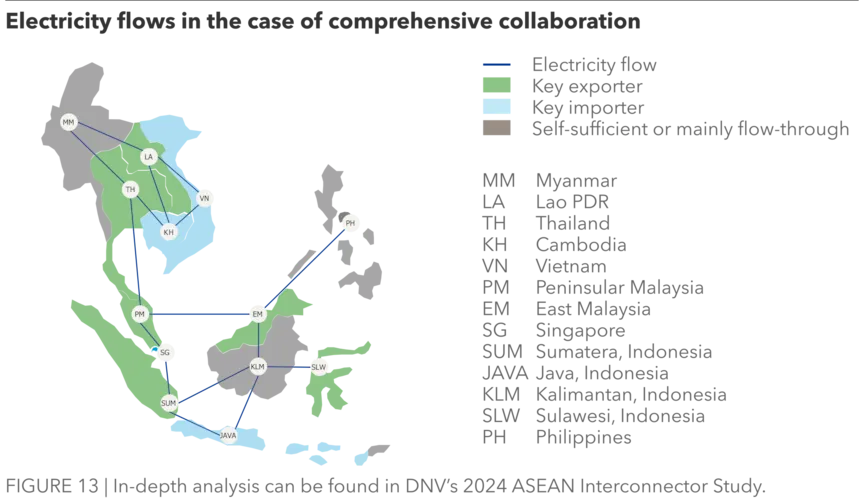
Fig 13

DNV’s ASEAN Interconnector Study

DNV’s 2024 ASEAN Interconnector Study: Taking a Regional Approach to Decarbonization provides an in-depth analysis of the ASEAN power sector. The report identifies that up to USD 800 billion could be saved through comprehensive regional collaboration when compared to individual countries pursuing decarbonization goals without cooperation. Even moderate collaboration could lead to USD 300 billion savings. The significant cost- and space-saving benefits encompass power interconnectors, hydrogen networks, and energy storage technologies and infrastructure. Countries with a diversified supply of solar, wind, and hydropower resources (e.g. Thailand and Lao PDR) will be the main exporters of clean energy within the region.

Climate and emissions

Climate impacts on people and infrastructure are raising risk

Many countries in South East Asia have historically contributed very few emissions compared to wealthy countries which industrialized earlier. But South East Asia bears a disproportionate burden of the resulting climate changes: it is one of the most disaster-prone regions in the world, its geographies and climate rendering it particularly vulnerable.

Extreme heat is a significant concern for South East Asia, while Asia as a whole is warming at twice the global average. Heatwaves are arriving earlier, lasting longer, and becoming more frequent. Temperature records are falling. Myanmar set a new national temperature record of 48.2°C in 2024 and countries like the Philippines, Thailand, and Indonesia are experiencing more instances of the heat index reaching 'dangerous’ and above (Tachev, 2025; WMO, 2025). High temperatures and subsequent heat stress have significant impacts on health, agricultural resources and activity (which contributes a significant portion of South East Asia’s economy), labour and productivity, urban infrastructure, and energy demand (Asian Development Bank, 2026).

Precipitation is another significant concern for the region, which is prone to tropical storms and has large population centres adjacent to coasts and rivers which are at risk of flooding. Climate change is exacerbating the intensity of these storms, increasing the severity of impacts. Typhoon Senyar was responsible for intense rainfall and severe flooding in Thailand, Malaysia, and Indonesia. In Vietnam, prolonged flooding from several events resulted in over 200 deaths and economic losses of nearly USD 2 billion (WMO, 2026b). Typhoon Kalmaegi (Tino) and Super typhoon Fung-Wong struck within days of each other, disrupting millions of people and killing nearly 200, causing over USD 600m in damage, and destroying critical energy infrastructure, which triggered power outages (WEF, 2026).

Given the risk of climate impacts on people and infrastructure, climate resilience and adaptation measures are necessities for the region. A combination of public, private, and global finance is required to adequately prepare and protect energy infrastructure assets against future climate impacts and to safeguard supply chains and competitiveness. Resilience and adaptation measures must also centre people and communities; the social costs of inaction on climate impacts like extreme heat and precipitation have a tangible impact on economic growth, energy demand, and competitiveness (WEF, 2026).

CCS value chains in nascent stage; storage is in focus

CCS deployment at commercial scale remains close to zero in the region. Currently, there is insufficient carbon tax incentive and therefore low value added for implementing CCS, limiting short term buildout. However, there is interest in CCS for gas production. Gas fields in Malaysia and Indonesia are currently highly carbon intensive unless CCS is added, and it is increasingly being mandated in the environmental approval for these projects. One example is the BIGTS Cluster, a shallow-water gas development operated by state-owned oil enterprise Petronas in Malaysia, expected to come online in 2029. Other CCS projects under construction include Tangguh LNG (Indonesia), and Kasawari gas field (Malaysia) which could deliver up to 7 MtCO2/yr capture capacity by 2030 (IEA, 2026b).

Countries are evaluating CCS feasibility, drafting legislation, establishing institutions, and pursuing collaboration across Asia Pacific. Malaysia and Japan are in active discussion regarding building up a CO2-storage value chain, where Japan would export CO2 to Malaysia for storage. Singapore has signed memorandums of understanding with Indonesia, Malaysia, Japan, and Australia to prepare for cross-border CCS value chains, with intention to capture and potentially utilize or export CO2 to neighbouring storage hubs (Global CCS Institute, 2026). For CCS to support emissions reduction long term, it must expand beyond the gas sector and into others like power and cement production.

Emissions reductions primarily come from the power sector

Annual energy-related CO2 emissions from South East Asia are projected to peak around 2035 at 2.5 Gt. From the peak, total emissions reduce on average 2% per year until 2060, reaching 1.4 Gt, which is 43% lower than peak emissions and 35% lower than today’s level (Figure 14). Coal is currently the largest contributor to emissions by source, but will see the biggest reduction of the fossil sources between now and 2060. Emissions from oil will reduce by 2060, largely due to electrification of transport, but will be the largest source of emissions (nearly 40%) by then. Natural gas is expected to contribute about the same emissions in 2060 as today. The biggest sectoral emissions decrease is in power, especially from the replacement of coal-fired generation with gas and renewable sources.

In the context of global climate policy, several countries within South East Asia have net-zero goals. Lao PDR, Cambodia, Vietnam, Malaysia, Singapore, Papua New Guinea, and several Pacific Island states, are all targeting 2050, and Myanmar proposes to do so. Indonesia has pledged a 2060 net-zero target, while Thailand has brought forward its target from 2065 to 2050. The Philippines has no target. Although several of these targets are enshrined in law, comprehensive policy plans outlining the path to net zero are often lacking.

The country pledges and nationally determined contributions (NDCs) imply a regional goal of restraining GHG emission increases to no more than 395% (i.e. a five-fold increase) by 2030 compared to 1990 levels. Discrepancies in targets and forecasts arise due to uncertainties concerning whether targets include non-energy-related CO2 emissions. Our Outlook forecasts energy-related and process-related CO2 emissions (after CCS and direct air capture) increasing 493% (six-fold) between 1990 and 2030. This suggests that countries will fall short of meeting their pledges.

Key policy observations

Note: For extended regional sector-policy summaries, we refer the reader to ETO 2025. For details on ‘how’ policy factors are incorporated into the analysis, please see the main ETO 2026 publication.

Climate 

Indonesia, Malaysia, Singapore, and Thailand submitted quantifiable 2035 targets in updated NDCs. Malaysia, Singapore, Thailand, and Vietnam target net-zero GHGs by 2050, and Indonesia by 2060.  

Power 

ASEAN Plan of Action for Energy Cooperation (APAEC) 2026-2030 has a collective target of at least 45% renewables in installed power capacity by 2030 (ASEAN Centre for Energy, 2025). National renewable targets include Vietnam’s Revised Power Development plan (PDP8), which targets 56-64% of total installed capacity by the 2030s with over 100 GW from solar and wind; the Philippines’ targets of 35% by 2030, 50% by 2040 and more than 50% by 2050 (Energy Transition Partnership et al., 2026). South East Asia is moving away from fixed feed-in tariffs toward competitive auctions, corporate procurement, and renewable portfolio standards. Notably, the Philippines held its first dedicated offshore wind auction in 2025 for 3.3 GW between 2028 and 2030. 

Nuclear is under feasibility assessment in several countries. Advancement of coal phase-down has new collaboration concepts emerging between governments, power sector, and international finance partners.  

Grid investment plans increasingly focus on accommodating variable renewable power and expanding cross-border power exchange and system flexibility, such as the ASEAN Power Grid (APG) project. 

Storage 

With increasing renewables integration, countries prioritize storage, signalling a shift toward dispatchable renewable energy. 

Vietnam’s PDP8 increased the battery energy storage system (BESS) target from ~300 MW to 10–16.3 GW (100 MW currently) and develops market and pricing mechanisms for BESS participation. Indonesia has 10.3 GW storage capacity additions in the newest 10-year electricity supply plan to 2034. Malaysia’s competitive tenders for 2 GW solar capacity (LSSS6) has mandatory inclusion of BESS. Singapore, with the most advanced market for flexibility and grid services, includes improved participation for distributed assets (BESS, EV charging systems, demand response) to support grid resilience.  

Hydrogen  

Hydrogen regulation in South East Asia remains uneven. Although several ASEAN countries have adopted hydrogen strategies and roadmaps, dedicated regulatory frameworks are at varying stages of maturity, and hydrogen-specific legislation remains limited (Bird & Bird, 2026). Singapore leads regional efforts through its hydrogen strategy (2022) focused on imports, ammonia for power and bunkering, and hydrogen-related research under the Low-Carbon Energy Research Funding Initiative.   

CCS  

Policy and regulatory momentum for CCS is accelerating across the 2020s, though carbon prices remain too low for widespread deployment. Key drivers include the European carbon border adjustment mechanism (CBAM) and ambitions to establish an Asia-Pacific CO2 storage hub, with flows expected from Japan and Singapore. Malaysia adopted a CCUS framework in 2025, while Japanese cross-border support has catalysed regional projects and investments. 

Manufacturing 

There is growing decarbonization pressure from national climate commitments and global supply chains.  

Regional policy actions largely emphasize mandatory industrial energy and efficiency management and renewable procurement frameworks, e.g. Vietnam’s Direct Power Purchase Agreement (DPPA) scheme for corporate consumers to purchase renewable power directly from generators. Singapore leads in carbon pricing and research efforts on hydrogen use, green chemicals and fuels. 

Transport 

EV incentives include a variety of tax incentives, reducing EV purchase costs by 10%-40%, depending on country (Aseanncap.org, 2026). Adoption barriers include limited charging infrastructure and high costs. Thailand offers investment incentives to EV manufacturing; Indonesia couples tax incentives with rising local content requirements (40% in 2026 and 80% from 2030 onward). 

Road biofuel blending mandates are rising, including Indonesia (50% biodiesel mid-2026) and Malaysia (15% by mid-2026) with higher blends planned.   

Plans for SAF production and blending ratios in aviation, lean on mandates rather than incentives. Singapore pioneers a mandatory sustainable aviation fuel (SAF) passenger levy starting October 2026, targeting 1% uptake from 2027 and increasing to 3-5% by 2030 through central procurement. 

Buildings 

Building efficiency standards have strengthened, such as Malaysia enforcing a new framework from 2025, but effectiveness varies. Singapore leads with comprehensive regulations, retrofit mandates, low-carbon building target, and district cooling demonstration and deployment. Rooftop solar adoption (commercial and residential) is expanding, supported by net-metering, mandates, and feed-in tariffs.  

Carbon pricing 

Carbon pricing is presently low but assumed to advance across the region, supported by CBAM-related competitiveness concerns. Average regional prices are projected to rise from about USD 10/tCO2 in 2030 to USD 40/tCO2 by 2050.  

Established schemes include Singapore’s carbon tax (announced to reach USD 60/tCO2 by 2030) and Indonesia’s emissions trading system (ETS) (coal power). Vietnam is piloting an ETS (power, industry) and aims for full scale launch in 2029, while Malaysia and Thailand are expected to operationalize systems in the coming years, followed by the Philippines.  

Taxation 

Fossil-fuel support measures, such as negative taxation (i.e. subsidies) in transport, hinder substitution by keeping prices artificially low. In the wake of the Iran war, several countries introduced emergency measures, including cutting or suspending taxes and increasing state budgets for fossil fuel subsidies (IEA, 2026a).  


Contact the author

Henna Narula

Henna Narula

Researcher

Connect with me on LinkedIn

References versions

References versions

ABB (2025). Harnessing Indonesia’s geothermal ‘Ring of Fire’ | ABB.

ACMF – ASEAN Capital Markets Forum (2025). ASEAN Taxonomy for Sustainable Finance Version 4.

ADB – Asian Development Bank (2026). The Unfolding Heat Crisis in Thailand and Southeast Asia: ADB’s Blockchain Initiatives in Asia and the Pacific.

ASEAN – Association of Southeast Asian Nations (2026a). ASEAN Energy Security Insights: Implications of the Middle East Situation.

ASEAN (2026b). ASEAN Energy in 2026.

ASEAN (2025). ADB and World Bank Group Launch the ASEAN Power Grid Financing Initiative with the ASEAN Secretariat and the ASEAN Centre for Energy (ACE).

ASEAN Centre for Energy (2025). ASEAN Plan of Action for Energy Cooperation (APAEC) 2026-2030.

ASEAN NCAP (2026). EV Adoption and Infrastructure: ASEAN EV Tax Incentives Explained: Savings Boost EV Adoption.

Bird & Bird (2026). Hydrogen: Developments in Singapore and around ASEAN.

Chong, R. (2026). Sharp spike in fuel subsidy bill.

Demoral, A. and Setyawati, D. (2026). Currents beneath currents: Overcoming ASEAN’s subsea power cable governance challenges.

DNV (2026). Energy Transition Outlook 2026 ─ A global and regional forecast to 2060.

DNV; FESSIA (2026). Key Findings: Unlocking the Role of Utility-Scale Battery Energy Storage Systems in ASEAN.

Energy Transition Partnership and UNOPS (2026). 2025: Stocktake report Southeast Asia’s energy transition.

Fair Finance Asia and Inclusive Just Energy Transition in the ASEAN (2026). Phasing out coal, phasing in justice: Roadmap for financing responsible regional coal phase-out in Asia.

Global CCS Institute (2026). CCS Quarterly Update Q1 2026.

Guew, J. et al. (2026). Thailand’s Direct PPA pilot for data centres: What has changed since early 2026?.

Huda, M.S. (2026). Subsea power cables as catalysts for the energy transition in Southeast Asia.

IEA (2026a). 2026 Energy Crisis Policy Response Tracker.

IEA (2026b). Financing the ASEAN Power Grid – Analysis.

IEA (2026c). Southeast Asia Energy Outlook 2026.

Kraev, K. (2025). Russia And Vietnam Sign Agreement To Build Ninh Thuan 1 Nuclear Plant.

Lempriere, M. (2026). New coal plants hit ‘10-year’ global high in 2025 – but power output still fell.

Liang, J. (2026). Indonesia’s nickel nationalism falters in the face of China’s tech.

Reynolds, S. and Iyer, R.N. (2026). Iran tensions underscore the urgency of Asia’s renewables pivot for macroeconomic stability.

Rystad Energy (2026). Asia’s coal demand to rise by 100 million tonnes in wake of Middle East conflict.

Simpson, T. (2026). Who is Building AI Data Centres in Southeast Asia in 2026? A Comprehensive Infrastructure Map.

Srisuk, N. (2026). As U.S. Engagement Wavers, Southeast Asia Finds a New Climate Partner in China.

Stanway, D. (2026). Deadly November Asian storms 'supercharged' by climate change, researchers say.

Tachev, V. (2025). The 2025 Heatwave in Southeast Asia: A Window Into the Future.

Tan, S.X. (2026). Elevated oil prices compound Southeast Asia’s fossil fuel subsidy challenge.

WEF – World Economic Forum (2026). The climate adaptation and resilience opportunity in Southeast Asia.

WMO (2026a). State of the Climate in the South-West Pacific 2025.

WMO (2026b). Extreme heat and rainfall, glacier loss and record ocean heat impact Asia in 2025.

WMO (2025). Rising temperatures and extreme weather hit Asia hard.

Wong, A. (2026). Why Malaysia’s growing data centre industry may need solar-plus-BESS.

Xue, X. and Larsen, M. (2025). China’s Green Leap Outward: The rapid scale-up of overseas Chinese clean-tech manufacturing investments.