Transforming wind and solar forecasting in New Zealand
DNV’s central forecasts help Electricity Authority Te Mana Hiko improve accuracy, cut costs and increase efficiency in electricity market
About the customer
The Electricity Authority Te Mana Hiko is New Zealand’s electricity market regulator. It is responsible for governing the country's electricity industry for the long-term benefit of consumers, promoting a reliable supply and efficient operation.
Introduction
New Zealand currently generates around 88% of its electricity from renewable sources, including hydro, geothermal and wind power. The country is actively growing wind and solar and around 80% of new generation over the next 5-10 years is expected to come from these sources. Wind and solar generators selling electricity on New Zealand’s spot market must submit an initial offer, based on power production forecasts, about 36 hours (71 trading periods) ahead. They don’t need to update this offer until 2 hours ‘(4 trading periods) before real time.
The customer challenge
Inaccurate forecasts cost the market millions each year
Until August 2025, generators were responsible for sourcing their own forecasts. However, forecast accuracy was inconsistent, with significant variation between generators – even for near-real-time forecasts.
This inaccuracy makes it difficult for other participants in the energy market to make informed decisions. Overestimates may encourage other generators to produce less, creating supply gaps that need to be filled at short notice by expensive firming generation. Conversely, underestimates could lead to firming generation being brought online unnecessarily.
Accurate central forecasts improve decision-making for lower costs and better market efficiency
After reviewing global approaches, the Electricity Authority decided to implement a hybrid forecasting arrangement to improve forecasting accuracy. Under this model, one central body supplies a forecast for each variable generation site.
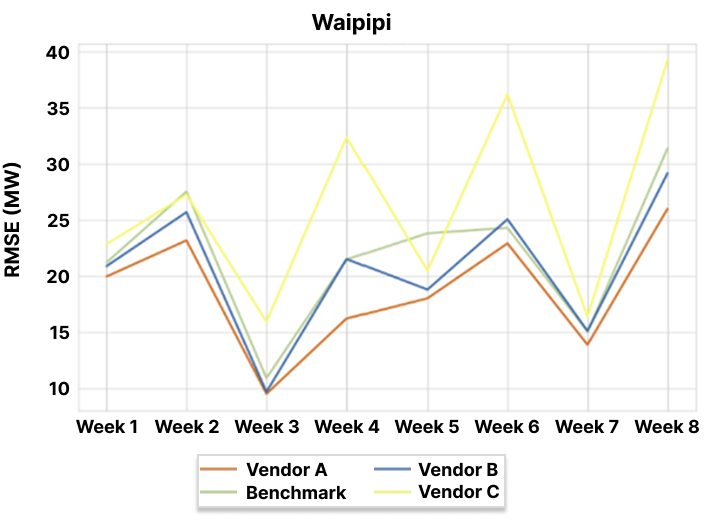
The Authority chose DNV as the central forecast provider following a rigorous competitive selection process which featured an eight-week trial. During the trial, short-listed candidates provided forecasts for 8 forecasting windows based on the same data. Candidates received feedback on their performance halfway through the trial, allowing them to refine their approaches.
Figure 1. DNV (Vendor A) showed consistently lower forecast errors during the selection trial (data from Waipipi wind farm - 1 of 8 sites)
As the selected central forecaster, DNV now provides 7-day-ahead forecasts updated every 30 minutes. These forecasts are generated via DNV's Forecaster team based on data from the system operator (generators may also use their own forecasts provided they meet minimum performance standards). In its first five months, the new arrangement has significantly improved forecast accuracy, with solar root-mean-square error (RMSE) less than half of the previous year and wind bias almost zero.
Impact
Significant improvement in forecast accuracy
Solar and wind generators can maximize asset performance and returns
Other market participants have the lead time they need to plan with confidence
Increased market efficiency and security of supply
Key stats
Forecast errors impacted spot prices by up to NZ$273 million (€139 million) annually
Under-forecasting wind increased spot process by average of NZ$ 6.90 (€3.50) per MWh
Solar RMSE cut by 58% (15.36% to 6.38%)
Wind mean bias error of just -0.2%
DNV’s team and technology demonstrated real agility during the trial. We’re confident the new hybrid forecasting model, with DNV as the centralised forecaster, will improve variable generation forecast accuracy and offers – enhancing system reliability and efficiency, and reducing costs for consumers.
Forecaster offers unparalleled accuracy and dependability in energy data, supported by our team of global experts and nearly two decades of experience in power forecasting.
With DNV, your wind farm project is in the safest hands possible. Recognized as the world’s leading technical authority in wind power generation for three decades, all the expertise and know-how of our global team of experts is at your disposal.
SolarFarmer is a reliable and comprehensive desktop software application for solar photovoltaic plants project yield assessment, utilizing DNV's methodology and drawing on extensive operational data to address the challenges of the rapidly expanding solar industry.
The WindFarmer software makes it easy to predict reliable yield results for future wind farms, bringing the world's most validated methodologies to secure the long-term return on investments for your projects.