Aker BP improves incident learning and data quality with Event Learning Taxonomy (CLUE)
Event Learning Taxonomy offers a consistent approach to classifying contributing factors, helping organizations turn incident and near-miss data into actionable insights.
The challenge
Like many organisations, Aker BP wanted to improve the consistency and quality of how incident and near miss data was classified and analysed. Previous approaches had highlighted challenges with usability and data quality, limiting the value of the information available for learning and trend analysis.
The organisation was looking for an approach that would be easier for users to apply consistently while providing meaningful insight into the conditions that influence events.
The solution
Aker BP introduced Event Learning Taxonomy (CLUE) within Synergi Life for two key case types: Near Miss and Incident.
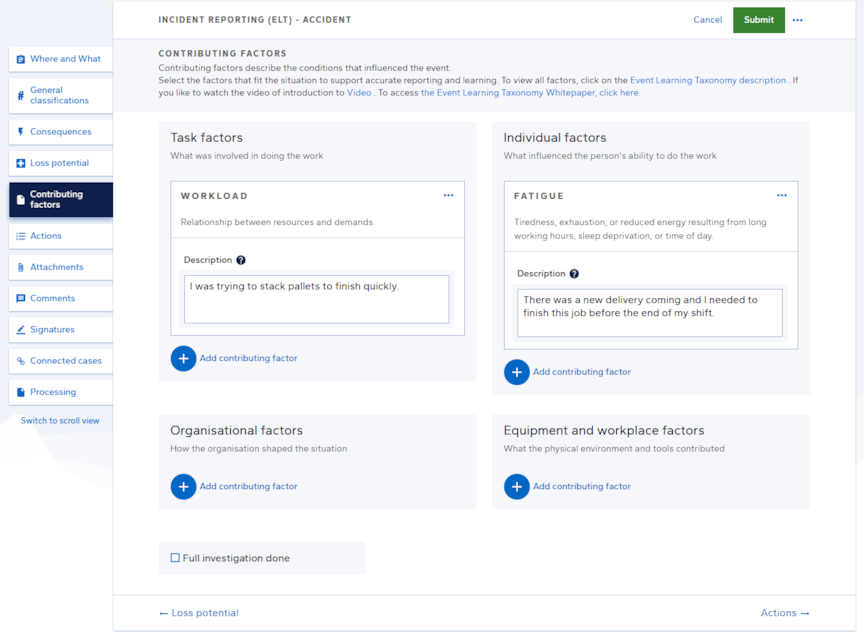
Example of contributing factors in Synergi Life
Rather than making Event Learning Taxonomy mandatory, Aker BP adopted a pragmatic approach designed to encourage adoption while maintaining a positive user experience. Users receive a warning if they attempt to approve or close a case without selecting a contributing factor, but they can proceed if no relevant contributing factor has been identified.
This "soft stop" approach encourages users to consider and document relevant contributing factors while avoiding the frustration that can arise from mandatory fields and helping maintain data quality.
Event Learning Taxonomy provides a simple and practical way to classify contributing factors in incidents and near misses. More consistent classification strengthens our foundation for learning, analysis, and identifying improvement opportunities.
Terje Lauvvik
Aker BP
The results
User adoption through simplicity
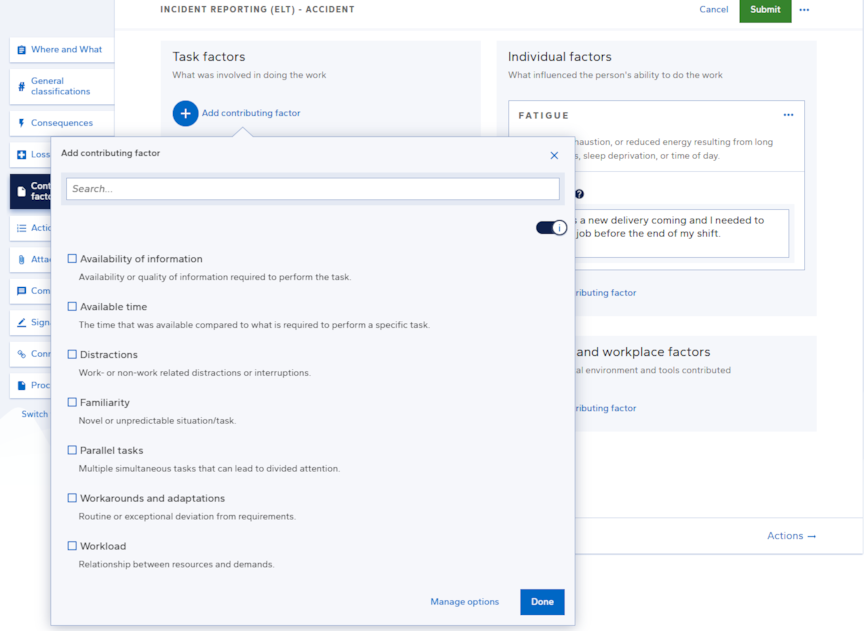
Example of selecting contributing factors in Synergi Life
A key reason Aker BP selected Event Learning Taxonomy was its simplicity. Users find it significantly easier to use than traditional taxonomies while still providing the relevant options needed to classify incidents and near misses effectively.
The organisation values that Event Learning Taxonomy provides the right balance between usability and analytical value. Rather than introducing additional complexity, it offers a streamlined set of contributing factors that supports consistent reporting across the organisation.
Better quality data for learning and analysis
Aker BP's approach has resulted in approximately 65% of incident and near miss cases being assigned a contributing factor, despite the classification not being mandatory.
More importantly, the organisation reports that the quality of the data collected through Event Learning Taxonomy is better than with previous classification methods. This provides a stronger foundation for identifying recurring patterns, analysing contributing factors across events, and identifying potential improvement opportunities.
More targeted improvement efforts
Event Learning Taxonomy also supports the review and follow-up of incidents and near misses.
By focusing attention on the factors that influenced an event, case handlers are provided with a more structured basis for assessing whether improvement actions are needed and what those actions should address. This supports more targeted and proportionate follow-up and helps direct resources towards the conditions with the greatest potential impact on safe and effective operations.
Rather than creating actions for every event, teams can focus on improvements that are directly linked to the contributing factors identified during the review process.
Event Learning Taxonomy is significantly easier to use than our previous taxonomy. It covers our needs, provides relevant options, and gives our users a simple and practical way to classify events.
Terje Lauvvik
Aker BP
Looking ahead
For Aker BP, Event Learning Taxonomy is delivering value in two important ways: supporting structured learning from individual events and providing a more consistent and reliable foundation for analysis across the organisation.
As more data is collected over time, the organisation expects to further strengthen its ability to identify recurring patterns, analyse contributing factors across events, and prioritise improvements that support safer and more effective operations.