New Nordic research funded to tackle the AI safety challenge

Stiftelsen Det Norske Veritas is awarding NOK 96 million to 10 research projects at universities in Norway, Denmark, Sweden and Finland, including research into some of the most pressing questions in the current AI safety debate.

The three AI projects form part of a broader portfolio of 10 projects receiving a total of NOK 96 million. The first funding call attracted 145 applications and cover all three research areas: autonomous systems, critical raw materials, and societal risks.

It is very positive that Stiftelsen Det Norske Veritas is taking clear responsibility for strengthening basic research. If we are to succeed in developing solutions for the future, we need more private actors to invest in research. This will help strengthen our knowledge, innovation and competitiveness in Norway

  • Eileen Fugelsnes
  • Norway`s Minister of Research and Higher Education

Can we trust AI as it becomes more autonomous?  

In recent weeks, the debate around advanced AI has increasingly focused on safety and alignment: whether powerful AI systems will continue to act as intended as they become more capable and autonomous. 

 Can AI systems develop unexpected behaviours? How do we know they are safe before giving them control of critical infrastructure? And could relying on AI gradually weaken the expertise of the humans responsible for supervising them? 

Three of the newly funded projects tackle these questions from different angles. 

 At the University of Oslo, EMERGE will study unexpected behaviour in advanced AI, including what can happen when multiple AI agents interact. The researchers aim to identify warning signs and explore how harmful behaviour could be addressed before it spreads. 

Another project at the Technical University of Denmark will investigate how AI can be assessed before it is allowed to control critical infrastructure, including how it performs when conditions change and when there is not enough evidence to support a safety guarantee. The research will be demonstrated in energy and mobility systems. 

 At Aalto University, PRAXIS will investigate whether relying on AI assistants can gradually erode human expertise, and how AI could instead be designed to strengthen it. The research will be tested in radiology and safety-critical autonomous systems. 

We are in a global race to build the knowledge needed to address some of the defining challenges of our time, from increasingly autonomous AI and access to critical raw materials to emerging societal risks. The strong response to the Foundation’s first funding call reflects the quality and breadth of Nordic research. We have great confidence in the projects selected for funding and their potential to advance our understanding in these critical areas. We look forward to seeing the knowledge they generate

  • Jon Fredrik Baksaas
  • Chair of Stiftelsen Det Norske Veritas

Securing critical resources and resilient societies 

The other seven funded projects focus on critical raw materials and societal risks, two areas of growing importance for security and resilience. 

Research into critical raw materials will look at how resources can be identified and recovered more effectively, how dependence on scarce materials can be reduced, and how Nordic and Greenlandic resources could contribute to Europe’s future supply. 

The societal risk projects will investigate how climate change, digital dependence and interconnected infrastructure can combine to create new and cascading risks across society.

We are proud to support research in areas of great importance to society and that can provide the knowledge needed to meet future challenges. Through the research initiative, our goal is to support established Nordic research environments and projects that can contribute to a safer, more sustainable and resilient society

  • Knut Ørbeck-Nilssen
  • Group President and CEO of DNV and CEO of Stiftelsen Det Norske Veritas

Research funding committee
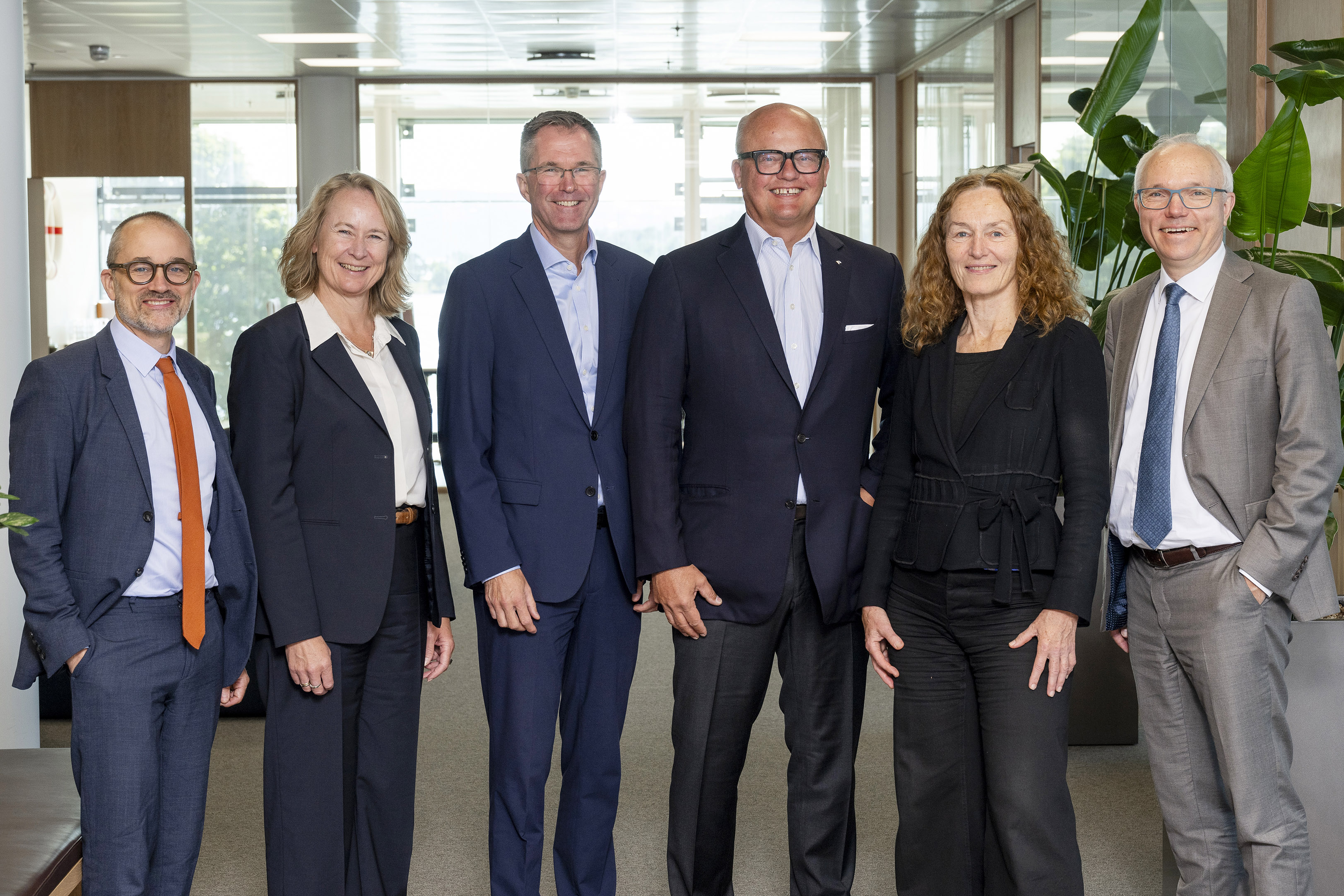
rfc

The Research Funding Committee of Stiftelsen Det Norske Veritas, which assessed the proposals and provided recommendations to the Board on which research projects should receive funding. From left: Joakim Appelquist, Astrid Rusås Kristoffersen, John-Arne Røttingen, Leif Høegh, Camilla Stoltenberg and Jens Lundsgaard.

The 10 funded projects 

Autonomous systems 

EMERGE, University of Oslo 

Project lead: Malcolm Langford 

 Risk and Uncertainty Quantification for Certifiable Autonomous AI Control of Critical Infrastructure, Technical University of Denmark 

Project lead: Filipe Rodrigues 

 PRAXIS: Autonomous AI that Sharpens, Not Erodes, Human Expertise, Aalto University 

Project lead: Jiancheng Yang 


Critical raw materials 

MINBUBBLE, NTNU 

Project lead: Nadia Shardt 

 ReMIND, NTNU 

Project lead: Karl Fabian 

 Unlocking Nordic and Greenlandic Critical Raw Materials through Endogenous Market Modelling, NTNU 

Project lead: Sebastian Zwickl-Bernhard 

 Acid-stable and CRM-lean Electrochemical Materials, Technical University of Denmark  

Project lead: Heine Hansen 


Societal risks 

FLARE: Hybrid Wildfire Risk in Digitalised Landscapes, Technical University of Denmark  

Project lead: Martin Drews 

 Assessing systemic risk to critical infrastructure, Stockholm University 

Project lead: Emmy Wassénius 

 Integrated Cascading Risk Model for Offshore Wind Energy and Shipping under a Changing Climate, Aalto University 

Project lead: Osiris Alejandro