NorMoor: developing reliable offshore mooring design requirements
Over 15 years of industry collaboration on offshore mooring safety
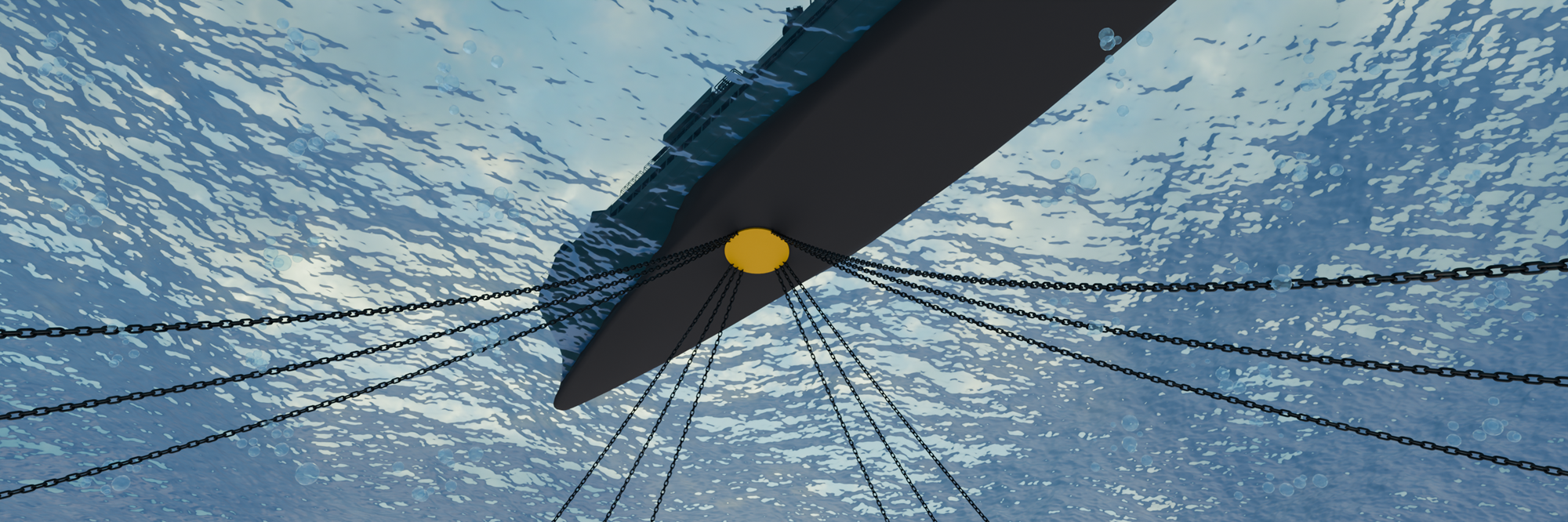
NorMoor is a multi-phase joint industry project (JIP) that develops design requirements for offshore mooring systems based on probabilistic methods. The work covers the ultimate, accidental, and fatigue limit states (phase 1-3) as well as the lifetime extension and reassessment of chains (phase 4). Phases 1-3 are now complete, and phase 4 is in progress and due for completion in June 2027.
The JIP is a global mooring study covering the Gulf of Mexico, Northern Europe and Brazilian waters. It considers areas with hurricanes, winter storms and combinations of wind sea and swell. The objective of the JIP is to propose a mooring design code with a consistent analysis methodology and with safety factors that are in line with that methodology and calibrated at an appropriate target reliability level. It will also provide guidance on chain reassessment and lifetime extension for ageing units.
The industry challenge: ensuring the required safety level for mooring systems
When the NorMoor JIP began in 2011, global mooring design standards, including API, ISO and DNV, were mostly based on work from the late 1990s. The reliability level implied by these standards was not known, and the requirements were often interpreted and applied differently. There was also an assumption that the safety factors used in existing mooring standards were conservative. The JIP set out to use reliability-based calibration to improve the design procedure and assess whether the safety factors could be reduced while maintaining a required and consistent safety level across the cases studied.
As the global fleet of production units continues to age, NorMoor is addressing the next challenge: developing methodologies and chain replacement criteria for reassessment of mooring chains, an area where current regulations provide limited guidance.
A four-phase program covering design methodology and life extension
Phase 1: Ultimate limit state: strength of the intact mooring system under extreme loading
The ultimate limit state (ULS) addresses whether the individual mooring lines in an intact mooring system have adequate strength to withstand tension caused by extreme environmental loading.
Phase 1 investigated the relationship between characteristic line tension calculated according to design standards and the annual extreme value distribution of line tension, and calibrated safety factors for the ultimate limit state (ULS) based on structural reliability analysis, accounting for uncertainty also on the capacity side.
The work covered different oil and gas units, mooring systems, line materials, water depths, environmental conditions, and geographical locations. Alternative design formats were evaluated, including a partial safety factor format with separate factors for pretension and environmental tension.
Phase 2: Accidental limit state: strength of the damaged mooring system under extreme loading
The accidental limit state (ALS) addresses whether the mooring system has adequate strength to withstand extreme environmental loading following the failure of one mooring line.
Phase 2 extended the reliability-based calibration to ALS, considering damaged mooring systems with one line failure. The work also examined empirical line-failure data and rare events and extended the analysis to Brazilian waters.
Combined outcome of Phases 1 and 2: A partial safety factor format with separate safety factors for pretension and environmental tension was recommended for time-domain ULS and ALS design for environmental conditions comparable to Haltenbanken, providing a more consistent reliability level across the analysed cases.
Phase 3: Fatigue limit state: strength of mooring system to withstand cyclic loading
Fatigue limit state (FLS) addresses whether individual mooring lines have adequate strength to withstand cyclic loading.
Phase 3 studied tension-tension fatigue of permanently moored systems, covering analysis methodology, environmental modelling, mean-tension effects, corrosion and chain fatigue capacity, and calibration of the design fatigue factor using structural reliability analysis.
The preferred analysis method uses time-domain simulations with sea states selected from hindcast data by importance sampling, with rainflow counting for fatigue damage. Design fatigue factors of 5 and 8 were proposed for the selected target reliability levels.
Phase 4: Chain reassessment and life extension: criteria for continued use and replacement
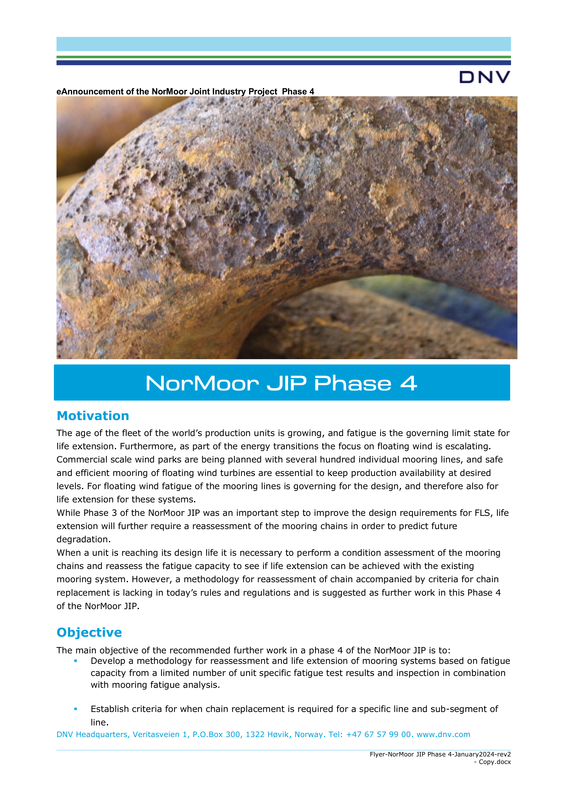
Phase 4 builds on the fatigue work to develop practical methods for chain reassessment and life extension of existing/ageing mooring systems. Inspection, unit-specific fatigue testing and mooring fatigue analysis are combined to assess degradation and establish criteria for when chain replacement is required.
The methodology we are working on includes a two-step reassessment approach, starting with inspection and generic fatigue data for used chain, followed where needed, by fatigue testing of chain from the actual installation.
Key outcomes from NorMoor
- Analysis methodology with associated safety factors calibrated to the required target reliability levels for ULS, ALS and FLS
- Methodologies for chain reassessment and life extension of mooring systems - ongoing
- Technical reports documenting the analyses, results and JIP recommendations.
Value for participants
- Influence the technical work, priorities and decisions through project participation
- Exchange experience and knowledge with operators, suppliers, regulators and other industry participants facing similar challenges
- Insight into detailed analyses, test-data evaluations and project reports
- Contribute knowledge that can support future updates of offshore mooring requirements and guidance.
Relevance for floating offshore wind
Commercial-scale floating wind farms may include several hundred mooring lines. Fatigue performance, degradation modelling and efficient reassessment are therefore important for production availability, integrity management and future life extension. The phase 4 methodology is intended to be applicable to floating offshore wind as well as conventional floating production units.
Project timeline
- 2010: NorMoor pilot study investigated directional line-tension response and reliability
- 201-2017: Phases 1 and 2, ULS and ALS studies, with the consolidated summary report issued updated in 2021
- 2017-2022: Phase 3 on fatigue limit state. The Phase 3 summary report was issued in 2022
- 2023-2027: Phase 4 is ongoing, to be completed in June 2027.
Industry participation
NorMoor has involved operators, engineering and mooring-system companies, component manufacturers and authorities across its phases. Participants in phase 4 are Equinor, Aker BP, Neptune Energy, Vår Energi, Petrobras, BP, Shell, TotalEnergies, ExxonMobil, SBM, MODEC, Cenovus, Vicinay Marine, Norwegian Ocean Industry Authority (Havtil) and Norwegian Maritime Authority (NMA).
Deliverables and further reading
- Summary and Recommendations from Phases 1 and 2 - ULS and ALS
- Summary and Recommendations from Phase 3 - FLS
- NorMoor JIP Phase 4 flyer: reassessment and life extension
- Separate technical reports for the Phase 4 work packages and a comprehensive Phase 4 summary report with JIP recommendations. Phase 4 reports are confidential and available to JIP participants only; some reports are still under preparation.
Want to join the NorMoor community?
New participants are always welcome. Contact Siril Okkenhaug, Project Manager for the NorMoor JIP, to discuss participation and access to project information.
10/12/2026 12:00:00 PM