The growing tail of oil demand destruction
By Sverre Alvik, VP and Energy Transition Outlook director, DNV

Shortly after the US and Israeli strikes on Iran, a consensus formed: it was widely thought that, after a short war and a sharp spike, the cost of a barrel of oil would soon return to near pre-war levels, and demand would resume its previous growth pattern once the Strait of Hormuz reopened.
Most mainstream energy forecasters have followed the lead of the International Energy Agency. Every month, the IEA publishes its Oil Market Report, and as stated in its August report: [global oil] demand is projected to contract by 4.9 mb/d in 2Q26 and 2.8 mb/d in 3Q26, before flipping to growth of 580 kb/d in 4Q26. Until now, we in the DNV Energy Transition Outlook team have also been operating under this presumption, as have leaders in business and government.
It is time to acknowledge that we could all be wrong. Oil prices have not come down. The likelihood of a long conflict seemed slim in late February. Now, in August, not only has the conflict lasted for half a year, but there is also no clear indication that oil exports from the region will be normalized any time soon.
Global oil production, prices, and demand are significantly influenced by the flow of oil through the Strait of Hormuz. Oil producers outside the Gulf can, to some extent, increase their production, and some oil from Saudi Arabia and the UAE can be rerouted to other ports. Global oil inventories are huge and are an important buffer against the shortfall in supply. The Strait of Hormuz is not entirely closed, but it is also not open. Global supply is nevertheless down by more than 5 mb/d (million barrels per day) relative to pre-war levels. Demand is also down by more than 3 mb/d at the time of writing, which is approximately the equivalent of the oil consumption of Japan.
Most of the world’s oil is used in transport. In Asia, we are seeing a significant contraction in road transport demand, while the US is also experiencing moderate demand destruction as higher prices lead to reduced driving. More relevant for long-term impact, higher oil prices following the Hormuz crisis appear to be accelerating the shift to electric vehicles. EV sales in “new markets”, i.e. outside China, Europe, and North America, jumped 97% in July this year compared with the same month last year. Oil used for petrochemical feedstock production, notably in China, has fallen moderately.
Reduced oil supply and elevated prices over a longer period will amplify these trends. For shipping and aviation, realistic large-scale alternatives are few, but leisure aviation demand is somewhat price sensitive. In the road sector, oversupply of batteries and EV production in China will accelerate the phase-in of EVs in many countries, although electricity infrastructure for charging will remain a challenge in some regions. Oil-to-coal switching in chemical production is already happening in some markets, and that may continue. The reopening of Hormuz would remove an important source of market anxiety, but diesel shortages are now as much an inventory problem as a crude supply problem, suggesting that elevated prices could reverberate through freight and industrial markets for months to come.
History shows us the strong link between sustained supply constraints and permanent demand destruction. This happens in all industries and is sometimes referred to as material replacement. The prime example from the energy industry is the structural demand destruction caused by the 1973 and 1979 oil shocks, with permanent changes introduced through fuel-efficiency standards and the replacement of oil-fired power generation. The more recent 2022 gas crisis in Europe has had a similarly structural effect, accelerating the region’s transition away from imported energy.
The spillover of the strikes against Iran into regional conflict is an ongoing illustration of the vulnerability of regional oil and gas transport routes. For every month the conflict lasts, the probability of permanent demand destruction increases. Ongoing attacks and threats by the Iran-backed Houthi militia against the Bab al-Mandab Strait are exacerbating the situation and making a quick normalization even less likely.
We illustrate the implications of a prolonged crisis and ‘higher-for-longer’ oil prices. A short-term price hike leads only to temporary changes in behaviour, such as driving or flying less, or to delayed demand, such as in petrochemical production. If the price hike is sustained, it will create different, structural, and permanent changes.
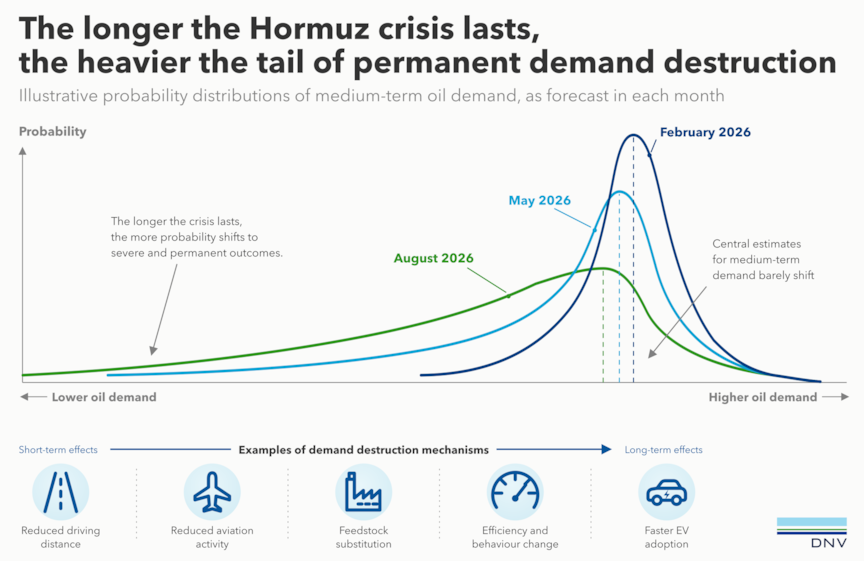
Graph: The growing tail of permanent demand destruction
In our Energy Transition Outlook report, to be published in October, we face the challenging task of quantifying and forecasting the most likely development of future oil supply and demand. At the time of writing, this includes a moderately long crisis in the Middle East. In addition, we will discuss the sensitivities of a much longer crisis and more permanent demand destruction.
Our intention in this article is to challenge the consensus. All nations, organizations, companies, and individuals should factor in an increased risk of a prolonged Hormuz crisis and an increased probability of permanent oil demand destruction.
8/26/2026 3:22:00 PM