Whole system thinking must guide the UK’s energy transition

The UK’s energy transition is accelerating, but our latest Energy Transition Outlook UK (ETO UK) makes one thing clear: progress will not be fast enough to meet the nation’s legally binding climate targets without a fundamental shift in how the system is planned, operated, and governed.
That shift is whole system thinking, the ability to see the energy system as an interconnected ecosystem rather than a set of competing technologies, sectors, or policy priorities.
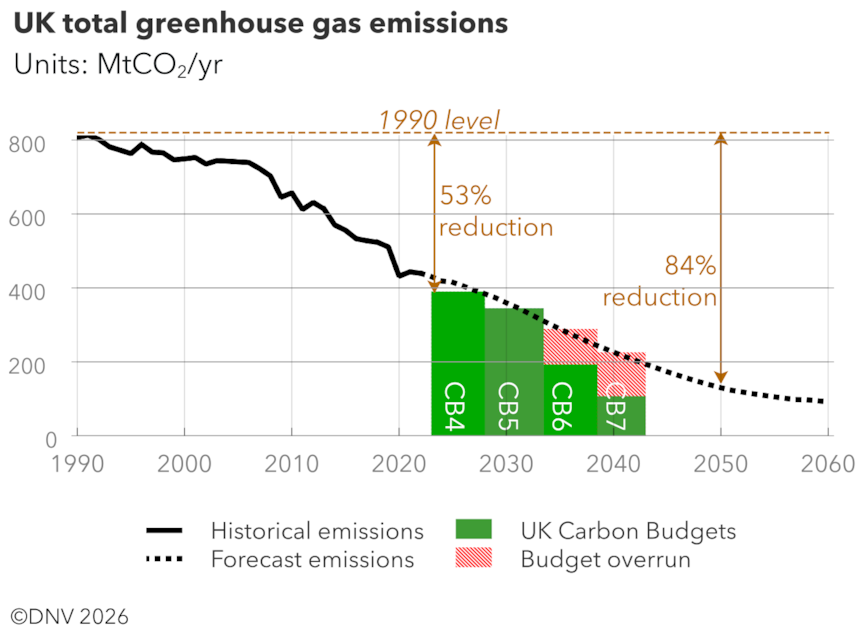
Our 2026 forecast to 2060 shows that despite rapid growth in renewables and electrification, the UK remains off track for Clean Power 2030, the 2035 NDC and the 2050 net zero target.
- In 2030, the UK will still rely on unabated gas-fired generation for 15% of its electricity needs (reduced from 41% in 2023).
- By 2035 the UK will reduce today’s emissions by only 33% over that period, roughly half of what is needed to meet the NDC target.
- The UK’s annual emissions will still amount to 130 MtCO2e in 2050, equivalent to an 84% reduction relative to 1990 levels.
A continuous shift away from fossil fuels
The Outlook shows the UK's primary energy supply will progressively shift away from fossil fuels to low-carbon sources, with fossil fuels reducing from 75% of primary energy today to 15% by 2060. Yet in the near term, fossil fuels still play a significant role, with two thirds of homes using gas boilers in 2035, and more than half of vehicles still fossil fuelled.
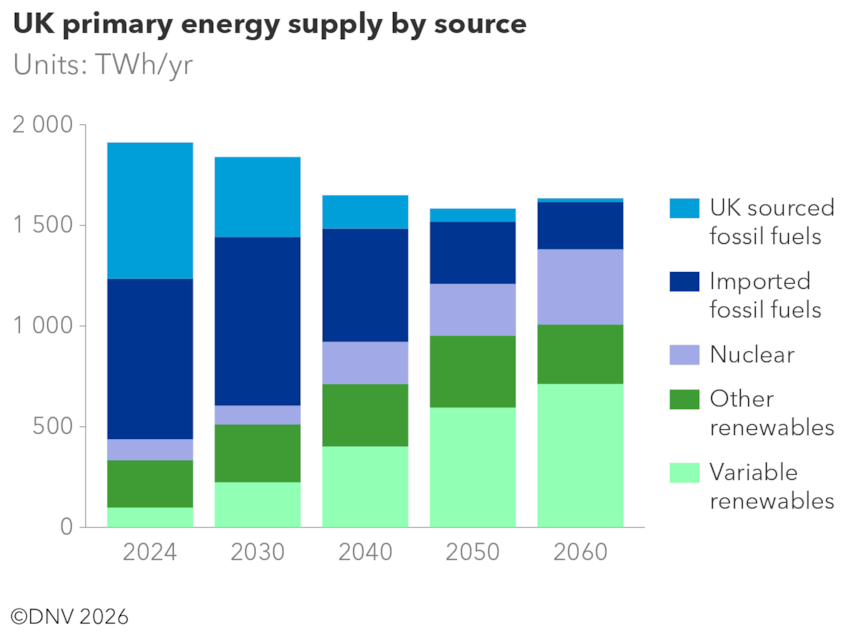
- Fewer fossil fuels make for a more energy-independent UK; today the UK imports roughly 40% of its primary energy needs as fossil fuels, this will reduce to only 15% by 2060 as the system electrifies.
- UK final energy demand will no longer grow in lockstep with GDP and population growth. In fact, energy demand will fall by a quarter by 2050 because of energy efficiency gains linked mainly to electrification.
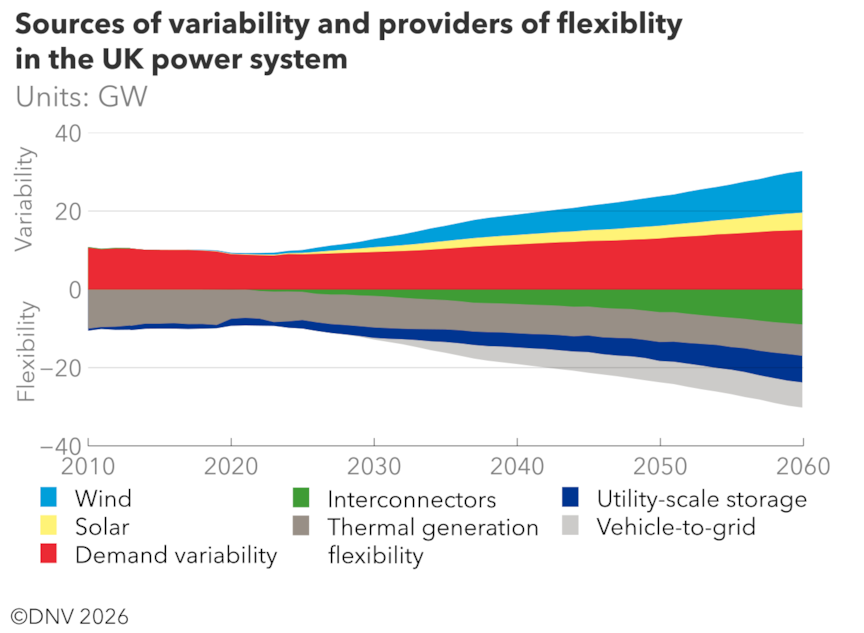
At the same time, the system becomes more dynamic. With a six fold increase in variable renewable capacity over the next 35 years, hourly variability in the electricity system will treble from ±10 GW today to ±30 GW in 2060. This will require a commensurate growth in flexibility to maintain energy security.
As Hari Vamadevan, DNV regional director UK&I, explains, “We cannot afford to champion one element of the energy system over another… all these elements are needed and deeply interconnected and essential to balance the energy system.”
The need for integrated thinking – across every sector
Whole system thinking resonated strongly at the UK ETO launch event in London, where panellists and speakers repeatedly returned to the need for integrated thinking across infrastructure, policy, investment, and public engagement.
For investors, whole system thinking is critical. Eduard Fidler of Allianz Capital Partners highlighted the need for coordinated policy to unlock capital across emerging technologies: “We’re doing well in renewable generation and battery storage but still falling behind in hydrogen and biomethane, and those are clearly areas that are going to be needed, both in the medium-term and long-term… we need policies to support those.”
But the need for integration goes far beyond electricity and hydrogen. Transport, agriculture and waste are also critical to the UK’s pathway.
This was underscored by Patricia Thornley, Chief Scientific Advisor for the UK Department for Transport and Professor at Aston University, who emphasised the scale of untapped potential in bioenergy: “There are two areas where we’re struggling. One is transport - that’s all about fuel - the other is agriculture and waste. Those are exactly the sectors that bioenergy is sorting.”
She noted that bioenergy has the potential to play a far larger role than many realise: “Bio produces about 10 times the transport energy that electricity produces today in this country… and yet we’re not going further and faster.”
And she highlighted the missed opportunities in land use and waste management:
“When we look at land use… where we could be putting in place perennial crops - we’re not doing it. When we look at waste… where we could be using that to produce biomethane - we’re not doing it.”
Patricia’s conclusion was clear: “I don’t believe anymore that the reasons we’re not doing that are technical… the potential is absolutely huge, and we can’t meet net zero in time without accelerating biofuels.”
Patricia’s comments reinforce a central message of the Outlook: the UK cannot meet its climate goals by focusing on electricity alone. Transport fuels, land use, waste, hydrogen, biomethane, CCS, and electrification must all move together - and be planned together.
A system that must move forward, faster, together
Shell’s Christian Gibson echoed this need for realism and coherence, noting the continued role of oil and gas in maintaining resilience during the transition: “Fossil fuels remain a key part of the energy mix, and that’s important to recognise when you think about long term resilience of the UK system.” His message was not about slowing the transition, but about planning it realistically and coherently.
And from DNV’s own experts, the call for integration was clear. Frank Ketelaars, DNV energy transition director, UK&I, captured the challenge succinctly: “Whole system thinking means looking at the system overall, combining the different energy vectors, and making sure we look at all the different policy requirements to make the more difficult things happen.”
As Hari concludes, “We need to move forward, faster, together. Whole system thinking is how we do that - not by choosing between technologies or sectors, but by recognising that the UK’s energy future depends on how well they work together.”


