International hydrogen demand is shaping North America as an early export player
By Pedram Fanailoo and Amit Goyal

Low-carbon hydrogen in North America is entering a more pragmatic phase. DNV’s Energy Transition Outlook: Hydrogen to 2060 shows that long-term demand, both domestic and international, will determine how hydrogen scales across the region.
Demand defines long-term direction
Hydrogen’s long-term role is increasingly shaped by demand for low-carbon molecules and derivatives, rather than expectations of rapid supply expansion.
In North America (US and Canada), demand remains concentrated in refining, ammonia, and chemicals. Future growth will come from sectors where electrification is less viable, including sustainable fuels, industrial feedstocks, and heavy transport.
At the same time, international demand signals are strengthening. Policy frameworks in regions such as Europe and Japan are creating sustained demand for low-carbon hydrogen derivatives including ammonia and synthetic fuels, independent of short-term policy variability in North America.
As a result, hydrogen investment in the region is increasingly influenced by global demand, not domestic ambition alone.
Policy supports supply, but demand remains uncertain
Policy frameworks in North America continue to prioritize production support over demand creation.
- The Inflation Reduction Act supports hydrogen production pathways with practical limitations on green (renewable) hydrogen
- Canada provides investment tax credits
- State-level initiatives are emerging for adoption and blending
However, the implementation of demand-side mechanisms such as mandates, procurement programs, and long-term contracts remain limited. This creates a gap between production incentives and bankable offtake.
In practice, this reinforces reliance on external demand and export markets to underpin investment decisions.
North America positions for export
North America is positioning itself as a competitive supplier of low-carbon “blue” hydrogen and derivatives. Key projects illustrate this direction:
- CF Industries’ Blue Point complex focuses on large-scale ammonia production
- Woodside’s Beaumont project is developing clean ammonia capacity
These developments are enabled by structural advantages:
- Low-cost natural gas as a feedstock for low-carbon hydrogen
- Significant carbon dioxide storage capacity, particularly along the Gulf Coast
- Established industrial infrastructure and export capabilities
Together, these factors position North America as a credible supplier to regions with strong demand and limited domestic production.
Domestic demand is emerging alongside exports
While export markets are a primary driver of hydrogen and sustainable fuel demand, domestic demand is also advancing, supported by voluntary decarbonization efforts.
Companies are beginning to integrate low-carbon hydrogen and its derivatives into their value chains:
- Food and beverage companies, including PepsiCo, are securing low-carbon ammonia to reduce emissions across agricultural supply chains
- Hydrogen is contributing to sustainable aviation fuel production, supporting domestic decarbonization
- Low-carbon methanol is emerging in chemicals and maritime applications, with both domestic use and export potential
- Chevron’s ACES Delta project integrates green hydrogen into power systems
North America hydrogen demand by sector (MtHs/yr)
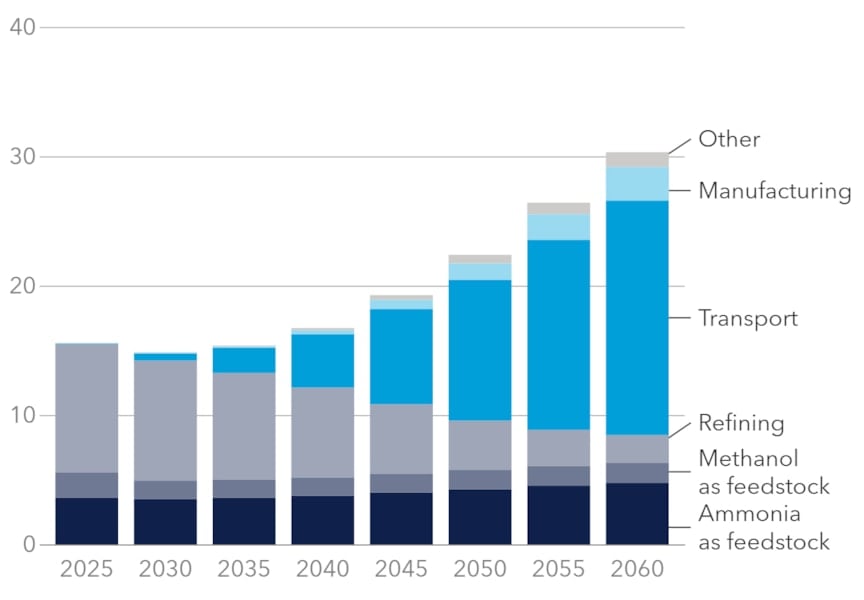
These developments are driven not only by regulation, but by corporate decarbonization strategies and market positioning. Although early, this signals the emergence of commercial demand beyond policy mechanisms, helping to underpin future scale. Industry sectors are preparing for hydrogen and DNV has supported the foundation work for long-term efforts to enable transport through several projects such as feasibility assessments for Enbridge and FortisBC to blend hydrogen into their natural gas infrastructure.
De-risking international value chains
As hydrogen markets develop, projects must meet increasingly complex international requirements. This includes:
- Early-stage validation and product certification of carbon intensity and emissions reductions
- Alignment with evolving regulatory frameworks across regions
- Demonstration of safety and performance at scale
Across North America, DNV supports hydrogen value chains through:
- Independent verification and certification of low-carbon hydrogen and its derivatives.
- Technical advisory across hydrogen and carbon capture and storage systems
- Risk management and safety assurance
Further details are available in our hydrogen services ebook
By supporting alignment with international standards, DNV helps enable market access and strengthen investor confidence.
What comes next for North America
The next phase of hydrogen development in North America will depend on how effectively the region connects supply, demand, and global trade. Key priorities include:
- Strengthening demand through international offtake and domestic industrial adoption
- Expanding infrastructure for carbon dioxide transport, storage, and hydrogen logistics
- Establishing consistent certification frameworks to support global trade
If these elements align, North America is well positioned to contribute both to domestic decarbonization and to the supply of low-carbon fuels to international markets.