Renewable Component Library
Component files you can assess with confidence
Solar yield assessments depend on the component data behind them. The Renewable Component Library gives SolarFarmer users PV module (PAN) and inverter (OND) files curated by DNV engineers as technically accurate on the date recorded in each file's metadata. Use them through the SolarFarmer API or in the SolarFarmer desktop application. The library is also used in PVcase.
Journey continues on Veracity, DNV's trusted digital platform.
Renewable Component Library
Component data for solar yield modelling
A reviewed source of PAN and OND files
Reliable PAN and OND files can be difficult to procure and even harder to create. Manufacturer specifications are not always supplied in these formats, and files already in circulation may not show where they came from or when they were last checked. Because PAN and OND files tell a yield model how each module and inverter behaves, those gaps carry straight into the assessment.
The Renewable Component Library is part of SolarFarmer. It brings module and inverter files together for use in solar energy assessment models. DNV engineers review and approve the files as technically accurate, with the review date recorded in each file's metadata. SolarFarmer users can retrieve native PAN and OND files through the SolarFarmer API or download them in the desktop application, and the library's data is also used in PVcase.
This gives solar yield and performance engineers, developers, EPCs, and Independent Engineers providers a clear view of the component inputs behind their assessments.
Component files you can assess with confidence
Module (PAN) files
Inverter (OND) files
File downloads each month
SolarFarmer desktop
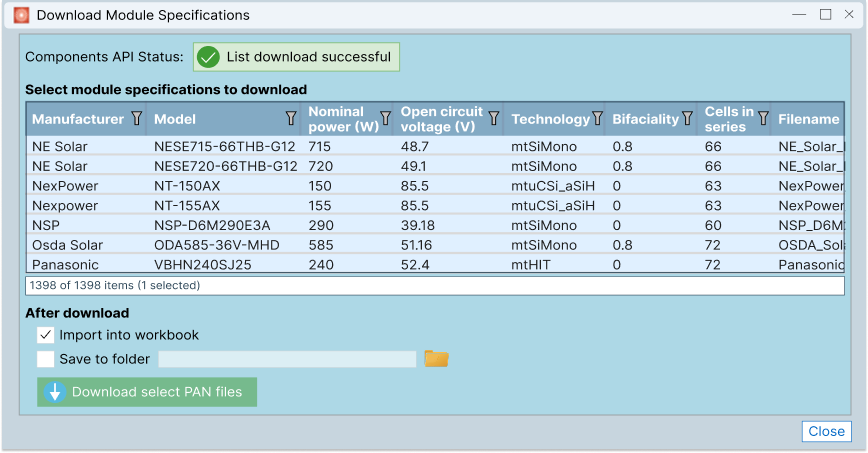
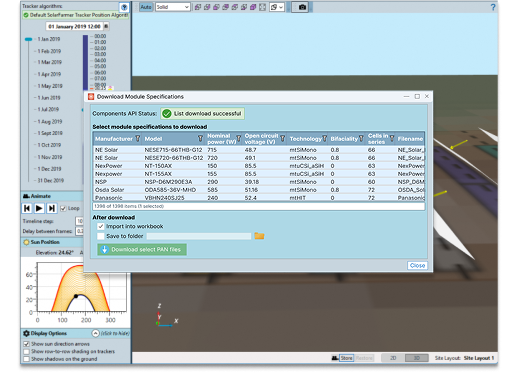
Search, filter and download PAN and OND files directly from the library in SolarFarmer, You can then import them into your workbook or save them to a folder. See Downloading a PAN file and Downloading an OND file.
Search, download and use files
- Search the module and inverter catalogues, filtering and ordering by fields such as manufacturer, nominal power, bifaciality or inverter efficiency
- Download individual PAN and OND files, using the file reference returned by your search
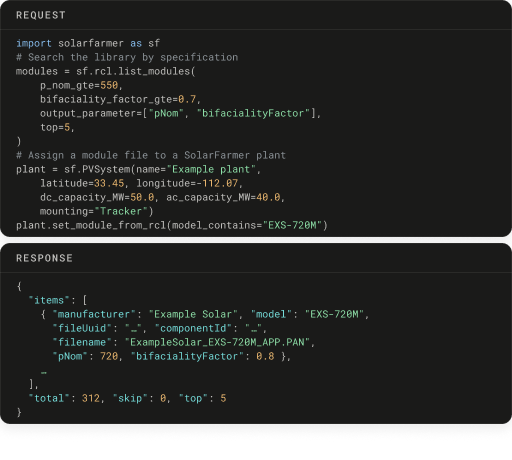
- Use them in your model, for example by assigning a module or inverter to a plant with the SolarFarmer Python SDK.
Search the catalogue as often as you need and download up to 100 PAN and OND files each month. Working in Python? The SolarFarmer Python SDK includes functions to search, filter and download files directly from the API.
API and SDK
The Renewable Component Library is built to be used through the API. API access is included with your SolarFarmer subscription, so you can search the catalogue and download files from your own scripts and services.
Get your API key
To use the API, you will need a SolarFarmer API key. If you don’t have one, contact us and we will help you get started.
Helpful links
Partner platforms
PVcase Ground Mount
Beyond SolarFarmer, the library’s component data is also available in the PVcase Component Database, introduced in PVcase Ground Mount version 2.62. Designers can find modules and inverters from DNV alongside their organisation's own components, using PVcase's "DNV verified" filter.
What’s included in each component file?
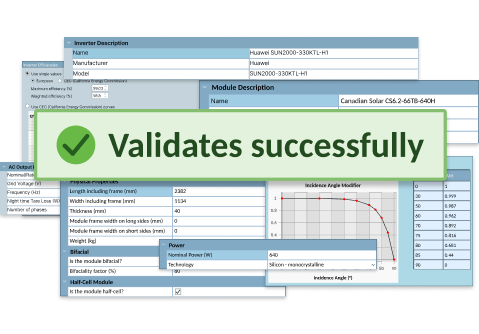
Each component record includes the technical inputs needed to represent the module or inverter in a solar yield model, together with source information that helps users understand where the data came from.
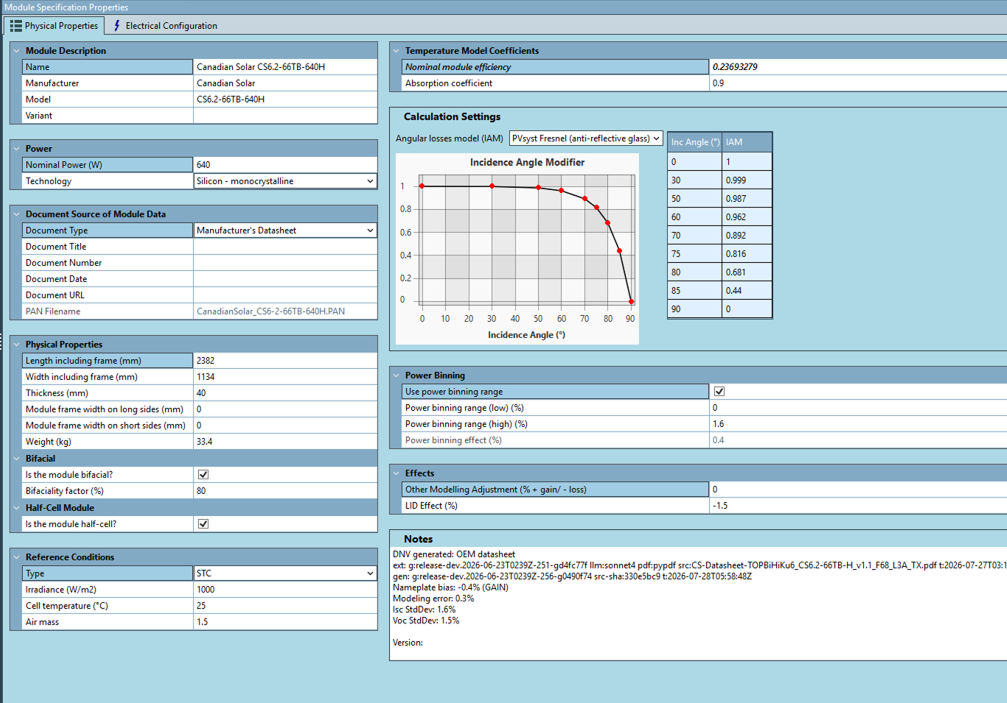
PV modules (PAN) specifications
-
- Module description
- Name
- Manufacturer
- Model
- Variant
- Power
- Nominal power
- Module technology
- Source of module data
- Document type
- Document title and number
- Document date
- Source URL
- PAN filename
- Physical properties
- Length
- Width
- Thickness
- Weight
- Frame dimensions
- Module configuration
- Bifacial status and bifaciality factor
- Half-cell status
- Reference conditions
- Reference-condition type
- Irradiance
- Cell temperature
- Air mass
- Optical and temperature modelling
- Incidence Angle Modifier model, curve and values
- Nominal module efficiency
- Absorption coefficient
- Power tolerances and effects
- Power-binning range and effect
- Light-induced degradation effect
- Other modelling adjustments
- Supporting notes
- Data source and file-generation information
- Modelling error and standard deviation
- Version information
- Module description
-
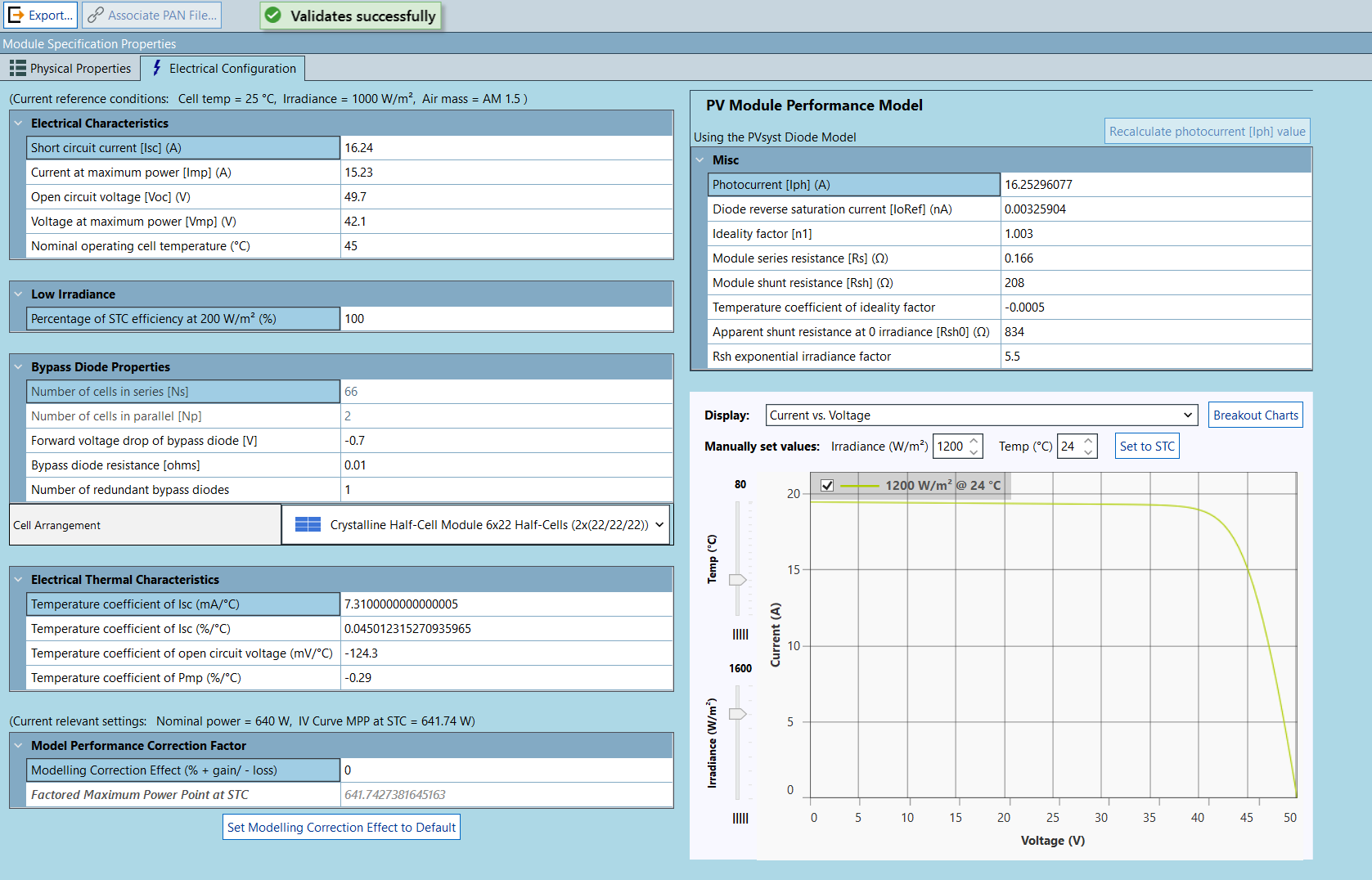
- Electrical characteristics
- Short-circuit current (Isc)
- Current at maximum power (Imp)
- Open-circuit voltage (Voc)
- Voltage at maximum power (Vmp)
- Nominal operating cell temperature
- Low irradiance
- Percentage of STC efficiency at 200 W/m2
- Bypass diode properties
- Number of cells in series
- Number of cells in parallel
- Bypass-diode forward-voltage drop
- Bypass-diode resistance
- Number of redundant bypass diodes
- Cell arrangement
- Electrical thermal characteristics
- Temperature coefficient of short-circuit current
- Temperature coefficient of open-circuit voltage
- Temperature coefficient of maximum power
- Model performance correction factor
- Modelling correction effect
- Factored maximum power point at STC
- PV module performance model
- Performance-model type
- Photocurrent
- Diode reverse-saturation current
- Diode ideality factor
- Module series resistance
- Module shunt resistance
- Temperature coefficient of ideality factor
- Shunt resistance at zero irradiance
- Shunt-resistance irradiance factor
- Current-voltage performance curve
- Electrical characteristics
PV inverters (OND) specifications
-
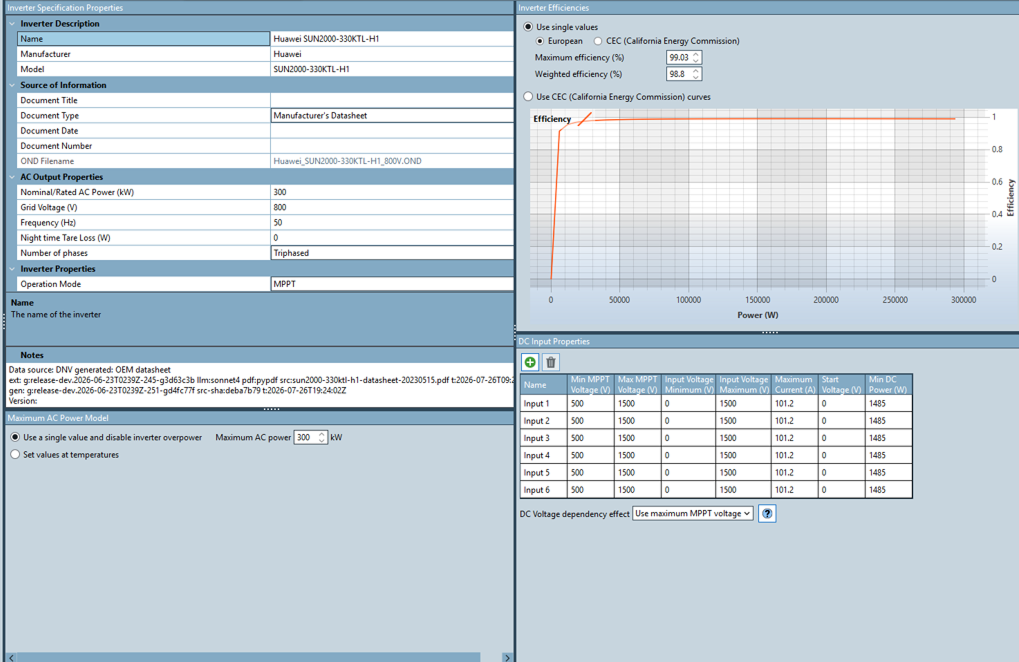
- Inverter description
- Name
- Manufacturer
- Model
- Source of information
- Document title and type
- Document date and number
- OND filename
- AC output properties
- Nominal/rated AC power
- Grid voltage
- Grid frequency
- Night-time tare loss
- Number of phases
- Operating properties
- Operating mode
- Maximum AC power model
- Inverter-overpower treatment
- Inverter efficiency
- Maximum efficiency
- Weighted European or CEC efficiency
- Efficiency curve
- DC input properties
- Number of inputs
- Minimum and maximum MPPT voltage
- Input-voltage limits
- Maximum input current
- Start voltage
- Minimum DC power
- DC-voltage dependency method
- Supporting notes
- Data source and file-generation information
- Modelling error and standard deviation
- Version information
- Inverter description
DNV review and file status
Each file carrying Approved status has been reviewed and approved by DNV as technically accurate as of the review date shown in its metadata. The library is curated over time, with new files added and reviewed before carrying the Approved status. Metadata makes the review date visible alongside the component record.