OCPP Certification is becoming increasingly important across the EV charging industry and is frequently specified as a requirement for government funding programs, public tenders, and commercial projects.
As manufacturers expand their EV charger portfolios, certifying every product variant individually can become both time-consuming and costly. To address this challenge, the Open Charge Alliance (OCA) introduced the OCPP Product Family Certification in February 2025. This framework allows multiple charger variants that meet the Product Family criteria to be certified under a single Product Family certificate, reducing certification effort while maintaining interoperability and compliance requirements.
The industry has responded positively to this approach. As of May 2026, OCA has issued nine Product Family certificates covering multiple charger series from six manufacturers worldwide.
At DNV's Singapore testing laboratory, we have observed increasing interest from manufacturers seeking to utilize the Product Family framework for their certification strategy. In this article, we explore the concept of OCPP Product Family Certification, including its definition, application process and practical considerations.
What is an OCPP Product Family?
Many charging stations share the same firmware and hardware features, while differing only in aspects such as physical size, power level, or non-OCPP relevant hardware. When these differences do not affect OCPP behaviour, such products can be grouped into an OCPP Product Family.
According to the OCA Certification Procedure, products belong to the same OCPP Product Family when they:
Share the same Firmware version
Have the same OCPP-relevant hardware feature set
Support the same certification profiles as the representative product, which must undergo full OCPP certification testing by an authorized test laboratory
Have the same PICS configurations as the representative product, with a limited set of exceptions
Practical variations allowed within a Product Family
The number of EVSEs or connectors (a product with more than one EVSE/connector can represent a product with a single EVSE/connector)
Connector types, a single product family can include chargers supporting different connector types such as CCS or NACS. However, certain technologies (e.g., CHAdeMO) introduce additional communication characteristics, and therefore require the representative product to also have a CHAdeMO connector
The number of RFID readers (a product with one or more than one RFID readers can represent a product with no RFID reader)
The number of Display (a product with more than one display can represent a product with one display)
If power rating ≤ 50 kW, one DC charger can be considered representative of other ≤ 50 kW variants within same power range
If power rating > 50 kW, one DC charger can be considered representative of other >50 kW variants, only when the charger is based on a modular power setup
If EVSE selection is not required before authorization, one product can be considered representative of variants that enforce EVSE selection before authorization
If a product supports a broader set of measurands, it can be considered representative of variants with a subset of those measurands
If one RFID authorization method (ISO14443 or ISO15693) is validated, one product can be considered representative of variants using the other RFID authorization method
Important: An OCPP product family can only apply for either AC or DC, not both
How to apply for Product Families?
Select a Representative Product: The vendor submit the PICS document including all the family products. Test lab identifies one product within the family as the representative product
Assess product family members: The test lab verifies whether the submitted products are eligible to be considered product family members
Full Certification Testing: The test lab performs the complete OCPP conformance test on the representative product
Vendor Declaration of Conformance (VDoC): For other family members, the vendor generates a VDoC report using the OCPP Compliance Test Tool (OCTT), performing the automated conformance test without test lab involvement
Family Member Deadline: Vendor is required to submit the VDoC for each family member to the test lab within six (6) months from the issuance of the representative product certificate
Add family product to the existing certificate: After successful review by both the test lab and OCA, an updated certificate will be issued by OCA based on the updated PICS and VDoC, incorporating the approved family products and the corresponding test reports. The original certificate will remain valid
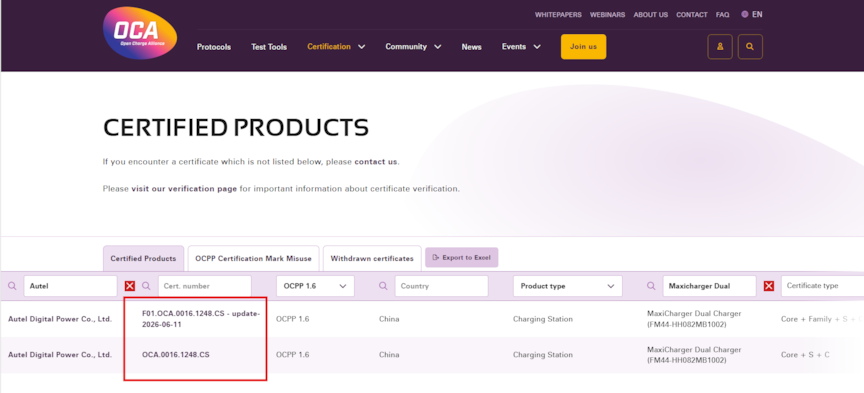
Example of updated certificate: The original certificate (OCA.0016.1248.CS) was issued for the representative product. An updated certificate (F01.OCA.0016.1248.CS update 2026 06 11) was subsequently issued to include five additional family products. Both certificates remain listed on the OCA website.
Figure 1. Example of product family certificate
Practical considerations for applying Product Family
To ensure a smooth and efficient Product Family certification process, careful preparation is essential. Based on practical experience, we recommend paying close attention to the following areas:
OCTT access is required Vendors need to obtain their own OCPP Compliance Testing Tool (OCTT) from the OCA. This is essential for both preparing for conformance testing and generating Vendor Declaration of Conformance (VDCR) reports for product family members
Plan your product family upfront The representative product and all intended family members must follow the eligibility rules defined by OCA. In addition, all family members should be clearly declared in advance within the PICS of the representative product Note: A Vendor Declaration of Conformance (VDoC) cannot be generated if there are test cases on the watchlist
Ensure API readiness before testing For family members, vendors are required to perform automated testing themselves using OCTT. This requires implementation of the relevant APIs:
The SUT Charging Station API must be implemented on the charging station
The SUT EV API can be implemented either on an EV simulator or directly within the charging station As a result, all necessary APIs should already be in place on both the representative product and family members before submitting test samples for certification testing
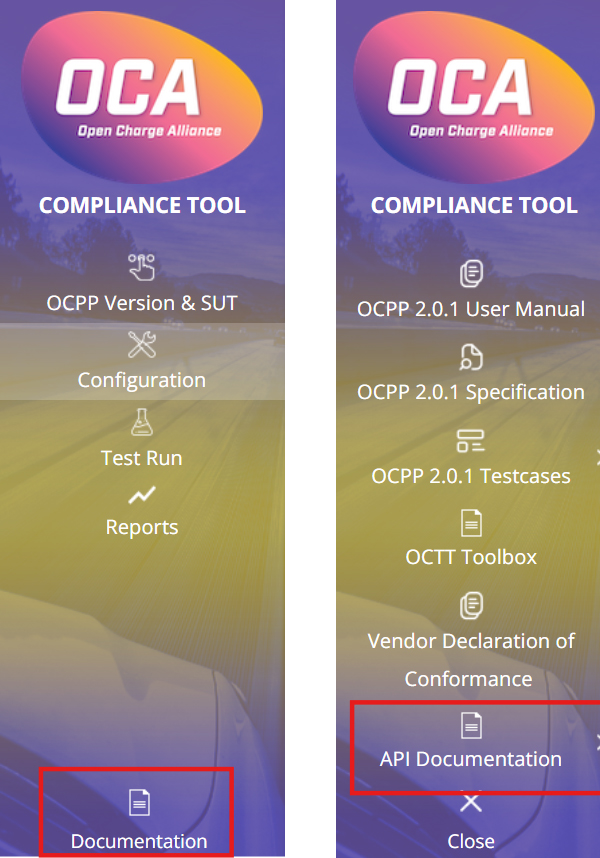
API documentation access The required API documentation is available within the OCTT interface under the “Documentation” section, as illustrated below.
Figure 2. API documentation access
About us
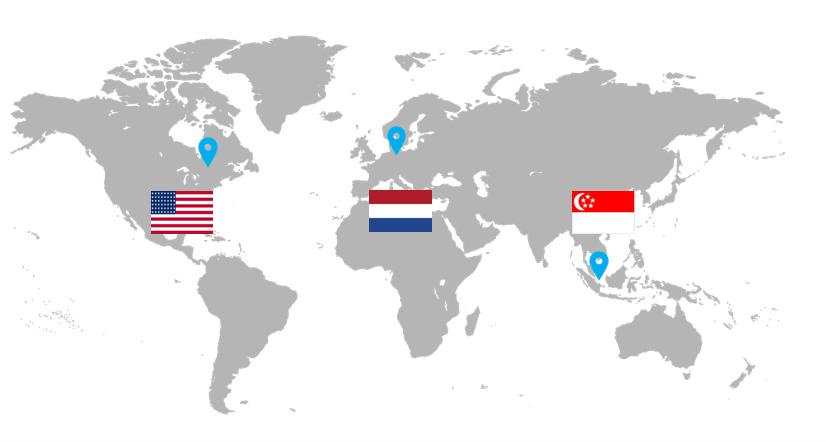
DNV has three laboratories appointed by Open Charge Alliance (OCA), located in the U.S., the Netherlands, and Singapore to serve customers worldwide
DNV's OCPP Singapore lab
As a leading OCPP testing lab in APAC, DNV has supported 93% of Chinese manufacturers, helping them enter global markets and advance industry standards
Proven success rate: 96% on the first attempt
Seamless English and Chinese communication for efficient collaboration
End-to-end certification support – from consultation and gap analysis to testing and certification
Protocol conformance testing service for OCPP
Independent, third-party testing service provider ensuring conformance implementation to OCPP standard