Offshore wind wake modelling: from bottleneck to pace setter
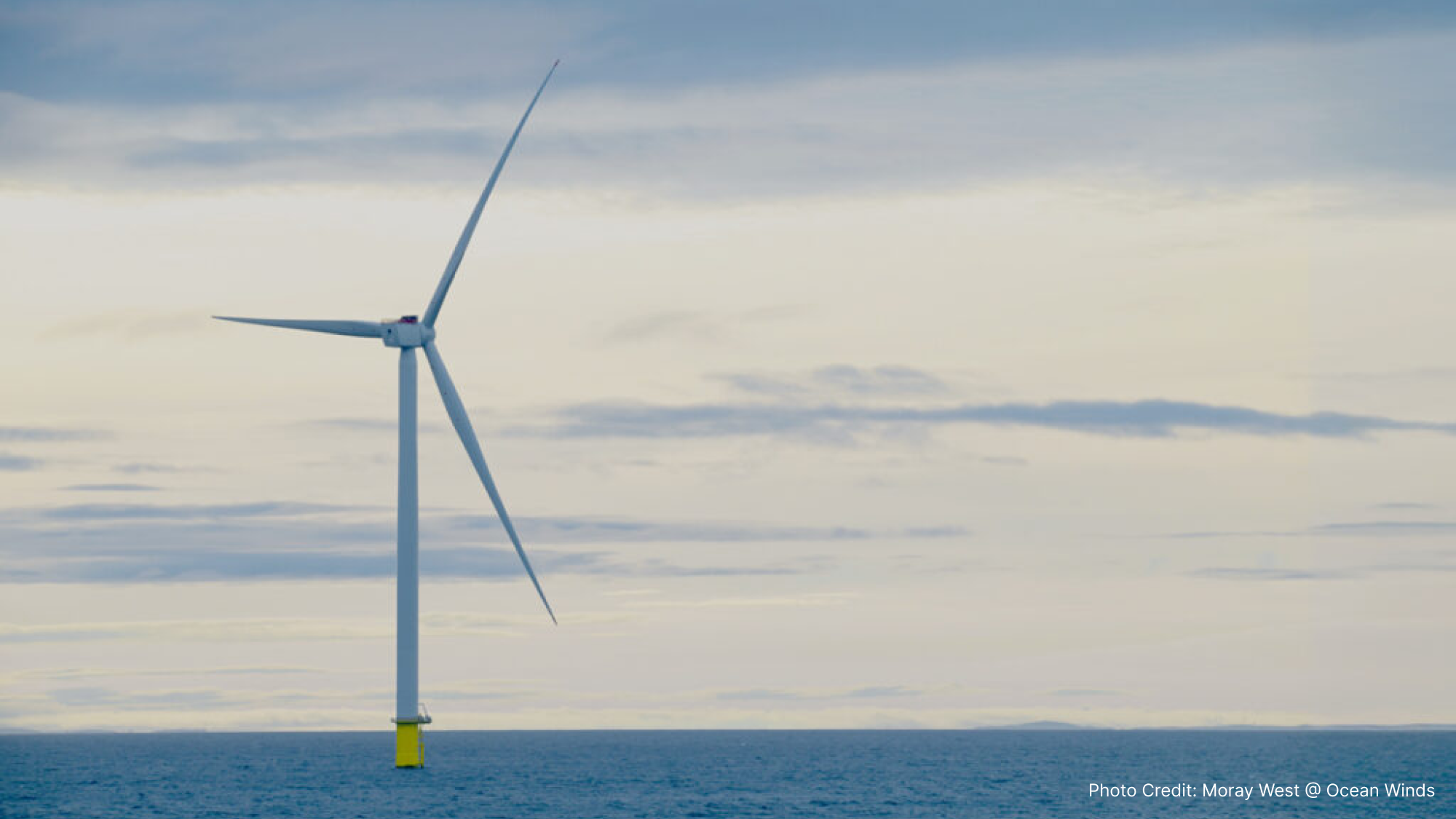
WindFarmer API helps Ocean Winds cut estimated assessment turnaround from four days to one
About the customer
Ocean Winds is a dedicated offshore wind developer, owner and operator, jointly owned by EDP Renewables and ENGIE. It has an offshore wind portfolio of nearly 21 GW across Europe, Australia and parts of Asia, managing the full project lifecycle from feasibility study to construction, operation and decommissioning.
Introduction
Securing finance and maximizing long-term operational performance for wind farms relies on finding the optimal design. Wake effects are largest source of energy production losses in offshore wind. Optimizing the design involves predicting wake effects accurately across every layout, turbine model and neighbouring development scenario. While the need for accuracy is well understood, how to deliver it reliably and efficiently in practice isn’t.
The customer challenge
Slowing down development: when wake assessments meet manual workflows
For the Ocean Winds energy assessment team, the difficulty in wake assessments was never the physics. It was the process. The standard workflow relied on desktop applications and constant manual interaction: navigating menus, exporting CSVs and copying between spreadsheets – repeating the cycle for every scenario.
Comparing scenarios reliably was slowed by the need to differentiate genuine design differences from process errors. And the problem was getting worse as projects require increasing numbers of layouts and neighbour-scenario combinations in evolving conditions due to neighbouring developments. Exploring that manually, even with appropriate software, was not sustainable.
DNV’s solution
Breaking the bottleneck with programmatic access to WindFarmer’s wake model
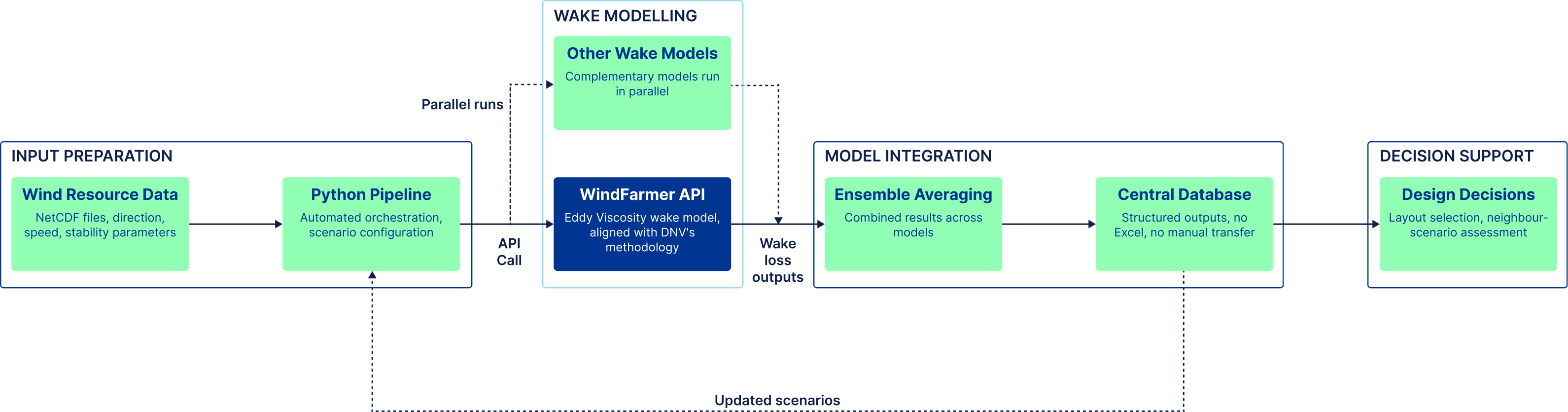
Ocean Winds’ energy assessment team uses WindFarmer’s Eddy Viscosity wake model to assess wake effects and related losses for different scenarios. Through the Wind Farmer API, the team can access this specific model directly from its Python-based pipeline – alongside other tools in the chain.
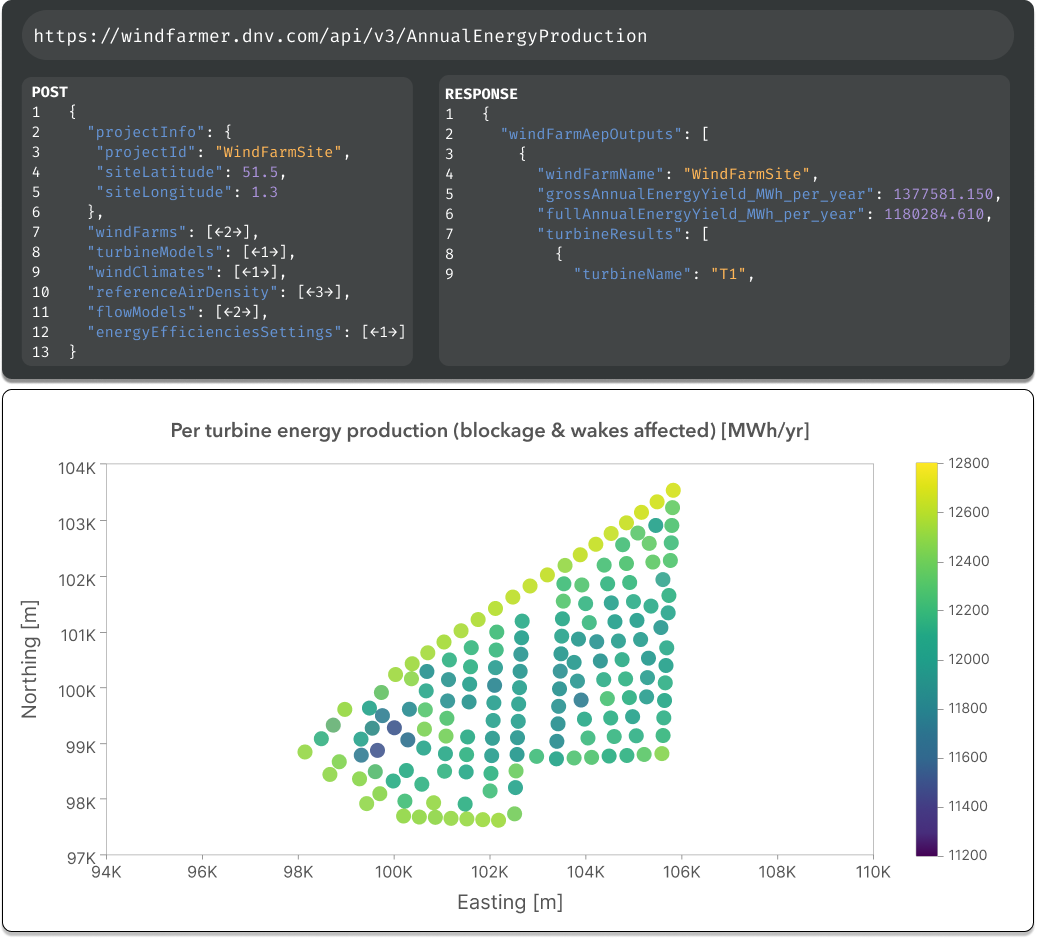
The WindFarmer API provides access to calculations at the heart of the modelling methodologies DNV uses to deliver independent energy yield assessments. By integrating the API, Ocean Winds works from a modelling foundation consistent with that of an independent assessment – reducing the likelihood of surprises when projects reach due diligence.
The automated pipeline has dramatically sped up wind yield assessments and expanded the scope of design exploration: where time constraints once limited the team to around ten scenario combinations, a hundred or more can now be evaluated. The energy assessment team has moved from being the process bottleneck to pace setter in an automation-first approach – with more time to interpret results and advise on design decisions.
Impact
- Faster and more extensive scenario exploration
- One pipeline: from resource data to database with no manual transfers
- Methodology aligned with DNV’s, simplifying due diligence with banks and investors
- Automation-first approach now spreading across Ocean Winds
Key stats
- Estimated assessment turnaround reduced: 3-4 days to ~1 day
- Design exploration expanded: ~10 to 100+ per assessment


