Enabling long-term marine ecosystem recovery in Allonby Bay HPMA

Non-destructive fish surveys in Allonby Bay Highly Protected Marine Area (HPMA) provide critical baseline data to support ecosystem recovery and long-term marine protection.
Turning data into conservation insight
With the designation of Allonby Bay as a Highly Protected Marine Area (HPMA) in 2023, Natural England faced a critical challenge: how to build a robust understanding of the site’s marine ecosystem while fully respecting its strict protection status.
Located on the Solway Firth in Cumbria, Allonby Bay is one of the UK’s first HPMAs and the only one within 12 nautical miles of the shore. The site includes a diverse range of habitats – from rocky substrates to sediment-dominated seabeds – supporting spawning and nursery grounds for commercially and ecologically important fish species, as well as significant seabird populations.
To measure recovery and guide future management, Natural England required a reliable ecological baseline. However, conventional survey methods such as trawling and gill netting were not permitted due to their environmental impact. This created a need for innovative, low-impact approaches capable of delivering high-quality scientific data without disturbing the ecosystem.
Supporting evidence-based marine protection
In 2024, DNV supported Natural England in establishing a scientific baseline for fish populations in the newly designated Allonby Bay Highly Protected Marine Area (HPMA). Using carefully controlled, non-destructive survey methods, we identified diverse fish assemblages, including thornback rays and shark species such as bull huss. These insights provide a critical foundation for long-term monitoring, enabling evidence-based conservation and supporting the recovery of this protected marine ecosystem.
We designed and delivered a series of seasonal fish surveys throughout 2024, using non-destructive methods tailored to the constraints of the HPMA.
The surveys combined techniques including long lines, fish traps, fyke nets, and beach seines, alongside targeted searches in intertidal rock pools. Each method was carefully selected to minimize environmental impact while enabling comprehensive sampling across habitats and species.
A strong emphasis was placed on animal welfare and data quality. Fish were handled using non-abrasive materials and kept in aerated conditions during measurement to reduce stress. Survey teams followed strict operational procedures to ensure consistency and reliability across all sampling activities.
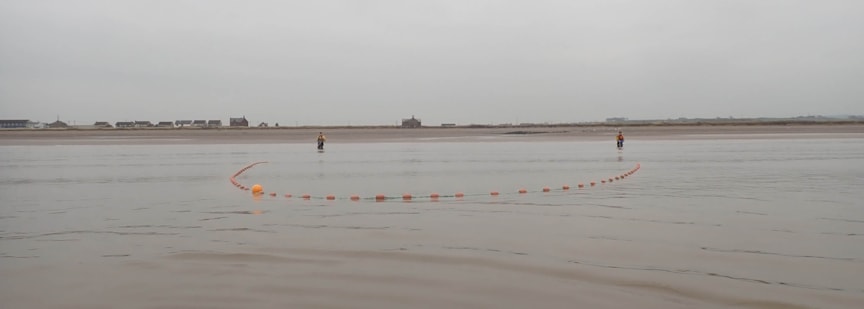
The programme included a baseline survey in spring, followed by seasonal monitoring in summer and autumn, with winter surveys undertaken to complete the annual cycle. A control site outside the HPMA was also included to enable comparative analysis.
The data collected forms part of a wider environmental assessment led by Natural England, incorporating additional monitoring approaches such as environmental DNA (eDNA) analysis.
A foundation for future monitoring and decision-making
The project provides the first comprehensive baseline of fish populations within Allonby Bay HPMA, creating a reference point against which future ecological change can be measured.
These insights enable Natural England to:
- Monitor ecosystem recovery over time.
- Evaluate the effectiveness of protection measures.
- Inform adaptive management strategies.
- Support evidence-based decision-making for activities in the surrounding area.
By combining rigorous scientific methods with a low-impact approach, the project demonstrated how effective environmental monitoring can be delivered within highly protected settings. It also establishes a model for future HPMA assessments across the UK.


