What validation studies teach us about modelling floating offshore wind structures

As floating offshore wind projects move into deeper waters and larger turbine sizes, confidence in simulation becomes increasingly important.
Why this research matters
- Floating turbines are becoming larger, more flexible and are being deployed in deeper waters.
- Engineering decisions increasingly depend on accurate simulation models.
- OC7 compared simulation results against physical measurements to understand the strengths and limitations of current modelling approaches.
- The findings help improve engineering confidence across floating offshore wind projects.
While numerical models are central to design decisions, they must be continuously validated against experimental measurements to understand where modelling assumptions remain reliable and where further refinement is required. This was one of the objectives of the OC7 Phase II project, led by NLR and supported by experimental data collected at the University of Maine.
OC7 Phase 2.1 focused on hydroelastic modelling and member-level load prediction in time domain simulations of large floating offshore wind structures. Eleven organisations compared numerical simulations against measurements from a physical test campaign based on the VolturnUS-S semisubmersible platform. The project investigated how different modelling approaches predict platform motions, mooring loads and structural loads within the floating substructure. In parallel, OC7 Phase 2.2 examined how global loads from offshore wind simulations can be transferred into local structural stress assessments. Together, these work packages contribute to improving confidence in the engineering methods used to design and assess floating offshore wind structures.
Accounting for floating platform flexibility directly within the coupled analysis is important because it enables new FOWT design workflows, such as performing early-stage design optimisation directly from coupled analysis results. It also improves the physical representation of the system. As floating structures become larger and more flexible, assumptions that were reasonable for predominantly rigid systems may no longer be valid and therefore warrant reassessment.
Key findings
The study found that hydrodynamic added mass has a significant impact on predicted structural natural frequencies that are very important for the systems design. Different modelling approaches produced noticeably different results, particularly when comparing strip-theory and potential-flow methods. The benchmark also showed that most participating models were able to predict platform motions and mooring tensions with good agreement against experimental measurements.
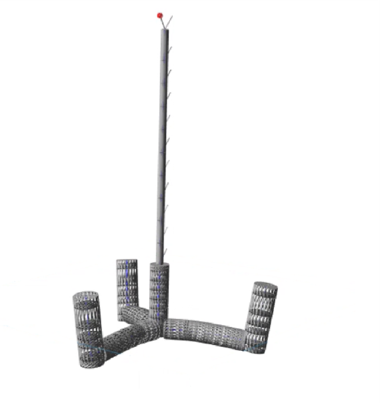
For structural loads, general good results were obtained for most of the internal load components used in the validation. On a more detailed analysis, it was noticed that some modelling options were important for the final load results (e.g. accounting for the changes in the instantaneous wetted surface under large wave conditions). A reduced number of cases were analysed so the generalisation of any conclusions needs further work, but highlights areas where modelling methods need to continue to evolve. Overall, these results are encouraging for this FOWT modelling approach and open doors to new workflows in FOWT design.
DNV's contribution
DNV participated in the study using Bladed as one of the engineering tools benchmarked in the project. The value of participation extends beyond a single paper. Projects such as OC7 provide access to experimental data, allow comparison of modelling approaches, help identify gaps in engineering methods, and contribute to the development of industry best practices.
Benchmark studies help the industry move beyond theoretical discussions by comparing predictions against measurements. That process improves understanding of model limitations, strengthens engineering practice, and supports the continued evolution of the tools that are being used across offshore wind projects.


