Introducing Premium PV & Wind Models: DNV’s site-specific forecasts via the Solcast API
For utility-scale renewable assets, forecast inaccuracies result in imbalance penalties, missed revenue opportunities, and operational uncertainty. Premium PV Power and Premium Wind Power combine DNV’s operational forecasting expertise with API delivery, providing site-specific solar and wind power forecasts to support day-to-day renewable asset operations.
What launched
DNV has introduced two new forecasting services: Premium PV Power and Premium Wind Power, delivered via API.
Both deliver site-specific, deterministic and probabilistic power forecasts for operational wind and solar assets. In addition, both are built by DNV’s forecaster team; the same team that has developed operational forecasting systems for system operators and asset owners across more than 20 countries.
Delivered via API, Premium PV Power and Premium Wind Power provide site-specific forecasts that can be integrated into existing operational workflows, dashboards and analytical tools. Organizations operating both solar and wind assets can access forecasts for multiple technologies through a single API delivery model.
Why site-specific power forecasting matters for the energy transition
Operators of utility-scale renewable assets rely on accurate forecasts to support bidding, trading and operational decisions.
DNV’s decades of operational forecasting experience shows that true forecast accuracy comes from matching actual behaviour, not theoretical expectations. Physical models configured from system specifications describe how an asset should perform — not how it actually does. They cannot capture site-specific effects like real inverter behaviour, clipping, complex shading, or localised meteorological conditions.
For utility-scale renewable operations, forecast performance can influence bidding outcomes, imbalance exposure and operational decision-making. Site-specific forecasting can help reduce uncertainty associated with these activities.
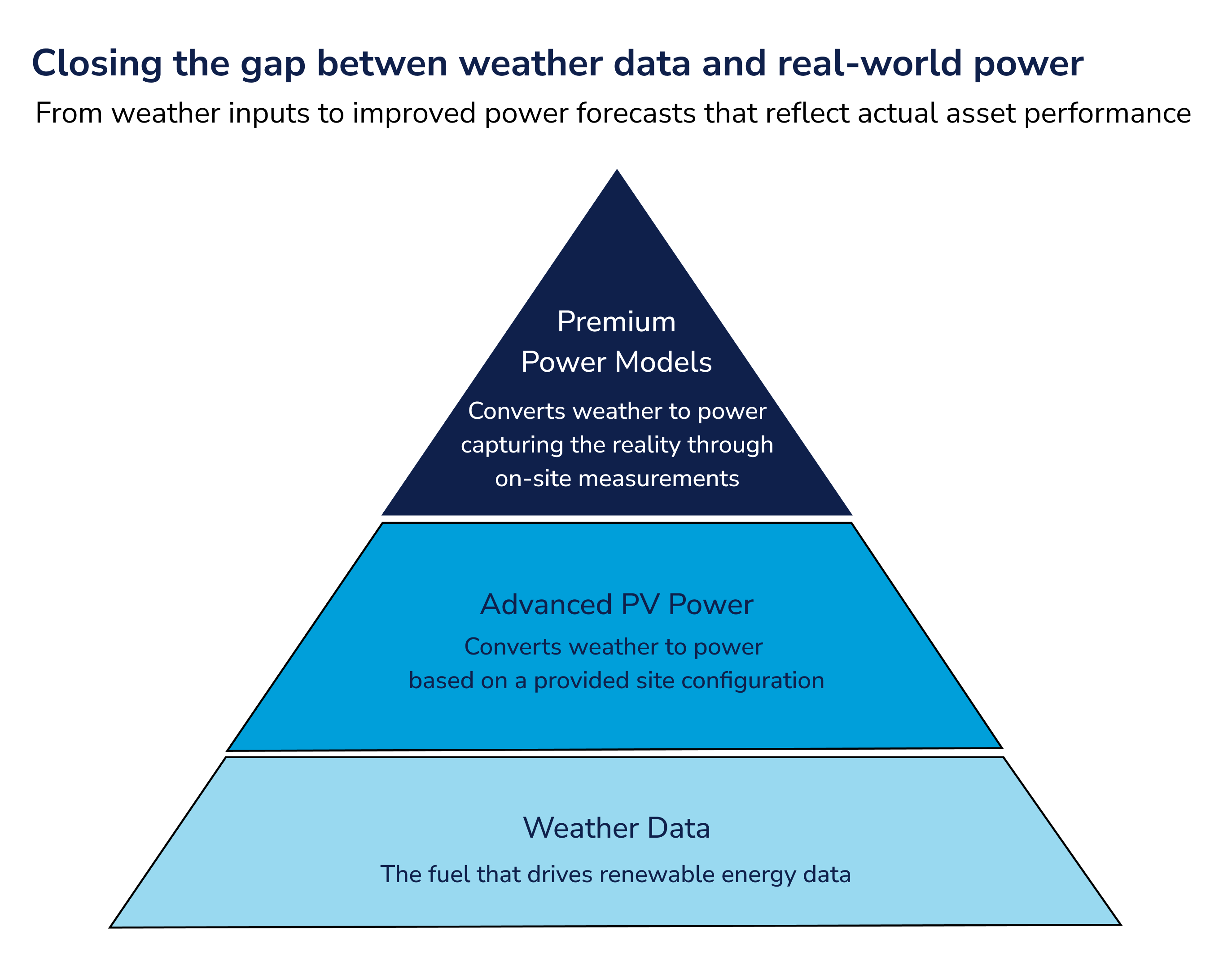
Premium Power is designed to reduce this gap through a multi-family model ensemble — candidates generated across physical, ML, neural network, and non-linear model families. DNV’s forecasting engineers review and select the most suitable configuration for each site, while weather inputs are refined through a site-specific NWP ensemble, not just the power conversion that follows. The result is a forecast tailored to the characteristics of an individual site, maintained by DNV and updated as site performance evolves.
How it works
The Premium PV and Wind modelling pipeline is built independently for each technology, but follows the same modelling pattern, with six stages:
- Multi-model weather ingestion. Multiple global and regional numerical weather prediction (NWP) models are ingested to capture a wide range of atmospheric outcomes. This reduces sensitivity to individual model error — no single weather model dominates the forecast.
- Site-specific weather refinement. The raw NWP data is downscaled and bias-corrected using your site's local measurements. The weather input itself is tuned to your location, not just the power conversion that follows.
- Optimal model blending. Multiple NWP sources are combined to produce optimised inputs for the power model, using approaches optimised from historical training data.
- Physics-based power conversion. Asset-specific physical and statistical models convert the refined weather data into power output. PV and wind follow different conversion paths, each grounded in the relevant physics.
- Machine learning optimization. ML models trained using site historical measurements close the gap between the physics-based forecast and what the site actually produced. This captures site-specific effects that may not be fully represented through physical parameterisation alone: real inverter behaviour, degradation, shading, equipment interactions in PV, as well as terrain complexity and wind farm layout effects in wind power generation.
- Post-processing and operational adjustments. Customer-supplied availability and curtailment schedules are applied to the forecast outputs.
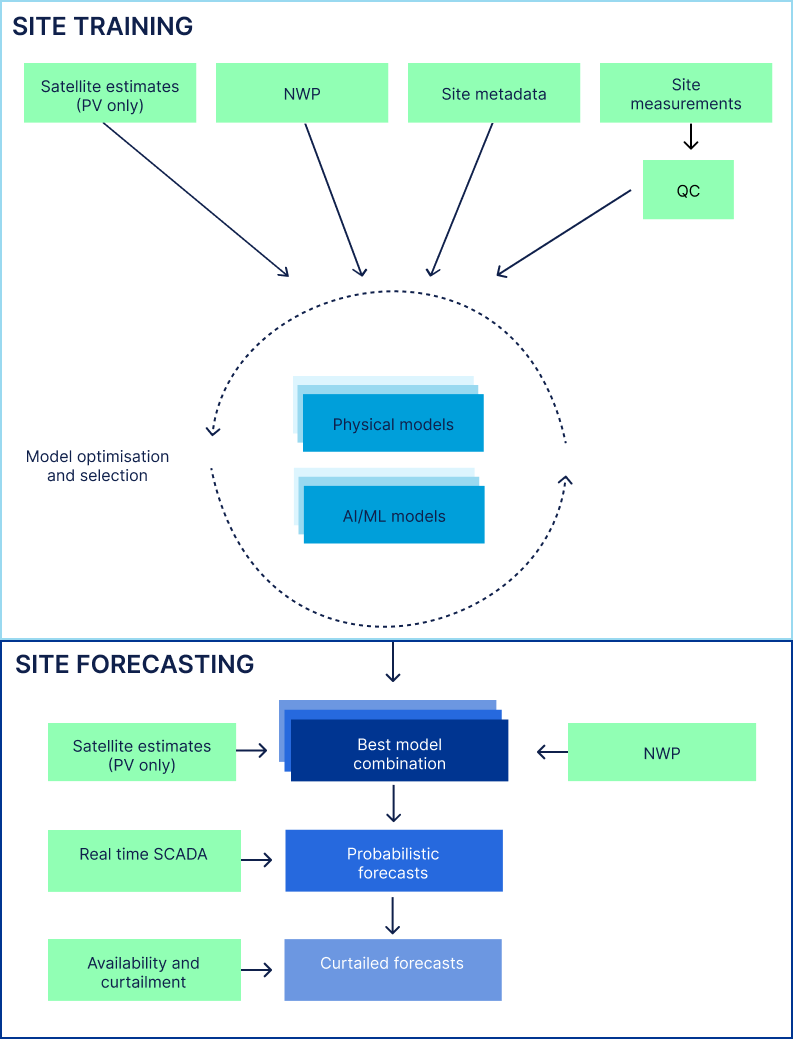
The result is a forecast that combines physics and machine learning, trained on your site, updated with your data.
What parameters are available through the API
- Power forecasts in MW — already modelled through the trained power model. Power forecasts provided directly in MW.
- Probabilistic percentiles — P10, P25, P75, and P90, alongside a central power forecast. These represent uncertainty ranges derived from ensemble spread and statistical methods. Lower percentiles can support more conservative operational or trading positions, while higher percentiles may be relevant where greater forecast risk is acceptable. The central forecast provides a balanced reference point.
- 14-day forecast horizon — from now +5 minutes through to two weeks ahead, at resolutions from 5 minutes to hourly.
- Curtailment handling — time-varying curtailment and availability schedules can be provided.
- API delivery — forecasts are available in JSON and CSV formats through API delivery, using stable, versioned interfaces designed for operational workflows.
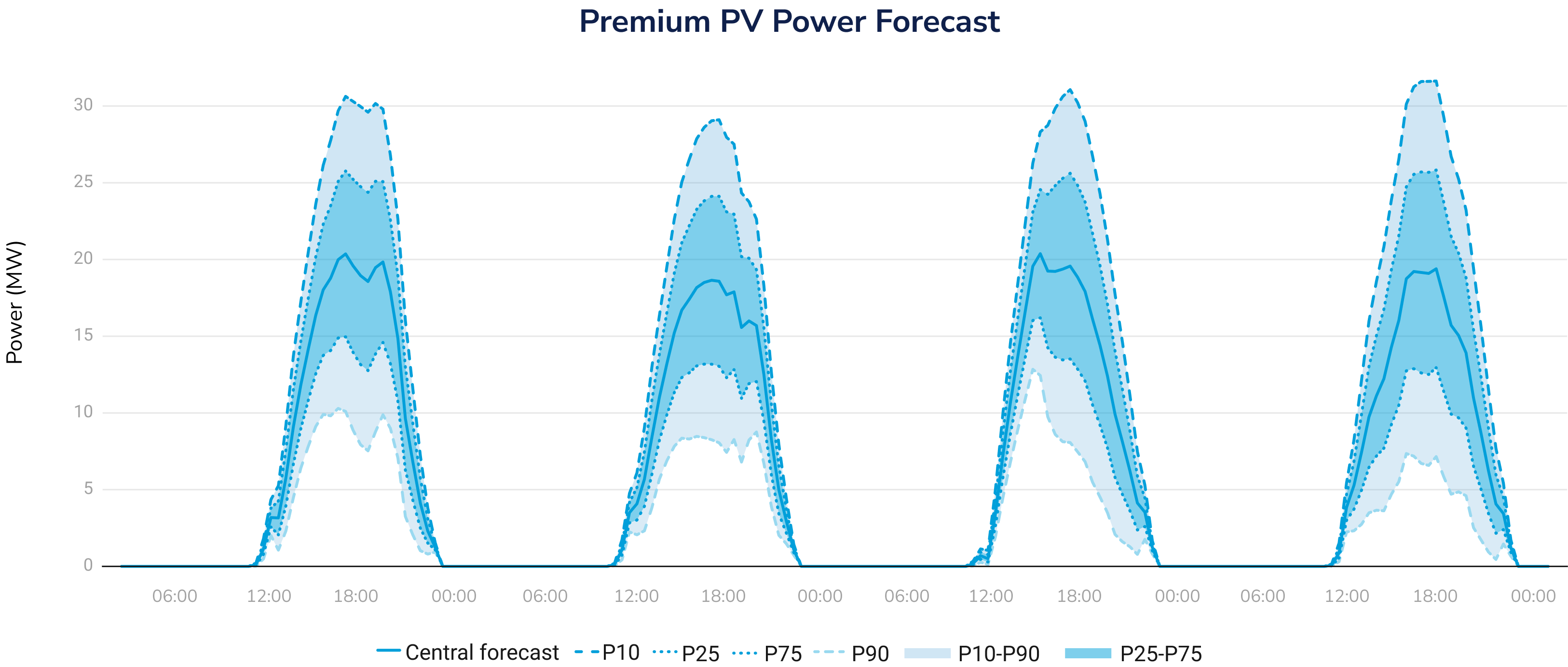
Example PV probability forecast from API
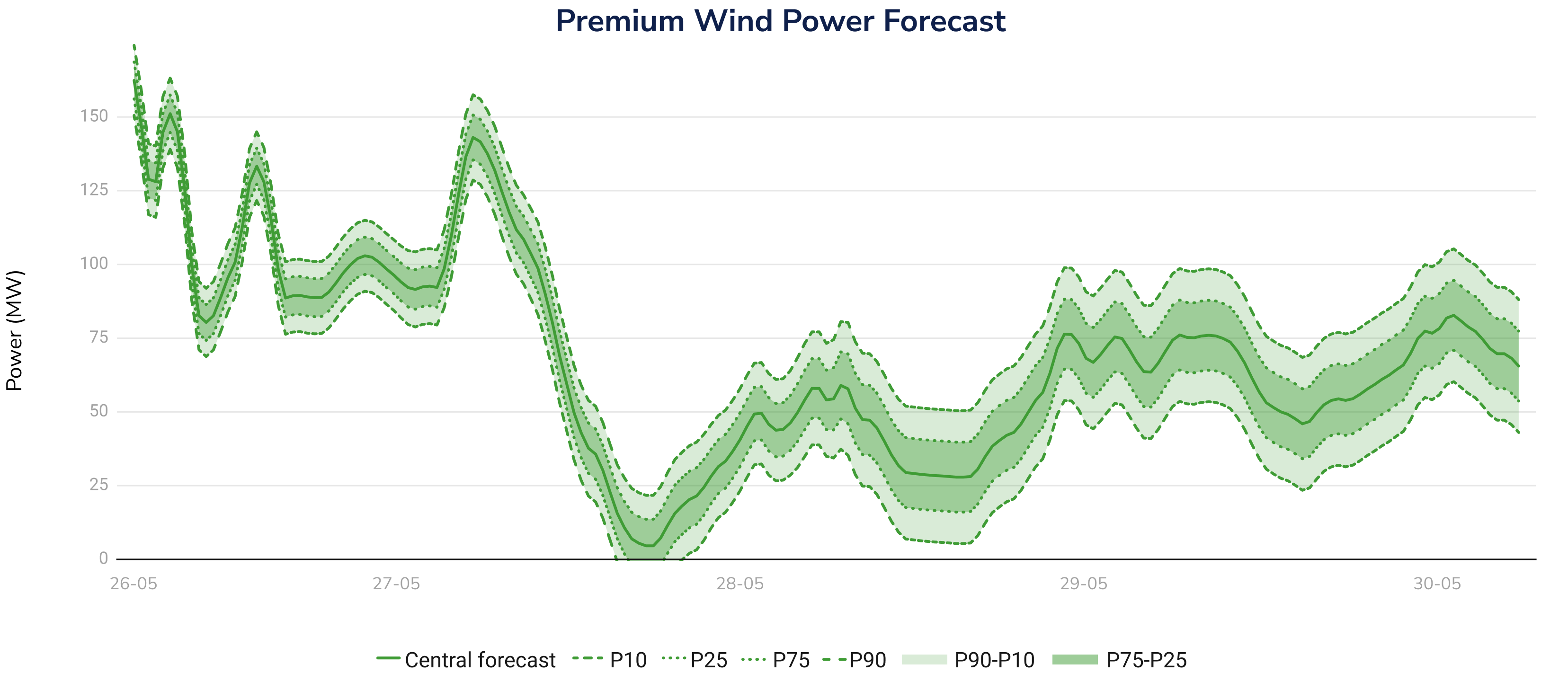
Example wind probability forecast from API
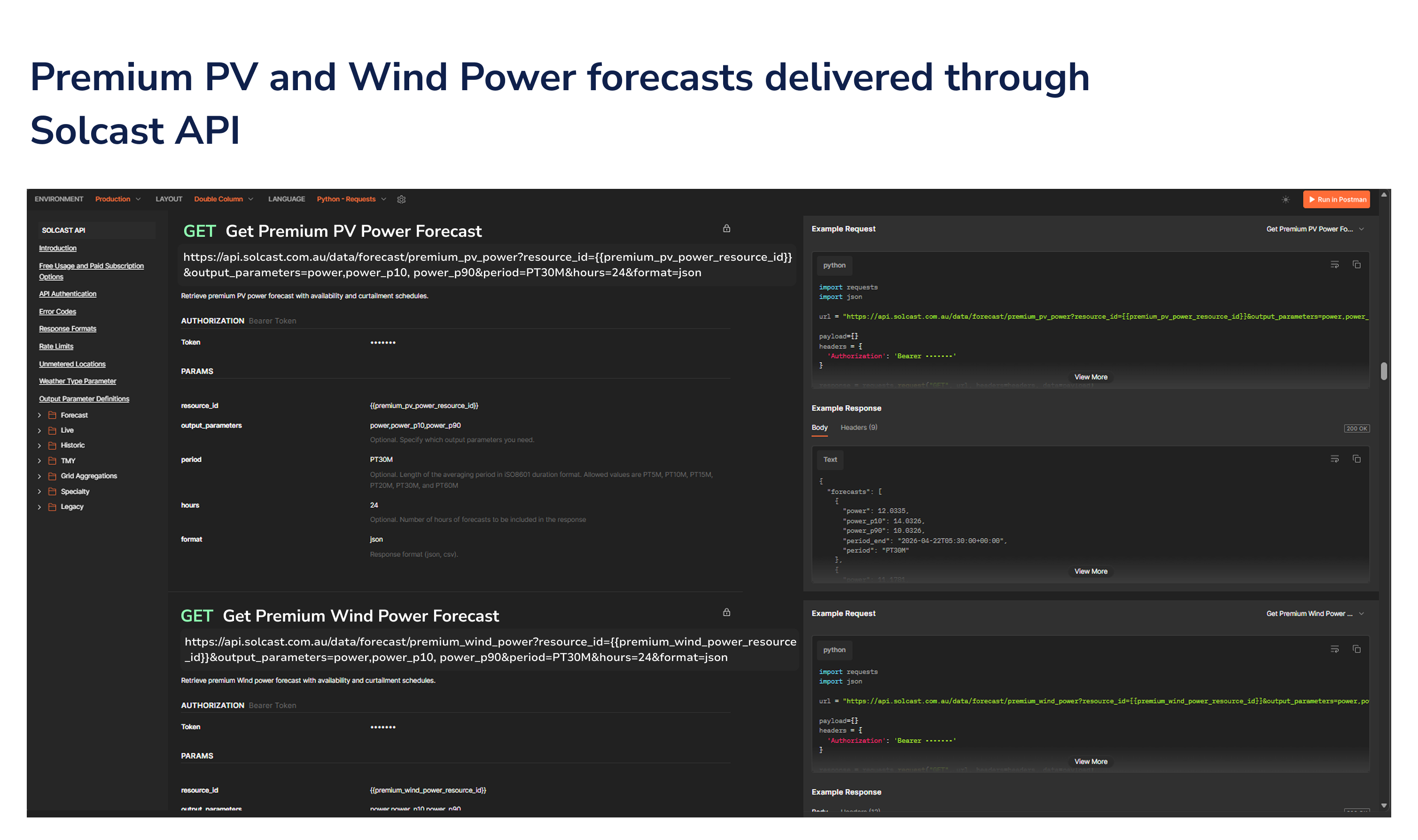
Premium PV Power and Premium Wind Power are the latest release from DNV’s forecasting team, making site-specific solar and wind power forecasts available via API for operational use.
For operators managing multi-technology portfolios, consistency across forecasting methodologies can simplify portfolio-level forecast management. Premium PV Power and Premium Wind Power use consistent modelling principles, uncertainty quantification and data formats across solar and wind assets. Portfolio-level forecast risk management becomes simpler when model quality and methodology are consistent across managed assets.
Premium Wind Power includes hub-height wind speed and direction alongside power output, supplementing the solar specific weather data already available Probabilistic percentiles are available for both power and wind speed.
Developed by DNV’s forecasting team
Premium Power is built by DNV’s Forecaster Team— the same engineers who have delivered operational forecasting systems to system operators, multi-technology IPPs, and asset owners for over 20 years.
That team's track record spans 2,000 wind and solar sites representing 150 GW of installed capacity across six continents. In 2025, the New Zealand Electricity Authority selected DNV’s solution, using the same underlying forecasting methodology — through a competitive evaluation process — as the national forecasting standard for all utility-scale wind and solar projects in the country.
Who this is for
Premium Power is designed for operators of utility-scale wind and solar assets — specifically:
- Multi-technology IPPs managing portfolios across wind and solar, often already running ensemble forecasts from multiple providers. Premium Power can provide an additional site-trained forecasting input within an existing forecasting framework.
- Single-asset operators where forecast accuracy has a direct financial impact on bidding, dispatch, or regulatory penalties.
- Operators in markets with imbalance penalties where the difference between a generic forecast and a site-trained forecast can have measurable financial implications.
DNV handles model training, validation, selection, and retraining. You provide generation data and engage at key decision points — no need to build an internal data science capability, source NWP models, or run QC pipelines.
Training a site-specific model requires your historical measurement data (minimum 6 months), engineering review, and quality validation. The accuracy you receive is a direct result of the care taken in model training.
What getting started looks like
- You provide at least 6 months historical measurement data and asset configuration
- DNV engineers clean and ingest the data
- The ML modelling pipeline trains and evaluates models for your site
- The training report is reviewed, reconsidered and re-run as many times as required — once model performance has been validated against DNV’s review criteria, your endpoint goes live.
Forecasts are available through API delivery.
Data handling
Customer data is used to train and maintain forecasts for the relevant site in accordance with DNV’s data handling and privacy policies.
Learn more about Premium PV Power and Premium Wind Power
Contact DNV to discuss forecast requirements, model training considerations and how Premium Power forecasts can support renewable asset operations.
7/23/2026 9:00:00 AM