
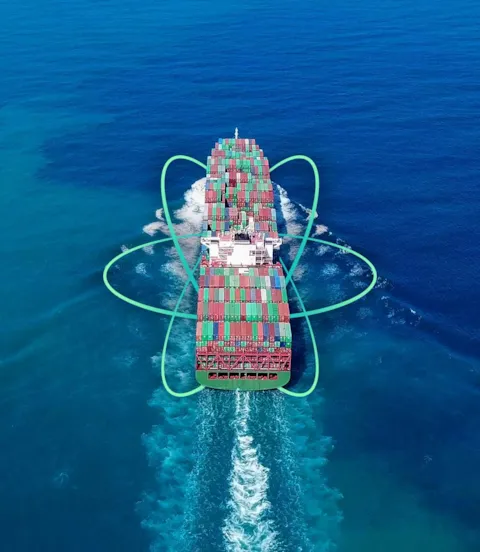

Charting a course for nuclear-powered ships
Nuclear propulsion, dormant in commercial shipping for decades, is gaining renewed interest as the industry seeks scalable, zero-emission solutions. Apart from being an energy source which produces no emissions, nuclear propulsion offers other advantages, such as stable, predictable energy costs, enhanced operational flexibility (including the economic feasibility of higher speeds), and reduced reliance on traditional bunkering infrastructure.
DNV’s white paper describes the state of play of nuclear maritime propulsion today, and emphasizes the need for technological innovation, regulatory clarity, and economic pragmatism for the industry to become viable in the future.
A short history of maritime nuclear propulsion
Nuclear propulsion in shipping first came to prominence during the so-called nuclear age of the 1950s and 1960s. With the land-based nuclear industry growing strongly, several military vessels were commissioned, mainly in the US and Russia. This was accompanied by some exploratory civilian projects, such as the Savannah, which entered into service in the US in 1962, and the German Otto Hahn and Japanese Mutsu, which followed soon after. All of these operated using pressurized water reactors (PWRs), which required extensive monitoring and active safety systems to manage transients.
However, most of these projects were not commercially viable and, apart from continued exploratory tests in Russia, no civilian commercial maritime nuclear projects have been commissioned in over 40 years.
In recent years, the growing need to decarbonize shipping, combined with the wide range of difficulties associated with this – such as limited supply of low-greenhouse gas fuels – has led to many in the industry re-evaluating nuclear propulsion as a potential problem solver.
Building nuclear reactors for maritime use
While a future civilian maritime nuclear industry can draw on lessons learned from the more established land-based industry, shipping creates its own demands and the white paper outlines reactor concepts being developed specifically for maritime use.
“All reactors should take into account factors unique to shipping, such as mobility, exposure to harsh sea conditions, and operational profile, while also bearing in mind key considerations like cost, space, reliability, power availability and, most importantly, safety,” says Ole Christen Reistad, Senior Principal Researcher and lead author of the white paper.
“Smaller, standardized reactors with passive safety and minimal crew needs may benefit merchant shipping, while low-pressure systems and Generation IV or heat-pipe reactors could provide safer, simpler alternatives to PWRs.”
As explained in the white paper, marine reactors must be compact and designed for infrequent refuelling, ideally aligned with other required maintenance activities such as dry-docking to minimize impacts on ship availability. Issues around surveyance at sea and safety can be mitigated through remote monitoring and advanced communication capabilities. Several projects are already underway in different countries, with differing approaches to fuel, coolant and safety.
The maritime nuclear fuel cycle in perspective
Going beyond reactors, DNV’s white paper also identifies the need for a dedicated, cost-effective maritime fuel cycle. This should encompass all stages, from ‘front end’ to ‘back end’, including key aspects such as fuel qualification and fabrication, spent fuel storage, and disposition.
“Any future commercial maritime nuclear fuel industry should be centred around a specific nuclear fuel cycle for maritime use, with recognised roles and responsibilities across the supply chain, from fuel production and reactor integration to loading, exchange, and disposal,” says Reistad.
Storage and disposal of spent nuclear fuel will be fundamental to the functionality and credibility of the supply chain. This will also be crucial for advancing public acceptance of the maritime fuel cycle.
Regulatory roadmaps for nuclear-powered vessels
With safety and public acceptance central to the evolution of the civilian maritime nuclear industry, the DNV white paper outlines the importance of developing a predictable and internationally accepted regulatory framework related to nuclear propulsion.
This will involve multiple actors, ranging from existing maritime organisations like the IMO and Flag states, to established players in the nuclear space, such as the IAEA. Classification societies, like DNV, also have a significant role to play and can help to overcome fragmentation and foster a standardized maritime approach. The white paper describes how all of these actors can contribute to the future maritime nuclear industry, using regulatory roadmaps to plot their likely pathways ahead.
“Regulation for nuclear shipping will surpass what the maritime industry is used to, opening the door for multiple system configurations,” says Reistad.
“The white paper’s regulatory roadmaps identify key actors, their mandates, and coordination needs, offering essential guidance. As roles multiply, clarifying interfaces becomes critical, and the roadmaps address that by mapping key interdependencies.”
The business case for maritime nuclear vessels
While technological and regulatory components need to be in place for a successful commercial maritime nuclear industry to emerge, well-established business models are the third crucial element. These must reflect the commercial realities of shipping and provide a clear understanding of total cost of ownership across the entire fuel cycle.
As laid out in the white paper, one of the main challenges which needs to be addressed is how to maintain a small number of operating personnel on nuclear-powered vessels, in line with general developments in modern shipping.
“Historically, large crews with specialized skills have been required for nuclear-powered vessels, particularly as the reactor required extensive monitoring and remedial action in the event of transients,” explains Reistad.
While this could be partly overcome by advances in automation and digitalization, which could move some of this work onshore, work still needs to be done to close the gap.
Cutting costs through standardization and modularization
Cost-competitiveness could be significantly enhanced through the adoption of a modular and standardized approach. Progress on this front is already being made through the integration of Generation III+ and IV reactor technologies, along with the increased preponderance of small modular reactors (SMRs).
“The adoption of these small, more modular technologies will help to streamline construction, simplify maintenance, provide independent assurance, and facilitate regulatory approval across jurisdictions,” says Eirik Ovrum, Business Development Manager and co-author of the white paper.
“These developments may also support reduced crew requirements and operational efficiencies, strengthening the business case for nuclear propulsion.”
Using a case study to assess costs of nuclear-powered ships
Ultimately, for nuclear propulsion to be a viable option for the commercial maritime fleet, the cost levels of reactors under different circumstances will be crucial. To achieve clarity on this, the DNV white paper presents a case study of a 15,000 TEU container vessel, examining key factors such as annual leasing costs and CAPEX and comparing these to conventional vessels.
The results offer some encouragement but will depend on the pace of decarbonization throughout the maritime industry. For example, in a high decarbonization scenario, higher reactor costs will compare favourably, due to higher costs of low-greenhouse gas fuels and regulatory penalties incurred for conventional fuels.
“A reactor cost below USD 18,000/kW could be competitive if full decarbonization is achieved by 2050, while costs below USD 8,000/kW could be viable even without full decarbonization,” explains Ovrum.
The pathway ahead for nuclear commercial shipping
As the white paper shows, nuclear propulsion has the potential to make a significant contribution to maritime decarbonization, but much work still needs to be done in addressing technological, regulatory, and commercial components.
Achieving this will demand coordinated global action and the involvement of a wide range of actors across the maritime industry, regulators, and society in general.
“This presents both a formidable challenge and a transformative opportunity,” concludes Reistad. “Success will hinge on our collective ability to manage its risks, earn public trust, and establish robust assurance frameworks.”


Get regular industry insights!
Join the thousands of industry leaders today who have already signed up to receive the latest insights.
sign up